Enjoy!
Life in Communism 2.1. African Trilogy vol. 1
On a Rubber Dinghy
By Carla O’Gallchobhair
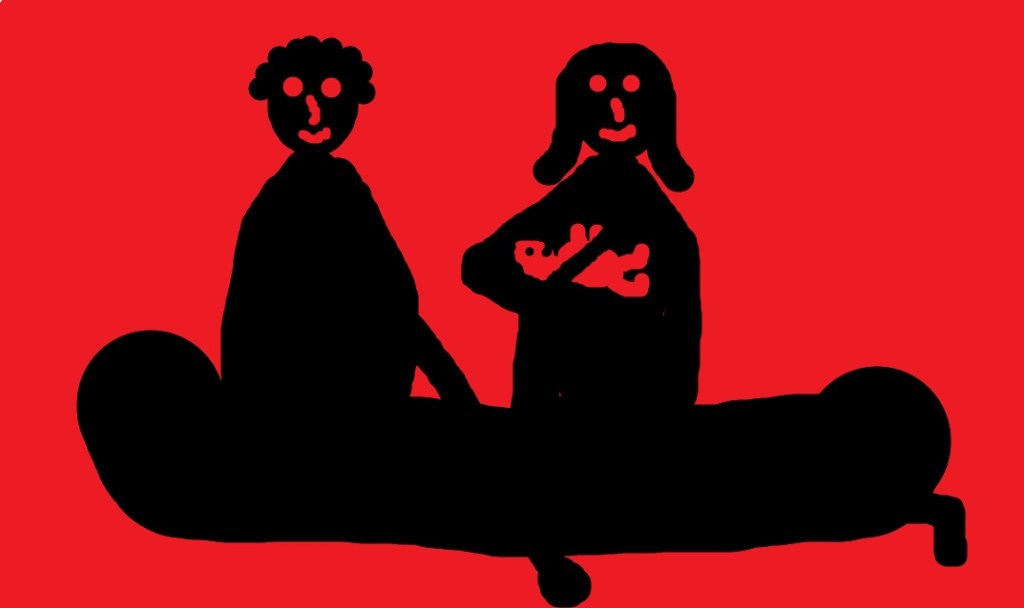
© Carla O’Gallchobhair, 2022-26. To Mamon, Cathal, Tanya, Evgeni, and Maksim, Yvonne, Michael, Odile, and Jean-Michel, Vicky and Nora, and all other friends of Africa.
“Solidarity is the tenderness of people.”
Che Guevara (1928-1967)
“Accumulation of wealth at one pole is at the same time accumulation of misery, agony of toil, slavery, ignorance, brutality, mental degradation, at the opposite pole.”
Karl Marx (1818-1883)
“We need, in backward countries, to give special support to the peasant movement against the landowners, against landed proprietorship, and against all manifestations or survivals of feudalism, and to strive to lend the peasant movement the most revolutionary character by establishing the closest possible alliance between the West European communist proletariat and the revolutionary peasant movement in the East, in the colonies, and generally.”
Vladimir Lenin, Draft Thesis on National and Colonial Questions, 5th June 1920
“Socialisme ou barbarie!”
Rosa Luxemburg (1915)
The African Manifesto in Year 20 of the Revolution, 2021 being Year 0
1) prevent the return of the state, imperialism, and colonialism,
2) distribute world water supply equally, Africa has 16% of the world’s population, but only 9% of the water resources,
3) end poverty. On average across the continent, more than 50% of the African population still has to fear not to get all the food and other basics they need,
4) stop wild urbanisation, deconstruct the agglo-(meration)s, disperse the villages,
5) maintain and revive wildlife,
6) regrow the rainforest,
7) maintain and revive native languages and culture, including dresses, pottery, music, dance, as well as nature-speak and nature language,
8) the refugee problem may continue for a while because of climate change and capexogarch (capitalist and ex-oligarch) wars,
9) stop the still smouldering wars and civil wars, especially capexogarch coups and sabotage,
10) Africa may still need a welcome and some material help from the more industrialised countries for some time to come.
Table of Contents:
Preface in Illyria. On a Rubber Dinghy
Chapter 1. The Revolution of 2021
Chapter 2. The Tree March Experiment
Chapter 3. Year 20, The New Boko Haram Raid – “We’ll wait!”
Chapter 4. Old Centre – New Periphery
Chapter 5. “Let’s take a Ride!”
Chapter 6. The Scam
Chapter 7. A most Horrific Back-Up Option
Chapter 8. MS – the Moral Strength Virus
Chapter 9. Saved by the Harp
Postscript. Discussion and Preview at the Marwan Barghouti Cooperative, the cooperative Illyria Garden Colony Manouche Camp near Aimeran, Yvelines, and the neighbourhood assemblies Casa Latina Russki Dom Peace Dove in Saint-Denis
Preface in Illyria. On a Rubber Dinghy
On a rubber dinghy, by Bouna and Akila
“The reason we called this book ‘On a rubber dinghy’ is that before the revolution, when right-wingers and racists were still roaming wild in the French lands, they often reproached us with landing on a rubber dinghy, supposedly pretending to be heroic adventurers, while everybody knew that people smugglers brought us in large boats to the vicinity of the coast, and only then were we loaded into dinghies.”
“But we had to circumvent customs, didn’t we?” asked Fofana.
And I, Omsinbaba, said. “We had to make sure the smugglers weren’t caught and their boats weren’t impounded.”
Then came the invariable question: “Were they,” the people smugglers, “black or white?”
“Usually Arabs, you know, North-Africans, sometimes Nigerians. It depended on the boat you got.”
“We tried to go with a Senegalese boat first,” explained Fofana. “We would have sailed North along the coast and then entered the Mediterranean through the Strait of Gibraltar. Because I might have been pregnant. Omsinbaba and I wanted to do well by me and our baby. But it would have cost a fortune. So, we went the land route, parallel to the coast through former Guinea-Bissau, Guinea, Sierra Leone, Liberia, Côte d’Ivoire, Ghana, Togo, Benin, and Nigeria. We wanted to take a people smuggler to Chad, but he was very dear. So we went up to the North West again to Mali or Burkina Faso where we had relatives. They had camels and other livestock. We planned to work for them a while, so they would give us money. Then we would have double-backed through Nigeria and Chad to Tripoli. Yet Boko Haram attacked and subjugated our relative’s village. So we fled back earlier than we had thought, meaning right away, and stayed at the monastery we told you about. I don’t even remember where it was exactly, maybe still in Mali, maybe in Burkina Faso, or maybe in Côte d’Ivoire, Togo, or Benin already. It was in the forest, that is why we want to go back there this time as well, to find out whether the monks and nuns can help us with a March of the Tree experiment, which would be one of the first in North West Africa if not the very first, just as Illyria’s was in the French lands. And the March of the Trees is a heroic endeavour of course, because it will bring back the forest, make plant lives triumph, so that animals, humans, and robots can live and their lives matter. We want to enable our children to be true green as well as red revolutionaries.
“The fascos back in 2020 laughed, ‘You must have been pretty drugged up that you don’t even remember the country you were in.’”
“No, we weren’t,” Omsinbaba said, “but we had travelled thousands of kilometres, mostly in vehicles, but long stretches on foot as well. When we arrived at the monastery, the brothers and sisters had a hard time nursing us back to health, so we could even start to work again. Anyway, after a few months, it seemed like ages, we had the money for the desert caravan and the boat trip from Tripoli to Marseille.
In 2021, after the revolution, Year Zero, we took a different route still, through Chad and Sudan to the Horn of Africa, because we were after these terrorists, now our comrades – Jacques, Béa, François, Gabriel, and so on –, but back then they were our enemies. Then we went up to the Mediterranean through Egypt and took the revolutionary ferry the Egyptian revolutionaries had just put in place to get back home. You see, air travel had been abolished. So, all travel around the Mediterranean would from then on be done in ferries. We joked that we would all travel like refugees from now on.”
“But dignified ones,” added Fofana. “It was the dawn of a new era.”
“Tell us first how it was in 2020!”
“I will in a moment, but you see, I told the FN-RN people, the Lepenists, if you will, back then already. ‘Arriving on a dinghy was not a dirty trick to appear poor, it was a way of allowing future caravan and boat people to arrive the same way.’
“And now that the fascos are using the March of the Trees to hide from the revolution and they are even trying to bribe and cajole or force and beat the Africans and their trees to oblige, I cannot help thinking, we were the more moral people already back then.” Everybody laughed. “And the revolution turned us into real angels.” Thus the optimistic tone was set for Omsinbaba’s long-awaited presentation, which would help all of us to get more immersed in the story of Africa, the continent most abused by the imperialists and colonialists, and which therefore needs our help most urgently.
Chapter 1. The Revolution of 2021
Once lucky, Paris! By Lulu and Maurice
“The Marseille authorities put us up in a refugee hostel somewhere not far from the harbour, maybe because they hoped that some of us would still go back. We were about 5 to 12 people in a room, several families, but each room had only one stove, and toilets and showers were down the corridor, sometimes on a different floor even. And I remember, the blinds were always down or the curtains drawn, so that the neighbours in the neighbouring high rises could not look in and see how they kept us. It was a terrible mess to carry a child in.
“At first, we did our own cleaning, but it was impossible to cope, especially because we did not have the appropriate cleaning utensils and no money to buy them. We got barely enough money to eat, and sometimes we were even punished for going out, if there had been a fight in the hostel, or if the Marseille right-wingers had complained about dirty ‘niggers’ begging or going through the rubbish bins.
“So then, shortly before we went to Paris, the hostel managers hired a cleaning service. They were hardly better off than we were, yet they looked us up and down as if we were dirt. If we spoke French, they spoke Arabic. If we spoke Fula or Wolof, they spoke French or Arabic. Anyway, they always tried to be one or two steps above us and turned their noses up when we passed. The cleaning service cleaned from early in the morning until midday, but by mid-afternoon, the staircases and corridors were a mess again already, and then they went on strike, because of impossible conditions and low pay.
“Well, the time came when Fofana was going to give birth. We tried to register her in hospital, but got turned down. As illegal aliens, or sans-papiers, as they called us in French, they could not accommodate us in hospital. There had been cases of women giving birth in the refugee home, with friends serving as midwives, but we were afraid. They were travellers, not Africans, and what worked in their close-knit families and communities did not work in our everyone for him- or herself modern African post-tribal societies.
“Yet one African friend knew that if you joined the police, either the internal police, DGSI, to spy both on fellow-blacks as well as fascos harassing them, the external police, DGSE, to spy on the powers in our countries, or Customs, to at least whistle-blow on smugglers, ‘they might put you on the train to Paris when her time comes.’
“So, we spied for customs, told them some generalities about people smugglers, that they raped women, Fofana even…”
“Was that true?” “Yes, of course, but as I told you before, it would have been impossible to get an abortion, and anyway, doesn’t Lulu look exactly like me?”
“She does,” said Fofana. “And anyway, the customs officers, one man, one women, were appalled, and I remember, one other woman who was cleaning the room, somewhat older already, turned around and said, the same had happened to her, and she had lost her baby.”
“So, they asked us to repeat our testimony in Paris, and we got the train tickets we needed. In Paris, we arrived at another hostel, with very similar conditions…”
“It was a modern house, another high rise – we demolished it after the revolution, that’s how much it stank –, the elevator did not function most of the time, and the staircase was very narrow, it was a nightmare when you were pregnant, and or were carrying things.
“Anyway, we arrived at a very exciting moment, there was going to be a manifestation, a rally for the sans-papiers, and it would have to do with Covet-19, peace, the environment, and plenty of other issues as well. We were going to demand to either get the vaccine and the sanitary pass for free or to be exempt from it altogether. We would also protest the authorities refusing us papers in the French lands and sending us to camps in third countries. I wanted to go, but Fofana was feeling bad, she was sure her baby was going to come any minute. So, another friendly African brother helped us…”
“So, there was some solidarity among Africans after all?” asked Jana, self-management expert.
“Yes, but for everyone who helped you, ten would turn up their noses, especially if they were not from the same region or tribe. Anyway, the brother said, he was going to bring us to a doctor from Senegal, and from our region of all places, René. René did not do births, our guide told us, as he led us through the metro, which was on part-strike, so you could travel free, but he was a paediatrician, he had his own cabinet, where he even harboured some refugees. If anyone could help us get a bed in hospital, it would be he. When we arrived, there were about twenty people, children and their parents, sitting or lying on mattresses in the waiting room, but it was cleaner and everybody looked happier than in the hostel. Comrade René said, merci again for that, brother,” and comrade Fofana started to cry from gratitude and had to wipe her eyes and her nose before she continued, “there was no need for me to go back to the hostel. Since my birth was imminent, I could stay overnight, Omsinbaba as well, and in the morning, he or one of his nurse-associates or their friends would bring us to hospital. It was getting dark already, and we were about to lie down when the police banged at the door, saying the neighbours had reported an unallowed gathering going on and the cabinet, make-shift policlinic had to be vacated. Later we found out that all of Paris was on high alert, because at the rally we had almost gone to, a policeman had wanted to separate another migrant woman and her daughter, ten years old or so, but a Communist street worker had fired a stun gun at him. We all would have to go back to our refugee homes or hostels, even if the little patients were seriously ill. Everybody was starting to shout and yell of course, but then one of the nurses, an African or North-African as well, said for Omsinbaba and me to come with her, didn’t I have to go to hospital immediately?”
“Yes, of course, and she escorted us past René and other nurse-associates who were busy coming up with similar excuses and ways out for all the other children and their parents as well. Then we got into a car, not an ambulance, maybe her private vehicle serving as one, with her fellow driving. Yet then the traffic got too bad, or we ran out of gasoline, ‘the prices have risen exorbitantly because of all the imperialist wars in the Middle East,’ she apologised, so we went into the metro again, Fofana was having birth pangs already, and after one or two switches, and a few hundred metres on a bus, we came to a hospital, ‘We are back in Saint-Denis, don’t worry!’ said the nurse. We did not even know we were in Saint-Denis. She had to stay outside, but she handed us over to a carer who led us through lots of corridors with some doors leading into wards and past other beds just standing in the corridors, until we reached the birth station…”
“Then I had to stay outside,” Omsinbaba took over here, “two carers supported Fofana in, and I waited for, what to me seemed an eternity, but it can’t have been more than a few hours, and then they asked me in, and there was my Fofana, with my Little Lulu in her arms. We hadn’t even known whether it was going to be a boy and a girl. In Marseille, nobody had bothered in the least about Fofana and her baby’s future. And then a young white man came, he seemed very nice though and said, we had to leave the hospital now, because the carers and the doctor had handled Lulu’s coming off the record. But René had alerted him, his name was Daniel. He was a Communist, and he and his wife, Marie, a street worker, had a large apartment in an old house in the 5ième and a couple of rooms free for cases like ours and could help us. “Marie is a hero, she was the one who fired at the policeman who wanted to separate the mother and her daughter, maybe you’ve heard about that?”
“But if they can’t find us at the hostel, they will suspect us of defection,” stammered Omsinbaba. “You see, we are supposed to spy for customs. That is how we even got to Paris from Marseille.”
Daniel laughed. “They will forget about you, I promise,” he said. “It’s a pre-revolutionary situation here in the région parisienne and in France as a whole. I think, we think, sanitary capitalism will collapse because of the Covet-19 scamdemic and not only due to that. There are many other reasons as well, inequality, injustice, police brutality, tolerance towards fascists. And if there is police violence or a civil war between right and left, you will be the safest with us.
Twice lucky, revolution! By Lulu and Maurice
“So, we had lucked out twice, first by getting recruited by customs at the right moment, and then by meeting somebody who knew comrade René. We moved in with comrade Marie. Comrade Salma and comrade Nicole, the mother and daughter whom the nasty policeman had tried to separate, were staying with her already. Nicole and Marie’s daughter, comrade Monique, both around ten, rapidly turned into extremely nice baby-sitters for Lulu. Soon afterwards, all of us moved into a nice medium-sized house, only five floors, at number 76 rue de Lorraine, Saint-Denis, and formed the neighbourhood assemblies Casa Latina, Russki Dom, Peace Dove. Then, another year later, we resettled into the old farm house at Illyria. Salma and Nicole moved in with comrade Youssef, their fellow Algerian, on the top floor of the old farm house. We stayed with comrades Marie and Daniel, one floor below them, and also got to know comrades Seth from Niger and Noah from Mali, who had very similar fates to ours. Down even to the fact of being police spies, be it with the DGSE. Well, anyway, all these services got dissolved after the revolution, customs brigades are spontaneous these days and their composition rotates between all workers at a harbour or a section thereof.
We participated at many revolutionary rallies, blockades, and assemblies of course. At the same time, comrade Fofana trained as a seamstress-couturier, specialising in fancy African dresses, and I became a flying worker at Illyria. Later on, Noah and Seth brought two girl-friends from Djibouti, Rashida and Karima. Rashida became a material balance accountant and Karima a nurse. I, Omsinbaba, can do farm work, help out in the furniture brigade, and I am also one of the permanent trainers of the Illyrian junior and intermediate-level soccer teams, as well as a permanent coach for the senior team at the Complexe scolaire Jean Moulin at Aimeran.
Even in our small one hundred-member cooperative, comrade Fofana is working with an international brigade of couturiers, comrades Claudia from South America, Zamira from Chechnia, Leyla from the Turkish or Kurdish lands, Evgenia from the Russian, and Camille from the French lands. Comrades Jeanette and Laure also help out sometimes at the couturier workshop, although their favourite speciality is cooking.
As a substitute in our furniture brigade I work with a very international brigade as well. The permanent members are Noah and Seth of course, Aslan, Muhammed, and Zelim from Chechnia, and Saïd and Rodion from Palestine or the Russian lands respectively. Boris sometimes also helps us out, but he is mainly with the computer and robotics, nowadays the intranet and bio-wifi brigade. The three Chechen comrades help out there as well.
There are only six permanent members of the robotics-intranet brigade, one shy of the usual seven. They are comrades Robespierre, Sylvain, Jean-Wadi, Josip, Rosa, and Lénina, but there is a constant stream of temporary members. Even I, although I am not that computer-literate, have already helped programme our computers and robots with African languages and the nature-speak and nature language of our native animals and plants. I am pretty sure that data base will be needed during this journey as well. Other recent substitute members have been comrade Maher, to help fight computer viruses such as Moral Atrophy that work similar to natural biochemical ones, and comrade Jean-Saïd who has helped our robotyags, or robotyagi – that’s what Russians call them, don’t they? – understand the yellow transport beam. More about that later, since we shall also travel on it during our journey.
The members of the farm brigade constantly rotate, so that we Illyrians and people in the garden colony and Manouche camp all gain the knowledge, even the very young revolutionaries from age two onward. The main senior experts are comrades Francine, agronomist from the Belgian lands, Jana, self-management expert from Bosnia, and comrade Abram from Ukraine, who has retrained as a forest-keeper and happens to be one of the few emerging senior experts on the march of the trees. Among the young revolutionaries, there are also several agronomists and ecologists experts on farm-work, in particular, comrade Che, very knowledgeable on all farm work going on at Illyria and a great organiser, comrade Malik, expert on bringing back the buffalos to the prairies, comrade Marius, who works on developing a wonder-cattle, comrade Zafira, expert on solar energy and irrigation, Jean-Fidel, expert on regrowing the Central American rain-forest, the Amazone, and the Gran Chaco, and of course, comrades Natalie, Julie and Danièle, Animal lives matter. Plant lives triumph activists and specialists on the march of the trees and regrowing the forests in the French lands and all over the world.
We natives of Africa have already undertaken several journeys back to Africa, to see how our families and our villages were doing obviously, but also to show young comrades the hardship of the travel we and many others took upon us to escape famine, Boko Haram, capitalist drudgery in the mines and the big agglos, climate change and adverse weather, especially heat and sometimes floods, diseases such as Ebola, which is a stomach flu a thousand times worse than Covet and Coflu, many terrible scourges that had made it impossible for us to stay home. And these FN-RN-types squabble over why we came on dinghies! Anyway, their times and those of the capexogarchs are gone forever, be it there are still some rearguard actions by criminal elements who won’t give up.
At Illyria, we are all the same and all enjoy the same rights to speak and moderate and help work out a consensus. All have the same work duties as well, essentially fifteen hours of socially necessary worktime a week, and another fifteen or more of creative work. Yet all unpleasant duties such as cleaning, picking up garbage and heavy farm work rotate among all workers able to do them, and wherever possible, we employ robots. We are all entitled to shower and wash, we have washing machines to do our laundry, clothes racks to dry them inside, and lines for outside, when the weather permits. While in our revolution, all households again do their own cooking, we have meetings almost every night, and so dinners are usually potluck dinners, where every household brings something, and we can share in many different dishes. That is an African tradition the Illyrians have successfully adopted. In the winter, we take turns following the meetings at the youth club and the others follow intraline from their rooms.
It used to be internet, and this was one of the ways the fascos got at our democracy during the so-called dark ages. Especially we Africans were happy to have found a way of communication that offered our relatives and friends in Senegal, Niger, Mali, Chad, Djibouti, and so on a way of participating in far-away gatherings and become less lonesome and parochial. Of course, the fascos could not suffer that and scared us with the adverse health effects of the internet. We found a way out, we reserved the use of the internet mostly for our meetings and limited it for homework. That way the young revolutionaries, including our daughter Lulu learnt more independently, and we got a way to discuss things with our relatives in North Africa. Everybody won!
These days of course we have the intranet. Even those of its waves with the highest frequency are 50 million times less harmful than the average internet and wifi waves of late capitalism, 100 Hz versus 5 Giga-Hz, meaning 5 billion Hz. They are also very secure. The intranet waves with the lowest frequency, the red delta waves, 0.4-3 Hz, allow subliminal and almost unhackable communication even in deep sleep. The yellow theta waves, 3-8 Hz, are for bio-radio music programmes and interesting bio-calls. The green alpha waves, still with a very low frequency of 8-12 Hz, can transfer almost any theatre, from bio-T.V., for instance the l’Humanité media channel, to assembly meetings on almost any topic, and involve a wide variety of participants, humans, robots, animals, even dinosaurs, plants and intranet-capable things and materials. The nature chorus in the Congo, our African physicists tell me, also travels on that band width. The light blue beta waves, 12-30 Hz, we call the school waves. So we have the secret waves, the radio waves, the theatre waves, and the school waves, which we also use when the seminars at the Illyrian and Casa Latina Russki Dom Peace Dove get really interesting and or complicated, if we talk about the anatomy of lupines, for instance. Finally, the dark blue or violet gamma waves, from 30-100 Hz, are for even hotter news, even more theoretical seminars, and the transfer of sophisticated programme code, for instance, our annual plans based on surveys, material balances, input-output analysis, and mathematical planning. So, guess on which wave length I am talking to you now?”
“Blue waves, I guess,” said comrade Ndeye. “But why is that so important?”
“For us village Africans it is less important, since we have stayed closer to nature than the city dwellers, let alone the average Europeans. But imagine what it meant to our comrades, the Illyrians! They had moved from the cities out into the countryside. For Fofana and me it was like a homecoming. For them, especially the second generation revolutionaries, called the Pléiades, comrades Robespierre, Philippe, Léon, Martine, Danton, Monique, Nicole, and their friends, who had grown up in Paris and Saint-Dénis, even for the Bosnians, Emilia and Anton, who had lived in a small town in Ireland, it was like a whole new world. Suddenly, they realised they could understand and talk not only to their computers and phones but also to the birds and other animals, and even to the flowers and the trees.
“Then they realised they did not need ugly and toxic metallic wifi-towers to transfer their data. In fact, not only their computers and robots via bios, but their own bodies as well as animals, plants, and other intranet-conductors such as water could do it just as well. They could have the revolutionary apps that organised allocation and distribution through the trefoil, hierarchy checks, material checks, cryptoleaks, surveys, referendums – both participating in them as well as launching them yourself –, the village forum that allows you to participate in intraline debates such as ours, and to launch a demand for a militia quorum, for example, … as well as the standard apps such as the Aurora browser, the Chinese Wall Security Suite with Digital Hounds and Bio-thicket for extra security, and the Science and Magic App installed in their brains. The Science and Magic App is new by the way. It facilitates doing scientific experiments and programming, as well as summoning red self-defence beams, bronze weapon-disabling beams, blue anti-chemical poisoning beams, yellow travel beams, and the blue-violet-wave-based time tunnel. These days we can travel both forward and backward in time. It used to be difficult to come back from the future, but our wizard-scientists have overcome this problem…”
“How exactly did they do that?” asked comrade Amadou from Omsinbaba’s village.
“On the basis of experiments. You as a traveller have to force yourself to immediately forget all but the most important things of what you have seen in the future, all but the facts that are relevant to the reason you went there, your mission, in other words,” answered young comrade Moussa, proud to be able to teach his elder.
“Oh, can we go into Africa’s future?” asked Moumin, Bouna’s harpoid robot, more of him later, “just to take a peek,” and after a moment’s reflection, Little Bouna, human added. “Just to see how far the trees will have gotten with their march…”
Everybody laughed and clapped. “You’ve already provided us with a glimpse of it, comrades Moumin and Bouna,” said Modou, another young villager, not quite as junior as Moussa.
“In the spring, summer, and fall, as long as the weather permits, we Illyrians usually sit outside for our assemblies,” Fofana continued Omsinbaba’s and her report from Illyria. “If it is a bit cold still or there is drizzle, we have a water-proof tarpaulin. No way you can get around plastic sometimes, especially as it has got to be transparent, to permit light to get through. We can stretch it out from the robot workshop to the stable and fasten it at the old farm house and the clothes and furniture workshop as well.
Illyria Meeting under the Tarpaulin, by Maurice and Lulu
“So that is where we sat to pick our travel brigade. Security is still paramount, and we had to choose our travel brigade very carefully,” explained Fofana. “Back then, when we first travelled, we wanted to tell them about the trefoil – meaning the three allocation and distribution methods of free, sharing, and barter –, and we asked comrades Philippe, Pascal, Hisham, and Rim from the Nanterre economics faculty to come with us. “Here is the updated drawing of the trefoil and the other revolutionary apps we made with Bouna and Akila’s help to explain it.”
The nine most important revolutionary apps, from top left to right, trefoil app – get goods free, via sharing or barter –, hierarchy-leaks or no-hierarchy app, material check app, cryptoleaks or whistle-blowing on crypto and other money substitutes app, survey app, referendum app, Aurora Browser, Chinese Wall security app with digital hounds and bio-thicket, and magic and science app, including red and bronze self-defence beams, blue anti-chemical beam, yellow transport beam, and blue-violet time tunnel, by Maurice and Lulu, with help from Bouna and Akila
“The survey serving as the cover of the survey app by the way is a Year 2021 or Year Zero survey on car traffic, only 33% of the French people wanted to keep it as it was, 10% wanted to end it entirely, relying on public transport, bikes etc., and their own feet instead. 57%, the majority which ended up shaping the consensus, proposed to keep just free public transport and free taxis, functional vehicles such as fire engines and ambulances, transporters – but just small ones and they need to be approved by the village or quarter assembly –, and to do away with all fuel-guzzlers, making all vehicles electrical.
“Then in Year 17-18, we went to Africa once more with Jean-Wadi, Zafira, Josip, and Rosa to show them the solar panels and irrigation methods, and the intranet and bio-wifi of course. Well, maybe this time we should ask Natalie and Danièle to practice the harp – human-animal-robot-plant communication – with our families and friends, and maybe even the march of the trees,” mused Omsinbaba.
“Only trouble, they are both pregnant,” said Lulu. “And as you said, we’d need better security. It sounds like sexist discrimination, but as with the unsettled situation in Niger due to the coup and the Uberyte capexogarchs trying to gang up with the African ones, we’ll need protection.”
“And we all need to take care of our babies and toddlers, unborn and born ones,” nodded Julie, rocking her baby Giles, who had come only two weeks ago. “But why don’t you take comrades Jean-Saïd, Olivier, and Faroukh? They are knowledgeable on intranet, bio-wifi, and harp as well, and they know lots about the march of the trees, having been to Palestine and the Taiga where it was originally tested. And you’ll have an extra-fast bio-wifi connection to comrades Natalie and Danièle that way, and to comrade Sarah, budding economist and planning expert on food sufficiency.
“Talking about Uberyte capexogarchs,” said Faroukh, who did not seem to mind the idea at all. “They have a new boss, in the ex-U.S. as well as in Europe, apart from Henri Uber for the Uber logistics stations, Louis Deshalles for the DHL ones, Fernando Deliverando for the Deliverando, and Viesturs Volt for the Volt service. The new underground company’s name is Flink. People suspect that Larry Fink Jr., son of the ex-U.S. clandestine banker is hiding behind the outfit.
“Good to know. Well, what about you then, Faroukh, as an expert on the capexogarchs?” asked Noah. “You may help Seth and me track them down also in Niger and Mali.”
“And in Chad and Djibouti as well,” said Jean-Wadi, where Illyria’s partners, the Nelson Mandela and the Tutu cooperative are located. “Sosthene and Dileita, are you intraline by any chance?”
“Yes, but can comrades Jean-Vladimir and Adilah with Little Akila, and comrades Jean-Wadi and Zafira with Little Sandrine come as well?” asked Sosthene from the Nelson Mandela cooperative. “We would miss them otherwise.”
“And Assad and Kaltouma with baby Nahel. Not that we would miss them so much, but they’d miss their home I suppose,” added Dileita mischievously from the Desmond Tutu cooperative.
“Later,” Jean-Wadi grinned. “Sandrine and Nahel are budding ecologists both of them. Look how they dig and plant, and here is a short bio-video of how they crawled after animals and also after trees when we had the experimental march of the trees. They are a lovely team, but they are two years old only. Let’s wait until they are bit older.”
“I’ll have to pass as well for now,” said Faroukh, as if remembering all of a sudden. “I still have to work on preparing my bac and my university entry project. Maybe I can join you later, in the summer holidays. But Jean-Wadi, you can travel, you are already a university researcher, you can come and go as you please.”
Picking the travel brigade, by Bouna and Akila, with help from Maurice and Lulu
Omsinbaba and Fofana were relieved. “That is a good idea,” said Omsinbaba. “Thus, in the initial travel brigade, we shall have me, Fofana, Lulu, Maurice, and Little Bouna – he is only five, he does not count as a full brigade member yet. That means that all three of you, Jean-Wadi, Jean-Saïd, and Olivier, could join us as physicists, ecology and security experts. Maurice, as you are studying medicine, you will be the pharmacist and chemical engineer this time, and not only the victim witness.” Comrade Maurice had almost died from a bad omnibus childhood disease immunisation vaccine before the revolution, in Year 2020, as a toddler of one. Its producer Roger Sabiani later became one of the top neo-Vichyite detractors of the revolution.
“I still think you should take additional security,” said comrade Denis, senior security expert, and his son, Jérôme, expert on digital terrorism, agreed. “We have testimony by repentant counter-revolutionaries like Dorian, Julian, Reinhard, and Stephen that all the fasco barons we have had to do with lately have fled the French lands and are now in Africa.”
“Including Édouard Stérilé and Arnaud Arrolle?” asked comrade Jean.
“Them, and even their bitches, Anne Dalgo and Marion Le Pen, descendant of the Le Pen clan,” said Jérôme’s buddy, Michel Wang, Sino-French expert on biochemical terrorism. “And the mercs that helped them set up the Uberyte logistics station and chemical workshop producing vaccines near Aimeran, Thomas Rutte, Fritz Schneid, a.k.a. Willy, and Ronald Gunpump, who calls himself Flint now, which is a sort of gun in German. His former buddy Stephen Kocho, alias Ice, has told us this and corroborated our information on Flink as a new Uberyte sponsor. Ronald is also doing the honours to him with his new nickname, I suppose.”
“Well, they are not that much stronger than we are,” said Olivier. “Even if we had to fight it out with our hands and red beams.” Red beams were the only weapon allowed to the revolutionaries. Well, there were bronze beams as well to stop metallic arms from bullets to tanks and drones and blue beams against chemical weapons . However, they were somewhat trickier to use.
Yet anybody with some training could summon red beams simply by willpower and stun an aggressor for half an hour until a quorum from the people in the nearest village had allowed a spontaneous militia brigade to form and come to arrest the criminal. The revolution prefers its militia to be spontaneous and ephemeral rather than looming as an additional power centre along with the four only permanent venues of interaction the revolution recognises: brigades, with seven members maximum and the fore(wo)man or brigadier rotating daily, household assemblies, consisting of seven households maximum with the chair rotating weekly, workplace assemblies, these days with a maximum of fifty participants only, and village assemblies, these days with a maximum of 200 participants only, workplace and village assemblies with moderating teams changing every hour.
“Don’t forget that the quorum for forming a spontaneous militia brigade in the Sahel, and soon maybe all over North Africa, is fifty plus percent these days,” said Seth. “Some village assemblies ask for 90% plus approval. People are wound up about the coup in Niger and similar events in Sudan, we want to make sure we keep the consensus.”
The seven travellers started to look a bit worried. “Want to know a synonym of sharing – saharing,” Noah added. “In other words, nothing left.”
“Oh, if you are going to be so cynical,” said Lulu, “I won’t come.” “But dear,” said Omsinbaba, straightening his back. “The class enemy is not there to run away from, you must fight him.”
“May I take Moumin?” asked Bouna. “Moumin is his latest name for his harpoid robot,” explained Fofana. Every child in Illyria, all over the French lands, and world-wide was supposed to get one grow-up-with-you robot that would grow up with you physically as well as learn with you. It could have any shape, human, animal, dinosaur, plant or useful intranet-capable thing. And young comrade Bouna, in a very brave move, had asked for his to look exactly like himself, same size, same skin, same hair, same clothes even if desired.
“Well,” said Maurice. “It’s not out of the question you may bring him. But remember, you would have to charge him. Do you really want Moumin to take the current from our African friends’ block energy works, needed for cooking, charging vehicles and other tools, irrigation, what else?”
“Of course not, papa,” said Bouna. “I’ll ask them.” Then, when on the train to Le Havre, Maurice tried to heave his son’s backpack onto the luggage rack, he had to curse: “What did you take, son? Stones?” “No,” said Bouna. “Just Moumin, partly disassembled and his generator.” On Maurice and Fofana’s picture of the travel brigade you can see it. While the humans are posing, Moumin is pedalling in back to generate the electricity for the next task, exploring Omsinbaba’s and Fofana’s ancestral village. You can see the far-away Nelson Mandela and Desmond Tutu cooperatives in the background.
Chapter 2. The Tree March Experiment
First experimental march of the trees near Omsinbaba’s village, by Jean-Saïd and Natalie
The small villagers beleaguered Bouna and Moumin with questions, how did they do their homework together? Sometimes Bouna listened to Moumin and at other times Moumin to Bouna. What other activities did they do together? Everything from cycling, soccer, farm work, cleaning and organising, flirting with Akila, and playing with the Illyrian Recycling Hounds, some of whom were also harpoids but in real dog shape and could do guard duty. Did Moumin and he also go to bed together? No, when Akila and Bouna had a siesta, Moumin either sat on the sofa recharging, or rested with the dogs.
Meanwhile, the adults were conducting a more serious assembly. “So, we villagers want to propose to you to conduct our first West-African tree march experiment not at the monastery but here, close to our village,” proposed Fatou. “Let us show you the route we found. It is a clearing, South-North orientation, with hardly any trees at the moment but a thick forest at the Southern end. The clearing is about 4 km wide, and 12 km long. We computed that in order to restore the North-African grassland, meaning overcome the Sahel and encroach significantly on the Sahara, if not with rain forest but at least with thick, high grass interspersed with bushes and trees, and within our lifetimes, trees would have to reclaim 40-50 km a year, which would result in them advancing 2000 km South to North in about 50 years. That would mean a phenomenal speed of about 3-4 km a month, about 100 to a maximum of 200 metres a day, maybe 4 to 6 metres an hour.
“You’d literally see the trees moving. Down here in our fertile areas this can be done without requiring significant additions of black earth, water, and natural fertiliser. Further North it will be much more difficult of course.”
“The comrades at the Nelson Mandela and Desmond Tutu cooperatives are working on it,” nodded Jean-Wadi. “It is a daunting task, but it is not impossible.”
“Yes, but at the very least, it will require this broad front of trees advancing from the South we just outlined. Then you may think about creating rings of woods around oases and thrusts between them. Yet we need to begin here, where there are lots of trees. When our thicket becomes lighter, new trees may grow that will replenish the supply for further tree marches, don’t you think?”
“Definitely,” said Omsinbaba. “The reason Fofana and I proposed to the Illyrians to start at the monastery was that the monks and nuns have connections all over Europe. Many young monks and nuns train as agronomists-ecologists these days. The monasteries have farms and workshops that can produce organic fertilisers and boosters, tools, even sophisticated measuring devices and robots. In comparison with them, you are an isolated village.”
“But we have you, Illyrians,” shouted the villagers. “Your help is worth that of quite a few churches.”
“We can try something at both venues,” said Jean-Saïd. “After all, we need not retrace the whole long march that Fofana and you had to take and during which you contracted Ebola even, didn’t you? We all know about your ordeal, but that was under capitalism, and luckily, that’s in the past, isn’t it?” The villagers jumped up and down, hitting the ground with the poles of their spears and agitating them.
“Yes, never to return if we can help it!” said Omsinbaba.
“We can start the march of the trees here, then beam over to the monastery and begin it there if the comrades monks and nuns agree to host an experiment. And then all villages in the region and further East in the real Congo will have to join the movement of course.”
“We have joined you intraline already, if you don’t mind. I am Brother Lucas. You may remember me, I was a young novice when you were staying with us, Brother Omsinbaba and Sister Fofana. I am the abbot of the day. We have split up in brigades, but we have no foremen, we decided that would introduce too much hierarchy among the thirty of us. Yet we are rotating the office of abbot every day. That way each of us, monk or nun, can be abbot about ten to a dozen times a year. We were very excited about your message the other day and have read up on the march of the trees. Of course, we shall be honoured and delighted to help and have started expeditions to the North to look for a suitable venue to launch it. So, far, we have found three locations.” And he played three short bio-videos. “Which one should we take?”
“All three if you can,” said Jean-Wadi, “and use the nature chorus for exchanging advice on how to proceed. If all goes well, once the process is truly underway, human agency won’t be needed anymore, at least here in the fertile regions of North-West Africa. The trees and animals can agree amongst each other.”
“What can we animals do?” a monkey from the area of Omsinbaba and Fofana’s village immediately asked. “The trees have told us to look for hard spots, where the earth is dry and you might want to water it. Fertilisation we animals can provide by ourselves.”
“Excellent points, dear…, what is your name?” “Coco. And Bobo has a suggestion as well.”
“We don’t know whether you have them in your areas around this village and the monastery already, but have you heard of the new Boko Haram, or in the Global North they call themselves Nemesis as well? They go through the bush and kill everything. They cut down trees, hunt lions and wild elephants, and you know how precious few capitalism has left us of these. Sometimes they even shoot down birds.”
Comrade Olivier immediately bio-messaged the security experts at Illyria, comrade Denis, Jérôme, the three Chechens Aslan, Zelim, and Muhammed, the two Russians Boris and Rodion, Saïd, the Palestinian, Miguel, the Argentinian, Ronggang, the Chinese, and the four Cambodian Shaolin martial artists, Dan, In, Ayak, and Vit, his nominal father, comrade Patrick, one of the editors of l’Humanité bio-media channel – bio-journal, bio-radio, and bio-TV –, as well as the experts already on location, Noah in Mali, Seth in Niger, and Pierre le Gars who was travelling in Sudan with his beloved Égale. “Ever heard of a new Boko Haram or a new Nemesis? Any Russian, South American, Chechen, or Asian equivalents? And do they have anything to do with our Uberytes – Uber, Deshalles, Deliverando, Flink, and Volt –, and their associates and underlings Stérilé, Arrolle, Dalgo, Le Pen, Rutte, Schneid, and Gunpump? Any indication that these could be in North-West Africa, recruiting?”
***
Later in the evening, Marwan, Zina and Mirielle gave an intraline concert from Illyria. Their parents Bouna Sr. and Amunet, Zyed and Cléo, and Muhittin and Marwa were listening from their neighbourhood assembly in Saint-Denis, called ‘Black lives triumph’ by the way, after comrade Lulu’s university entry project, dedicated to their suffering and near death under late capitalism. The best part of the concert was little one-year-old Tonyi beating her mini-drums. “She has got rhythm already,” one villager commented. Young comrade Olivier, who was near tone-deaf, used this respite for gathering further intel.
Fascos do what fascos do, by Olivier and Danièle
His real father, comrade Aslan, who had made him with comrade Marianne, was first to respond. “There are Nemesis groups in Chechnia, but not around our hamlets of Uyutnoe and Iasnoe Pole, and not even in Zumsoi, which is the next larger village close by. However, our comrades at ul. Kadyrova, house 26 in Groznyi, Eldar and the others know of some groups in the larger Chechen agglos, Groznyi in particular.”
Next was comrade Jean, whom comrade Denis had alerted. “Comrades Sergei from Lenin kolkhoz and Evgeni from Pionerskii tell us, there are Nemesis groups in Moscow, Leningrad, and other large cities as well, though not in small towns such as Pionerskii.”
Comrade Zelim who was still debriefing the repentant Russian oligarch group known as the Big Animals confirmed this. “Nemesis is also active in Novosibirsk, Ekaterinburg (Sverdlovsk), Cheliabinsk, Kazan’, Rostov, Donetsk, pretty much every agglo still larger than one million.”
“Well, what do they do?” “Wind up the neighbourhood and village assemblies, spread hatred against migrants, form brown cells in the workshops and try to take them over, the usual…”
“Fascos do what fascos do,” Peter Gar slotted himself in from Sudan. “We have Nemesis in Ireland, comrade Sinead tells me they have tried to recruit in her neighbourhood assembly, but Niall and Seamus were not interested, for once. In Sudan, there is the Al-Bara Battalion, which is mainly Islamist, and Janjaweed, which is partly Islamist as well. And I pass you over Ronggang and Quan. They have news from China.”
“There are Chinese Jihadi fighting in Sudan, and also in Niger. Maybe you, Seth, have run into them already? On both sides, it seems, revolutionary and also fasco,” said Ronggang.
“And in the Chinese lands itself there is Etim. They are Uyghurs who feel oppressed by the Chinese even in the revolution,” explained Quan. “They cooperate with fasco barons such as Guozhi used to be. He is a good revolutionary these days, just like comrades Jacques and Co., Silien and Co., Ugolin and Co., Markus Nah and Co., Elon Deer and Co., all these former monster gang leaders. In tandem with the New Dragon Triads, Etim is what Uber and Co. are in Europe, a new and evolving phenomenon, half fasco underground-half mafia.”
“I was just bio-messaging with comrades Josh, Malcolm, Jesse, Luis, and the others on the march of the trees, you know,” said Omsinbaba, “announcing that the African comrades are forging ahead, and they said they have both Nemesis and the Muslim Brotherhood in the ex-U.S. as well.”
“We have had another assembly of village assemblies in the Bolivian Andes, the informal, revolutionary gathering comrade Evo Sr. Morales organises every year,” said Miguel. “And believe it or not, they have had bio-video-clips on not only Uber and Flink visiting South America incognito – people have seen them in Mexico, Venezuela, and Argentina –, but also three African capexogarchs you probably know better than me, Aliko Dangote, Nicky Oppenheimer, and Nasif Sawiris.”
“That is very important,” said Noah. “They are doing mischief here in the Sahel as well. Aliko Dangote does the forbidden, synthetic NPK fertilisers, watch him! Nicky Oppenheimer does deconstruction-reconstruction against money, or crypto rather.”
“He is one of the sponsors of the putschists in Niger,” added Seth.
“And Nasif Sawiris, he has done synthetic clothing, which over 99% of the revolutionary village assemblies have forbidden of course, just like the NPK fertilisers, and he has collaborated with Arnaud Arrolle on organising villagers against migrants. Arnaud did the French, and his buddy Nasif the Egyptians. Remember, for a while, Arrolle called himself Arthur Avanti, that is one of Sawiris’ ventures.”
“Bastards!” Comrade Jacques who was listening in from rue de Lorraine clenched his fists. “If I had a free rein from you, I would pull a Roger Sabiani on them.” In Year 1 of the Revolution, he had murdered the pharma mogul Roger Sabiani who had almost killed Little Maurice. After that, Jacques had ended his career as a counter-revolutionary gangster and repented.
“After the meetings, the three African capexogarchs reportedly took a transatlantic ferry back to Dakar,” Miguel continued unperturbed. He knew he had everybody’s attention. “And some seagulls transmitted a bio-audio to Argentinian spontaneous custom brigades, where the three capexogarchs said they would meet Avanti and the others in Dakar. That’s quite close to where you are, comrades, so be on your guard!”
***
Next morning, our comrades, wary but optimistic, witnessed the beginning of the march of the trees along the thrust the villagers had planned out for them. “Once they have agreed with each other and with the other harpists – humans, animals, robots, and other plants –, the trees can start to march the same way revolutionaries can send a bio-message to a friend, throw a red, bronze, or blue beam at an opponent or opponents, or travel by yellow beam to any destination they have specified.”
“Except outer space?” asked comrade Guillaume.
“Although your and comrade Renée’s son Comet together with our, mine and Rosa’s Fabien will probably change that,” noted Josip.
How trees march, by Jean-Wadi and Zafira
“First you focus on the recipient, target, or destination, that determines the wave length of your beam. Then you concentrate on the content and intensity of the bio-message, the size and strength of the opponent, or the distance of the destination, that will determine the frequency of your bio-message, the force of your red beam – within the limits of revolutionary morality, you are not allowed to kill your opponent –, and the route and obstacles on the way to your destination. Those will determine your length of travel on the yellow beam, including your speed of disassembly and reassembly. Same with tree travel. The trees first focus on their individual finish line. By the way, the neurotransmitter glutamate can help them in that, so if necessary, we can boost our marching trees a bit just as we boost ourselves when we travel on a yellow beam. That will determine the wave length on which they interact with the other trees they march with.
Then they focus on the intensity of their – individual and collective – desire to march, that will determine the relative ease with which trees manage to extricate their roots and their stability during the march. The extrication process and the march cause a lot of stress, you can imagine. It is similar to transplanting a smaller plant, for instance, a flower. You and the flower have to agree on the move. You will want to talk to it, sing to it, protect it against cold, wind, excessive sun, and reinsert the roots with some earth around them very carefully. The only difference is that once the plants learn to march themselves, your support will be moral, rather than physical. Anyway, dopamine can help control that stress, and acetylcholine can help with the signalling between cells, both within the trees as well as between them, so we might think about helping our trees a bit with these two neurotransmitters in the future.”
Now everybody wanted to know the whole day’s story all at once.
“And so what happened, did you succeed in making the 6 metres?”
“Yes, the trees that moved advanced about 6 to 8 metres during the day, and the forest has advanced North by that distance, with the original forest being somewhat lighter as a result of course.”
“How did the extrication work?”
“No problems at all.”
“Had you watered or fertilised the ground or some of it?”
“It is still spring, meaning rainy season, there had been some rain not too long ago, and no, we did not use any fertiliser except for a little natural compost at one or two dry spots.”
“ Did you give the trees any neurotransmitters? Jean-Saïd and his brigade have sometimes used neurotransmitters, Oxytocin, Glutamate, and Dopamine to facilitate disassembly, speed, and agility, Gaba and Serotonin to promote restraint and caution.”
“No, this time we did not, although we might at some point experiment with the ones we mentioned, Glutamate, Dopamine, and Acetylcholine, making sure, of course, both that the neurotransmitters are the natural originals as found in the trees, and that their carriers, the nanobots are out of bio-tissue and entirely natural as well.”
“Any special problems with extrication and reinsertion of roots and stability during the march?” “One or two trees lost some threads from their roots, but they got over that. A few trees lost a few small branches. Not a single tree fell or had to be supported by other trees as happened at Illyria. The African trees at least in this region are very resilient.”
“How did the trees interact with each other?” “Like Communist humans interact with each other, respectfully and supportively. You could hear their rustling as they gave each other advice.”
“Did they get any help from the other harpists, animals and other plants?”
“Oh yes, they were most supportive. The birds and monkeys warned them of large deer or predators. One had the feeling that they sang and chatted to give them strength.”
“Did you use robots to guide them?” “Some of the kids from our and from neighbouring villages already have robots that will grow with you, so-called grow-up-with-you harpoids in tree shape, you know like comrade Olivier has gotten his olive tree robot from Danièle. The kids had brought those along to watch. They did not make any noticeable difference to the general mood of barely restrained euphoria.”
“Did you use nanobots to infuse them with anything, for instance, neurotransmitters?”
“No, and if we did, as we stressed already, they would be 100% bio-tissue.”
“Any sign that somebody hostile observed you, let’s say predator animals or fasco criminals?”
“Yes, and you asked that question, because you probably know already what happened. We are afraid that somebody, or maybe even two people, not kids, but adults, or at least older teenagers hid in one or two of the largest trees that marched. About a dozen spectators reported to have seen them, and they were not drugged, they were from all age groups, male and female. None of them knew them. They were not from our, nor from any surrounding village. We are afraid we may have taken some very cheeky fasco observers for a ride.”
Chapter 3. Year 20, The New Boko Haram Raid – “We’ll wait!”
Free riders in the Trees, by Maurice and Lulu
“Some of us were able to take a bio-snapshot of them, but as we said, nobody from the surrounding villages knew them, not even the market stall attendants, and as you know from comrades Aini, “ Illyria’s most frequent market stall holder, “and Louise,” equally dedicated share point holder, “market stall and share point holders know everybody and their uncle, even the occasional visitors. You can always recognize a share point by the blue sign with a red circle on it. I fear it’s our friends from the French lands…”
Jean gave the bio-photo the brigadiers had messaged him a cursory look and nodded. “No question, look comrades,” they were apparently in full assembly already, although it was only seven in the evening, not yet dinner time in Omsinbaba’s village. “Édouard Stérilé and Arnaud Arrolle, with plenty of make-up on…” “Maybe heightened by a sun-burn, and a few kilos lighter, maybe they had to forego some meals during their escape…,” added his beloved Mina. “And where they are, their flames Anne Dalgo and Marion Le Pen won’t be far away…,” supplemented Jean’s second partner of many years, Hélène. “And that means their protection detail, Fritz Schneid, Ronald Gunpump, and Thomas Rutte, the Boches, will be around as well,” added Bulan. “Wonder whether any of them speaks any Arabic or Fula or Hausa. They should be easy to catch.”
“If not for the fact that they will be armed to the teeth,” noted Alain.
“I’d look for them in your block energy works, by your solar panels in particular, because they will want to recharge their batteries,” comrade Anton said nonchalantly, and the bio-feed from Illyria showed comrade Pierre swerving around to him.
“You mean to suggest…”
“They are robots, and not even well made ones,” Anton nodded. As recycling expert, he had a fine eye for material. “Bouna’s Moumin made in Illyria would leave him for dead. Just blow up the picture above their skin. There, can you see?”
“Metallic-plasticky grains, as on a laptop,” nodded comrade Martine, excellent material scientist as well.
“I would have been surprised if the crème de la crème of our capexogarchs would have climbed on a marching tree themselves without a dummy run,” added Léon. “Because I’ve seen you check the trees on the bio-video from this morning. They would not have risked detection.”
“Let’s not worry about these capexogarchs. You are in great danger!” shouted comrade Misha. “Make sure you immediately install guards all around the village!”
“Not a problem,” said Omsinbaba’s father, these days called Papa for short, since he had made many children, “especially if you Illyrians will care to help us.”
“No problem,” said Jean-Saïd. “Jean-Wadi, Olivier and I will take the midnight to four o’clock watch.”
“Think about it,” mused young comrade Jean-François, budding security expert who had done his university entry project on the ex-capitalist barons and their mercs. “They literally had no choice but to bring robots given their inflated egos. Stérilé, a would-be media magnate, Arrolle, who considers himself a star agitator, Fritz Schneid, him-self a biochemical producer, specialising on synthetic fertilisers and pesticides, Ronald Gunpump, a would-be Dassault or Arnim Pappberger, weapon producer. And Thomas Rutte, well, an aspiring NATO general maybe, not a climber.” They all had to smile despite the seriousness of the situation.
“Can’t you ask some elephants to scare them?” asked Malik and let go of a long elephant whistle that made his partner, comrade Mao laugh so hard little baby Aisha got scared and cried.
“I will look for the closest elephant herd,” promised comrade Ibrahim.
“How can we find out where they are staying?” wondered Bashir. “Ah, I know. They would have left a crypto, voucher, token trail, whatever. Do you know who does them in your area?”
“Specifically, no,” said Omsinbaba Papa. “Workshops with 3 D printers which can do stuff like that, print cash, mint coins, and emboss cards are even rarer around here than they are in your region these days. Most of them are in Dakar, but their sponsor, their Uber, Deliverando, and so on, is one of those you mentioned, Aliko Dangote.”
“That’s dangerous,” said Fabienne, Maurice’s mamon, and expert on natural medicine. “He might collaborate with Fritz Schneid on some new deadly synthetic weed killer.”
Comrade Karla nudged Maher and bio-whispered. “Are you ready to preventively beam out there?” “Anytime you are ready,” was Maher’s delta wave answer. “You may leave baby Soho with her buddy Salvador and his mother, comrade Georgette.”
“I wonder what made them come to your parts,” asked comrade Laurent. “Usually, these capexogarchs on the lam seek refuge in Palestine rather or in Egypt.”
“Maybe they are interested in the march of the trees as well?” guessed comrade Jean-Fidel.
“Would they find support in some village around here?” asked Arlette, fervent feminist, and added herself. “Maybe from Islamists? But what would they say to women like Anne and Marion fighting like men?”
“Oh,” said Sevim, rocking Little Asma in her arms. “I read that most villages in North-West Africa allow schools to teach red beams to girls as well, precisely because of the fasco threat.”
“Make sure you protect the small kids especially,” said comrade Véro. “Fascos love child hostages, remember Years One and Eight.”
“I’ve asked in Novosibirsk,” said Emilia. “It is not elephants, but buffalohumans coming. The Babagidas, their son Jamie, his wife Lily, and their children, Claudio and Esther. They are beaming over right this minute.”
“Oh, that’s lovely,” said Fofana. “Now we finally get to meet Little Claudio and Little Esther. I have heard so much about them intraline.” Within seconds, the six of them had materialised, first as four large and two small African water buffalo. Then they morphed before the eyes of the astounded villagers. Instead of hooves, they developed hands and feet, their tail and head shrunk, their skin became softer, their facial features changed from buffalo to human, and after five to ten minutes or so, they stood upright like humans. Little Esther was almost as heavy as her mother Lily but had auburn hair, while Lily’s was blond. Little Claudio was heavy and dark like his dad.
“We are here,” Papa Babagida said. “What do you want us to do?”
“Well, relax. Have something to eat!” said comrade Cheikh. “Maybe later on you can do guard duty!”
“And make sure you check your water quality!” comrade Jean butted in again from Illyria. “We are going through the minutes of earlier fasco alerts here. Comrades Carla and Sophie are doing the research on an old-fashioned android, but we can bio-message you the highlights.”
“I wish little comrade Evo was ready already,” added comrade Lénina. “He will be the authoritative expert on revolutionary water.”
“And watch air quality as well,” supplemented comrade Rashida. “By the time little comrade Tahir comes on, it will be the last sneer of these poison doctors on air quality, I promise.”
“By that time, we shall be living in tree houses again and be able to sniff their toxic labs from afar with our own noses once more,” predicted Alexandra. “And young comrades Max – Jean-François and Alexandra’s –, and Lina – Jean-Saïd and Natalie’s kid to come in September, will be able to read their tracks in the forest again like our stone age ancestors.”
“Let’s make sure we write a collection of revolutionary literature on all of their exploits,” said comrade Inès.
“Excuse ye me for interrupting your happy dreams,” said Danton, and put his arm around her. “It just occurred to me. They must be interested in the march of the tree, because otherwise they would have stayed in Dakar. So, be careful!”
“Merci, Danton. I just realise, it is 10 o’clock already,” said Jean-Wadi and jumped up. “Jean-Saïd, Olivier and I should take position watching out towards the West. Who is looking out East, comrades?”
Omsinbaba, Fatou, Cheikh, Ibrahim, and young comrade Moussa got up immediately, traditional spears in hand, not to fight, they had rubber blades, but to look like traditional Wolof. Young Moussa brought Olivier, Jean-Saïd, and Jean-Wadi one each as well. If those bastard fake Boko Haram, alias capexogarch mercs really showed up, they would use red beams of course.
“Are we deconstructing-reconstructing Dakar at all, by the way?” asked Tim, budding deconstruction expert, intraline from the garden colony at Illyria.
“Yes and no,” sighed Omsinbaba Papa. “We are trying, but the builders and landlords, Nicky Oppenheimer’s pals, are blocking us. They say epidemics and hunger will spread if people are relocated to the villages too quickly. Of course, it won’t be easy for us if lots of people flock out here, but we have welcomed some already, and they are happy and well-fed. Comrades Abdoulaye and Aissatou, aren’t you?”
“Most definitely,” said Aissatou, who was just offering grilled vegetable sticks to the buffalohumans.
“And we have done our bit as well,” grinned Abdoulaye. “Look over there, that’s my hut. I constructed it myself, with my own hands, debunking the stereotype that we city-dwellers are good for nothing.”
“Don’t allow yourselves to be wound up,” warned Anisah, Philippe’s pal and Illyria’s noted anthropologist, mother of comrade Renée. “Conflicts won’t even arise if we discuss everything in the village harp assembly.”
“And keep these as small and informal as possible,” added her daughter Renée, anthropologist-sociologist. “If everybody is able to speak their mind early on, we will reach consensus faster, and it will last longer.”
“Medicine is not my expertise, actually,” said Zelim-Philippe. “I am an economist. But where is your next policlinic? Close enough, I hope, in case they have planned some vicious attack.”
“Yes, there is, and they bio-messaged they’ve already received a bio-call from comrade René, medicine students Kaltouma, Assad, Melanie and Murielle, and nurses Karima and Pauline who said they will stay awake all night at Illyria or Saint-Denis to advise them with any problem. And they said, you have already got comrade Maurice.” Again, everybody had to laugh.
“Yes, and is everybody up to beaming to the clinic, maybe even with a baby in their arms?” asked Jean-Saïd. “If not, I explain you the procedure again.”
“Do you still keep any weapon stores anywhere?” asked Guillaume, young peace researcher. “Not to use them obviously, we’ve got the red beams, and they are plenty adequate to stun any opponent for the half hour that it may take for a spontaneous militia brigade to get its 50% plus quorum from the village assembly, constitute, and arrive, but just so that they don’t steal them and use them against us.”
“Now that you mention it, there is one, about 30-40 km from here. We were going to use the metal to build a rocket and space station, you know, to explore revolutionary potential on other planets and in other Milky Ways even. We thought that was o.k.”
“Of course, that is o.k. Comrade Renée and I also want Little Comet to become an astronomer and cosmonaut, and comrade Josip and Rosa assure us Little Comrade Fabien will be a logistics engineer able to help him. But for now, that place has to have a 24/7 guard of very strong fighters.”
“Once I remember, and you can read it here in the minutes as well, a few capexogarchs and their fasco mercs also tried to abduct Illyria’s seniors,” said comrade Félix, comrade Alain’s dad. “Do you have a safe hut they can hide in? And don’t forget to take them along if you have to beam out.”
“Anyway, you should have a concept for everyone, young, old, your animals, your plants…” demanded comrade Marine. “Still having to abstract from most plants, unfortunately, for the moment, how many are you?”
“Seventy-seven humans including you visitors, and thirty-six animals, including you six buffalohumans,” said Omsinbaba Papa. “I counted you with the animals, because that way you’ll be able to poke the enemy with your horns maybe?”
“Oh, most definitely,” said Jamie and immediately began to retransform into buffalo.
“Don’t you have any help against these capexogarchs here in North-West Africa?” asked comrade Georges. “Any remnants of the Communist Parties?”
“Or maybe red trade union cells?” complemented comrade Emmanuel, still full of his recent presentation.
“Can’t those ex-capitalists who have become revolutionaries help discipline the remaining fascos,” asked comrade Aleksei. “We did it that way in Russia, all along, from United Russia to the Big Animals. Comrade Evgenia and I are preparing a presentation on that subject.”
“How are the roads around your place?” asked Annie. “I take it is still the rainy season. Are they very wet? Do you have a vehicle, maybe, a transporter to evacuate the people who might be afraid of beaming? I mean, don’t take offence anyone, the disassembly-reassembly bit is scary, so are the heights and the distances.”
“We have one, our village transporter, we Africans keep transporters per village, not per farm or workshop. It is even electrical, and it’s up and running, don’t worry. The rain hasn’t been so bad this season. In general, I must say, while it has gotten cooler by a few dozen centidegrees a year since the revolution, the global cool-down has remained below our expectations, at least here in Africa. And this where we have already reduced the vehicle park by over ninety-five percent, eliminated all big factories and mines, and used ecological methods like harmless, soft, piece-by-piece deconstruction, harmless chemical and plant- and bacteria-based methods for deconstructing the agglos. However, the environmental damage done by centuries of capitalism, imperialism, and colonialism all the way from feudalism has been much too great.”
“If these last desperado counter-revolutionaries hadn’t disturbed us, we could be focusing on these real issues,” sighed comrade Frédéric, senior peace researcher. “By the way, has Boko Haram been active here all the time even after the revolution or is its return a new phenomenon?”
“It was in remission for a while, wouldn’t you say comrades?” asked Omsinbaba Papa and they all nodded. “I am afraid the coup in Niger and the visit of your French capexogarchs may be related to its recurrence.”
“Would Boko Haram be for or against the capexogarchs?” asked comrade Matyas, himself a repentant German ex-capitalist who had married comrade Céline and lived in the Manouche camp near Illyria now.
“Good question!” Fatou bio-messaged from his guard stand , to the approving murmuring of Cheikh, Ibrahim, Abdoulaye and others. “As Muslims they would be against them, as venal capitalist bitches they might be for.”
“It is not only about the transporter being up and running,” comrade Fabien Sr. and driver at Logistique Yvelines, a logistics cooperative near Illyria, which allowed surrounding workshops, social organisations, like schools, farms, share points, households, and individuals to reserve transporters and drivers and to transport people, goods, materials, animals, anything from one local address to the other or to the closest train station for more long-distance deliveries. It worked so well, Illyria and many other workshops and social organisations had chosen not even to have their own vehicle, but to rely on Fabien and his friends to get goods and people around. “You must have a good driver close to the vehicle day and night from now on until the alert is over, since some vulnerable persons may need to make a quick exit.”
“Of course,” said Omsinbaba Papa. “Ibrahim has already assumed the first watch by the transporter.”
And they sat together until later into the night still. Comrades Arthur and Huguette and their daughter Françoise from the garden colony told the story on how they found out a lot about the future Illyrians already while they still lived at Saint-Denis. Then they had leased a garden house close to Illyria and continued to observe what was happening and to warn the Illyrians in case of imminent attacks, until after a long time the Illyrians had finally realised that they meant well and co-opted them in their circle of close comrades. The Africans said there were sort of curtain-twitchers in their villages as well, only that they spied not from their windows but through the pearl strings of their doors. “In our case as well,” Omsinbaba’s mamon said. “Beautiful friendships have started this way.” Comrade Melanie told about her work with arrested counter-revolutionaries and how long it took to get them to repent. Her friend Murielle, daughter of Françoise, who had been near-raped as a twelve-year-old by a fasco stooge, comrade Henri, now repentant, said that most of the fascos were victims of capitalism just like everybody else. Her license and doctoral project was going to be on precisely that, the way capitalism caused and exacerbated mental illness, especially in the agglos.
“True,” said Omsinbaba Papa. “Of those who went to the cities, only few have remained sane. You, comrade Abdoulaye, are one of them.”
“I was homeless and lonesome in the megalopolis of Paris,” comrade Raphaël, father of Fabien-driver, explained to the African villagers. “I had lost all contact to my wife, Jacqueline, as well as to our kids, Fabien and his wife Catherine and their children, Cédric and Charolaine, and Sabrine, her husband Charles, and their children, Colin and Cécile.”
“How come you did not get an apartment in the revolution?”
“I was working for counter-revolutionary drug dealers. In return they gave me a place to sleep, but they often hit and raped me, and they threw some illegal money at me, but it was not enough, not to live and not to die on.”
“Do you have tranies in your village?” asked Cato. “I mean transgenders.”
“Not officially, but we make less of an issue of it than you Northerners,” said Omsinbaba Papa, “except for the very religious people.”
“What if somebody wants to get an operation?”
“They would have to go to the agglo, find a policlinic there that wants to do it. It would be difficult.”
“Well, in my case, only the counter-revolutionaries agreed to do it, but while they did not charge me anything, I was going to be their experimental rabbit all my life,” said Cato. “So, I ran. I still have pains sometimes, but I am basically a man. I have a penis, I have a deep voice, I can have a beard.”
“Can you make babies?”
“No, but comrades Misha and Yvonne allow me to play father or nice older friend to Odile and Jean-Michel at least.”
“Comrade Cato is very nice!” said little five-year-old Jean-Michel. “I am his friend. Don’t be mean to him!” And he positioned himself on screen and rattled a broom stick as if he was a Senegalese fighter.
“This is Bérénice, my mother. Everybody says she has a bad name and she is a witch,” said Little Pierre pointing at his mother next to him. “But in fact, she is very nice.”
“We all like her,” comrade Sabrine supported him.
“And now I shall be a success as well, because I shall prevent the fascos bugging the harpoids and the plushbots with comrade Colin’s bio-thicket anti-viral and anti-hacking protection,” little comrade Pierre continued to general applause from Illyria, Saint-Denis, and all the way from Senegal. “You know about harpoids, plushbots are just small notebooks and tablets made with less metal and coated in textile rather than plastic, using the intranet capability of natural fiber as well as the fact that intranet devices get a lot less hot than internet ones.”
“You may hear of our daughter, little comrade Évita one day,” said comrade Raoúl. “She wants to bring back the tree houses.” “I can see on the video-feed that you have tree houses as well,” said Josetta.
“Yes, we are also researching this way of life, but because the climate has been so hot and dry for many centuries, most trees are no longer big enough. But this may change once the march of the trees really begins, and the forest comes back,” said Omsinbaba Papa.
“This may sound like a stupid question,” asked young comrade Orel. “Since we as Communists are supposed to be beyond all these things, but how do you Wolof get along with the Fula, or Peul they also call them my owlbot tells me? Want to see my owlbot?” And he biomessaged them a selfie. Although his name translated as eagle, Orel had wished for his harpoid to be in owl shape, “So I become better at school!”, and now he had a beautiful bird of wisdom sitting on his shoulder almost 24/7.
“Not a stupid question at all! We Wolof tend to be sedentary, the Fula are more Nomadic, a bit like the French and Germanic tribes versus the Manouches,” Fofana immediately explained.
“Well, they have had some village assemblies,” said Aissatou, “debating whether the march of the trees would be really good for them. ‘Will it mean that forty years from now, we shall no longer be able to ride on our camels and horses?’ someone asked, and another joker answered. ‘Oh, we’ll just move by jumping from branch to branch or swinging down on lianas like monkeys.’ Anyway, most of their assemblies agreed that they would wait and take developments as they came.”
“According to my research on Africa, and I have done a lot of it both for l’Humanité as well as for the peace movement, most if not all wars in Africa in the last few centuries were triggered by the imperialists and colonialists,” said Bertrand. “On their own, the Africans would have stayed in their regions and lived happily.”
The New Boko Haram Raid, by Jean-Saïd and Olivier
Just as he bio-messaged that – Lulu was just bringing Bouna to bed in the hut where Moumin, the harpoid had already been charging for several hours –, there was loud yelling from both sides of the village, one could see brown beams whooshing through the night and bullets zapping past them. The dogs were barking like crazy… Now finally, you could see red beams zipping into the night as well. Within minutes, the terror was over. Nobody was seriously hurt, although Jean-Saïd and young Moussa had been scratched by real bullets… Imagine, this although firearms had been forbidden by billions of neighbourhood assemblies, millions of village and quarter assemblies, and thousands of referendums! They both bore their pain with stoic grimaces and were patched up by Fofana and other motherly women.
“We caught one of them. His name is Sidy! He is willing to repent and tell us all the details about their attack. Should we bring him into the circle?” asked Fatou and Ibrahim. “We just drove after him in the transporter. He ran like the wind, but we were still faster.”
Sidy smiled a contrite and winning smile. “Sorry the lads got hurt. I did not fire any of those guns, I just threw a brown beam, which would have just knocked you out for a while, but I threw it with half strength, because I really did not want to hurt anyone. You see I am from…,” and he mumbled the name of one of the neighbouring villages. “I see you every week at the market, I am really sorry I got involved in this, I don’t know what rode me.”
“Are you jealous?” asked Ibrahim. “Do you want to drive a transporter?”
“Oh, no,” Sidy shook his head. “I am not interested in cars. You have seen how fast I can run. But you see, my sister, she has got high sugar, diabetes you call it, and she has got a nasty cough as well. We don’t know what it is, tuberculosis, covet, or just nerves. Anyway, these fellows who recruited me showed us golden or at least gilded coins, as well as paper money, and credit cards, and they said with that we could take her to a Uberyte policlinic as far away as Dakar, a really good one, be it against pay… They said it could even be Covet or any of the subsequent Coflu viruses that may have caused the chronic cough and then my sister needed an omnibus vaccine against Covet, Coflux-2021 and subsequent years all the way to Coflux-20 for Year 20, LEP-AL-18 and following years, and MA-20. Or if she had stomach trouble, then she would need one against Ebola.”
“Oh, no, they tried to catch you with that one,” sighed Clément, also from the neighbourhood assemblies Casa Latina Russki Dom Peace Dove, and worker at l’Humanité like Bertrand, Luc, and Patrick as well as a fervent anti-vax activist. “How can a vaccine have a curative effect?”
“They said the vaccine would have both preventive as well as curative effects.”
“Shortly before Égale and I came here, they tried to set up a workshop to manufacture this ominous omnibus vaccine close to our cooperative, Illyria,” said Peter Gar, speaking intraline from Sudan. “The comrades checked it. The vax is totally poisonous. I dare say all that will help against these bastards is the M.S. or moral strength virus. Next time they try to talk to you, for heaven’s and your sister’s sake, walk away!” They all applauded, or at least those who were still awake, or had woken up again after the raid.
“On that occasion, comrades Fabienne, Maher, and I as well went to that workshop to check the vaccine,” said comrade Maurice. “It was just a plastic syringe with divisions, quite permeable, as a matter of fact, and by the time they got into the body, the four agents would have mixed anyway. Maher told them…” “And I told them it could lead to an effect of reverse infection,” Maher continued, “where instead of producing the requisite antibodies, the body will just breed the diseases or at least one of them. And our revolutionary scientists had done prior studies in America, elsewhere in Europe, and in Asia, where it turned out that both the four individual vaxes, Covet, Coflux, LEP-AL, and MA, and the omnibus vaccine were no good and deserved to be forbidden by the village assemblies.”
“Maybe we ought to start a referendum on it, at least for the région parisienne, and then other regions may take it over,” suggested Pascal.
“Good idea,” said Marie. “And Aurélie and I shall organise a rally for the prohibition of these vaccines and to inform people about all the adverse effects from the individual as well as the omnibus vaccines and that the Uberytes are behind it.”
“You know, Dominique and I would like to organise a rally anyway in solidarity with the Niger people victims of the coup in Niger,” said Aurélie. “At the latest on 14th July. Could we combine the two?”
“Definitely,” said Seth. “After all, we are beginning to find out that the Uberytes are behind this coup as well as behind the vaccine campaign.”
“Don’t you think the two upsets might have passed by then,” asked Dominique. “Shouldn’t we rather focus the 14th of July events on explaining the march of the trees?”
“That as well,” said Django. “But there are people here in the French lands as vulnerable to their pharma sabotage as in Africa. You know they approached my parents,” Roman and his wife, “they are bit older already, and asked them, why not take the omnibus vaccine? For them, they would have made it free. Fortunately, my parents did not take it serious.”
“Never think about taking it for an instance,” shouted Peter Gar. “Just walk away! They might have killed you with it!”
“Merci, Pierre le Gars, you are a friend. I told that to Manou,” his wife, “and Céline,” his sister, “already,” said Django. “Make sure they can’t spread their propaganda in school. I know from our five-year-old daughter Isabel how open kids are in primary. They want to try everything.”
“We need three things: the referendum, a public awareness campaign in schools, and on Huma news channel, as well as an anti-vax block at the 14th of July rallies, don’t you think, comrades?” said Jean, and everybody nodded, quite distressed that the latest fasco ruminations that they thought had ended with the termination of their workshop, were not over yet.
“You know what I was just thinking,” said Sidy, who knew a bit of French and had followed the conversation the comrades were having intraline. “From those twelve people who just attacked you, only about half a dozen were Africans or Arabs, at least half of them were whites. Could they be the same group that messed with your neighbours up there in your village in the French lands?”
“Quite possible, how did they look like?”
“So, we were a round dozen, two Arabs, somewhat older, over 30 at least, they might have been young Boko Haram recruits before the revolution, although it would be sort of stretching it calling the whole group Boko Haram just for these two. Then there were four local people, one of them being me. I won’t rat out the others. They are like me, they are probably already at home cursing themselves that they said ‘yes’ and allowed themselves to get hired.”
“And then there were eight more people. They were all whites, you know, European types. Two women, but they stayed back.”
“Can you remember what they called them?”
“Something like Annette and Jeanine, was that it?”
“Were they about the same size, one dark blond, one blond, the blond one slightly taller?”
“Yes, I think that’s how they looked like, although they were wearing veils, I can’t be sure about their hair colour, I could just see the area around their eyes and it was white, and I spotted the occasional strand of hair. I think they would be those you just described.”
“Then they were Anne Dalgo and Marion Le Pen. Now describe the six others.”
“One was of middle height, kind of stocky, black or dark gray hair, quite strong, and a racist.” “How do you know?” “Because he called us ‘the four blackies’.”
“D’accord, that’s clear enough. That was Thomas. Next!”
“A guy with light gray hair and a moustache, maybe with some strands of blond in them, taller and slimmer than the first. He was always laughing, and he was the one who tried to chat me up for the vaccine.”
“Who could that have been?”
“Maybe Fritz Schneid, although he is more of an agrochemical producer by background, but he may have switched tracks lately.”
“Oh, and the third and the fourth had robots looking just like them. One was light brown, the other darker.”
“Like on this photo?” And Jean-Wadi bio-messaged him his memory of the humanoid robots in the marching trees.”
“Exactly like that, at least the robots. The humans were wearing head scarves as well, like the two women.”
“And the fifth one had darker hair, you could say black. He was more heavy-set, they called him Ronald or Ronaldo. And the sixth one was slim and had blond hair. They called him Jordan.”
“Not the Jordan who is now repentant in the North American prairies?” asked Patrick. “No, our Sioux friends, Mazanape and comrades, and our farmer friends John and Rory from the twin farm cooperative say Kévin and Jordan haven’t left the village or respectively the cooperative since ages,” replied Malik.
“We talked to a Jordan on the 1st of May rally,” reported Jean-Wadi. “He was being warped into a Uberyte clandestine set-up, but he was quite aware that he was being wound up against refugees, migrants, and foreigners, against democracy and self-management and in favour of hierarchy at the enterprise level, and of a return to the state and a hierarchical government structure like before the revolution as well. He was trying to joke it away, but he and his friends, Kévin and Raymond, were being brain-washed, so much is clear. But he was younger than me, sixteen, thereabouts.”
“Oh, no, this Jordan was older than you, in his twenties at least,” said Sidy.
“But the names may be fasco cover names, so that they don’t have to give away their real names to inquisitive revolutionaries. Jordan and Kévin were famous associates of Marine Le Pen before the revolution, weren’t they?” asked Denis, senior security expert.
“They certainly were, and Raymond reminds us older comrades of another famous conservative politician, be it not a fasco.”
“So, there may be at least two more fasco mercs protecting Stérilé and Co. in the background, maybe?” Denis continued asking.
“Could be,” said his son, Jérôme. “At least it is clear that the very same people we thought we had gotten rid of after closing their workshop are now here in Africa to haunt us. Can’t they ever give up?”
“What boggles my mind, is how did they get away so fast?” asked Omsinbaba. “How come we only caught you? And you are such a fast runner! Is there any record of Stérilé and Arrolle winning speed-running contests in secondary school? Or did they play soccer maybe?”
“None at all!” Comrade Patrick shook his head. “We did profiles of them in l’Huma as the rising stars of the counter-revolutionary movement, remember, we did not find any record of sports activities, only media and political agitation.”
“Oh, but they said something about taking a ride on the trees…”
“What do you mean…?”
And immediately, Jean-Saïd sent all participants in the conversation a bio-message to continue on delta waves. Comrade Colin from the garden colony, also an occasional member of the robot brigade, wrought his magic to activate the bio-thicket around Illyria to make hacking if not entirely impossible, then at least much more difficult. And our Africa brigade and their friends did the same in Omsinbaba’s village. It entailed alerting every grass, flower, bush, every tree, including any ivy on its stem as well as every insect, bird, monkey, and even far-away deer, camels and elephants that for the sake of our world-wide harp revolution literally nothing should seep out from the council now to be held in Omsinbaba Papa’s hut as well as in the Youth Clubs at Illyria and 76 rue de Lorraine, Saint-Denis. Only when they were quite sure to be safe and insulated did they begin the discussion of the momentous news that had just transpired.
“So, they not only want to escape right before our noses, but they even dare use our sacred trees, who are testing their march to regrow the Congo rain-forest and reconquer the Sahel and the Sahara, as a kind of green elephants or green camels!” Omsinbaba was understandably outraged.
“I have an idea!” said Papa Babagida. The buffalohumans were participating in the council mostly as humans. “We shall now all transform back to buffalo state and once the early morning hours offer us some light, right now it would make them suspicious, we shall start to graze innocently among the trees slated to march today. That way we can earmark the trees they are on and maybe warn them. They are to the North of the village, aren’t they?”
“Yes, they are!” rejoiced Fofana. “That is a great idea, comrades Magic Buffalos. But how to warn the trees? Maybe you should tell the trees to stay back? But what if the fascos start to shoot?”
“Then they might ruin your whole march that you have so carefully prepared,” intervened comrade Jean from Illyria. “And even threaten your lives in the process. No, comrades, I think we should let the march go forward and pick them off upon arrival.”
“What if they harm the trees they are on?”
“We don’t know. Let’s wait what the buffalohumans can find out.”
All six buffalohumans, the two senior Babagidas, Jamie and Lily, as well as Esther and Claudio had already left as it was four o’clock and gradually getting lighter. While the revolutionaries were waiting for their report, another debate arose that almost caused a fight.
“We’ll wait!” by Lulu and Bouna
“I think,” said Omsinbaba. “and I hope you will all agree, you, my heart Fofana as well as darling Lulu and Little Bouna, shush, let’s not wake him up just yet, will have to go back to Dakar and take the first boat home. You can then wait for us at Tripoli with comrades Zafira and Little Sandrine, Natalie, and Danièle, Rashida, and Michelle. You will be safe there, but certainly not here, nor during our trip North to join up with comrades Seth in Niamey and comrade Noah in Timbuktu. For a moment, we considered sending you to the Nelson Mandela cooperative on Lake Chad and even to Djibouti, but the fascos probably know of these cooperatives we are friends with as they knew of this village. You would be too much at risk there as well. I think there is no other way but to stand down.”
Comrade Fofana nodded, with tears in her eyes, comrade Lulu looked slightly disappointed but understanding.
“Comrade Ibrahim, could you take them all the way to Dakar by car?” Ibrahim shrugged.
“That long car journey is too risky as well,” said Jean-Saïd. “I’ll help them go directly to Dakar harbour by beam. It is just a matter of focusing on the destination, then not getting scared while you disassemble, then reassemble. You know the drill from your training sessions at the youth club or at school. First you feel like you are crumbling like a cake. Then there will be a moment when you are completely disassembled into molecular state and feel literally nothing. Yet then you will feel again already like you are growing together and your nerves are working, your blood is pumping, and your muscles are getting ready for you to jump off the beam and be whole again. Tell me, do you remember all of this? Can you get ready to do it, let us say, three hours from now before the beginning of the tree march?”
“Oh,” a tiny voice piped up from the back of the hut. “But I want to see the march of the trees.”
Merde, the little prince had woken up, thought Fofana. What was Lulu going to do? Obviously, she first allowed him to crawl between her legs.
“Has he ever travelled by beam before?” Jean-Saïd bio-messaged Lulu, but before she could even open her mouth, Bouna said: “No, but I want to try!” Everybody relaxed. Now it was not going to be all about missing the march of the trees. “Can Moumin come as well?” asked Bouna. Fofana and Lulu, and even Maurice looked quite alarmed. Moumin was a heavy little monster, especially as he was traveling with a generator.
***
“Yes, of course,” said Jean-Saïd after a moment’s hesitation into which those best at hacking delta waves could read a brief exchange with comrades Robespierre and Josip. “Would you be able to repair him if something went wrong?” “Piece of cake!” was Robespierre’s answer. “Take him apart like you did on the way there, that will make him lighter already and easier to disassemble entirely.” “And if ever something goes wrong, we can make him one just like it within a couple of days,” added Josip. “He won’t even notice the difference.”
“Will it be grow-up-with-you still?” “Of course, the expandable frame will be the same, and we’d just reconstitute him at exactly the point he is now, maybe a centimetre larger than he was when he joined Bouna for his last birthday. And with the same data set as well. He would be able to remember your trip and all your school work prior to it as if he had been there already.”
***
“That’s a relief!” said Bouna smiling. “He is so good at doing sums.” Then after another moment of silence, Bouna asked.
“So, we can’t watch the march of the trees because of the fascis?”
“How do you know?” asked Olivier.
“Because papa just told me. They may sit in the trees and shoot at us with guns and beams, he said. I know beams, but what are guns?”
Maurice laughed. “I just bio-messaged him today’s story. The truth always make more sense than a lie. Let me draw you a gun, sonny. Instead of a beam, it throws bullets.”
Suddenly, the pearl curtain at the door opened, and comrade Esther slid in already in the process of transforming back into a human. “The others still stayed in the field to observe things,” she reported. “They are eleven people, and they are sitting on six tall and strong trees. They picked the strongest ones, let’s hand them that. Papa,” comrade Jamie, “says that probably means they want to make a get-away, not harm the trees or ruin the march, at least at this stage. The fattest one, we think it is that Ronald Gunpump has one tree to himself, the two French politicians, Édouard and Arnaud have another one, Fritz Schneid and Thomas Rutte have a third, the young merc,” Jordan, “and one African have one, and then there are still two more trees with two more Africans each. Now, it comes, we heard them bio-chat…
The Buffalohumans spying, by Malik and Mao
“They are not all going to go all the way. The five Africans will get off first, when the march passes directly by their village at about lunch time, and if we catch them, they’ll want to say they were just trying to get a good view of things.”
“What if Jordan gets spotted?”
Esther went on with her report as if she had not heard. “The others will go all the way with their trees until these strike root again and then get off. That will be in the evening already. Then they have arranged for some Bedouins to pick them up with some elephants and or camels. So, their basic idea is to wait until we have inspected the trees and then get off when it gets dark.”
“Wait a minute? What if we spot them?”
“Then this Thomas said, he is the most violent of them all, we think, he said: ‘Then all bets are off!’”
“How good that Fofana, Lulu, and Little Bouna are getting out,” Omsinbaba sighed with great relief.
“Listen,” said Jean. “We’ll catch these fascos later. When you do your inspection in the evening, ignore the trees the buffalo humans will point out to you secretively. Or just give them a fleeting look. It makes absolutely no sense to risk your and your trees’ lives over a petty act of sabotage like that. We’ll catch these bastards later. You are sure, comrade Esther that the trees they picked will be able to carry them the whole day?”
“Oh, yeah, they are among the strongest of them all,” Esther replied, still with a brownish-red glow in her face, as if her transformation had not quite completed yet, or maybe from pride.
“Just a minute,” said Jérôme. “Be careful but make sure you follow these crims like hawks. I’ve got another bio-intercept comrade Emmanuella sent us. They planned this whole attack, the escape on the marching trees as well as a major scam to follow from it on the transatlantic ferry. Listen to this.”
Chapter 4. Old Centre – New Periphery
Green trees, elephants, and camels, by Lulu and Maurice, with help from Little Bouna
“Before we continue the conversation we started on the boat, tell us quickly how you managed to escape,” said a deep voice, probably Dangote’s.
“Oh, quite easily, the revs checked the trees, but quite perfunctorily, and then we travelled by elephant through the Savannah. Then, once it changed gradually into desert, we switched to camels, and for the last stretch, we took brown beam – you know, our contra version of yellow beam –, it’s just as fast and energy-efficient, also allows you to disintegrate. Only difference, you get red-hot angry at one stage. Apparently, we contras need more negative energy than the revolutionaries do. I say contras because I would have loved to come to South America as well. Anyway, we wanted to travel by vehicle, but it did not come, and it also seemed a bit risky, you know, more people in the know. Anyway, here we are. I’m Fritz, these are Thomas, Édouard, Arnaud, Anne, Marion, Jordan, and Ronald, handsome with a beard. Maybe I should grow one as well again? More from us later.”
“I’m Aliko Dangote from the Nigerian lands. I used to be in the oil business, but for the known reasons, greed, waste, and violent conflict, oil reserves were almost exhausted in the 2020s already. The ordinary people did not realise, but the powers of the Global North were already fighting over them. And when the revolutionaries came along with their plan of replacing combustion with electrical engines, and private cars with electrical ones, most people did not object too much. D’accord, the fuel-guzzlers accelerate a bit faster, but I and many others like the quiet humming of the electrical ones.” The other people in the conference looked at him, but did not say anything yet.
“To my right is Nicky Oppenheimer. He is from South Africa, but he has done so much business up here in North Africa that you can rightfully consider him North Africa- based. What do you do these days, Nicky?”
“Almost everything, but mainly deconstruction-reconstruction. And you?”
“Oh, that’s right, I forgot to mention that, I am into chemicals.”
“You mean, medication and drugs?” asked a slightly hoarse voice. “It’s Fritz Schneid again, by the way.”
“Not so much pharmaceutical chemicals as agrochemicals, fertilisers and pesticides. Same as you, I think. However, my turnover is about triple yours. I dare say the old centre is the new periphery, both Nicky and I are worth a lot more than you at the moment. We can compare net worths later, but for now, let’s proceed with the introductions.
“And to my left, I have Nasif Zawiris, also a crypto-trillionaire from his clothes workshops, and he is now into drugs as well. What was your current interest, Nasif, it sounded fascinating?”
“Combine the omnibus Covet-Coflux vaccines with those against our main North-African scourges, tuberculosis, Cholera, Ebola, and so on. And I also own hundreds, if not thousands of policlinics all over Africa. I think I may have been a Uberyte before your time, Henri.”
“I am not proud,” a youthful confident voice sounded across the Atlantic. “Good ideas always have many fathers. You say, you own policlinics? What about sports clubs, cultural centres, and logistics stations?”
“Mainly policlinics,” Nasif held his own. “We can discuss strategy later.”
“Since you have already gotten into an exchange there, why don’t we continue the introductions with you, Henri?”
“My name is Henri Uber, I am 38 years old, and I remember being impressed as a young lad before the revolution by the valiant cyclists delivering food, drugs, and other goods all over Toronto, where I grew up, as well as New York, where I went to college. The reason I added logistics stations into my portfolio is obvious. It is impossible to do deliveries without secure bases. I am having a bit of a debate with Larry, Fernando, Louis, and Viesturs about whether our logistics stations should also produce goods or at least assemble them, and I agree with them, some production would make sense in the case of products the revolutionaries choose not to produce or only in insufficient numbers…”
***
“For good reason,” grumbled Maurice who so far had listened to the tape, like everyone else, only with mild interest. “Their drugs are toxic.”
***
“… Such as drugs, agrochemicals, as you mentioned, some digital devices, construction materials – Nicky will know more about the concrete angle of that –, and some weapons, although the five of us are not that bellicose. We don’t share the view of our colleagues Pappberger, Rudolphe Dassault, and Ricky Handsome that war will be inevitable if and once the nation-states return. So far we have not needed them against the revolution, and we are developing the sports schools to keep it that way.”
“Nonsense,” said Fritz Schneid. “You make it appear as if the revolutionaries were pushovers. They aren’t. Their red stun beams, their bronze conventional weapons neutralising beams, their rumoured blue anti-chemical weapons beams, and their yellow transport beams as a matter of fact have forced us into a ruinous defensive arms race, don’t you agree?”
“At some earlier meeting like this, another oligarch, I think from Russia asked me whether I wasn’t a bit mafia,” Fernando Deliverando answered first. “One of the so-called Big Animals he was. They are now repentant and rehabilitating, that’s what the revolutionaries call it, recanting and squealing. Grigory was his name, I think. Of course, I replied, not in the negative sense of criminal, but in the positive sense of entrepreneurial and daring. In Italy and also in the agglos of North America where we still have a lot of Italians, we have started a new type of shop, the pizza share point. On the face of it, it is just that. People bring in a pizza they made, share it with others, and get to taste somebody else’s recipe. Yet over the pizza, conversations may start. People might get a vaccine, join a sports school and get training in fighting and use of weapons, go to a cultural centre, or rather its amusement section, and experience sex like they have never seen, let alone had, or they get something delivered through our logistics service. They may even join one as driver, or at least join a brown cell at their self-managed enterprise. I must admit, right now, spring of Year 20, only one in 2000 people has any sympathies for our Cause, as it were, meaning the counter-revolution. I think most revolutionaries are very docile.
“And it is getting worse with every generation! They run to their various brigades, at school, at work, etc., to their neighbourhood assembly, their workplace and village or cooperative assemblies to participate in lengthy debates on almost everything. From early childhood on, they get taught that everything is debatable, and that they must respect not only their fellow-human to the point of self-denial, but even a little insect or a grass stalk. They are all harpists these days, you see. My grandson, Benito is his name, brings the stories back from school. Every month, they have a debate on what books and material to use. Not only the teachers, teachers’ assistants and students participate, but also their parents, their pets, their haproid robots, and their potted plants if they care to. We are all harpists now, get it?
“One book had an informative frame on Benito Mussolini. There was a vote on whether to take that book or another where he just got mentioned in passing. The majority voted for the second book, the argument being: ‘Otherwise young comrade Benito may start to feel bad about his name!’ And not only that, if you work in a self-managed workshop or just do socially necessary jobs around the block, you’ll get everything you need for free, food – including home-made pizzas at the share point, fruit and veggies, meat, cheese, bread and desert –, clothes, including jewellery. Sometimes there will be a little barter involved, but let me tell you, it is hard to get any type of black market going, except maybe behind closed doors at one of our outfits. Books, toys, household goods, furniture, even a newly-built house, everything comes to you for free, just for being civil and discussing everything at the meetings. I am glad that you Africans are a bit more rebellious. At least you started the coup in Niger.”
“As for us,” said Larry Flink. “We have logistics stations, but we do not focus on everything, like Amazon used to, or nothing like you Uberytes tend to, but we are squarely focused on food. You are right of course, Fernando, everything is for free, but sometimes people just want to coil up at home and not have to go to the assembly and not even to the market. Then they might be willing to pay a little money or crypto for the chance. And well, then Flink is for them.”
“In the Baltics, we also want an accelerated march of the trees, but it is not as warm there as here,” said Viesturs Volt. “So, we have collaborated with some revolutionary workshops to create a tree tonic with extra glutamate, dopamine, and acetylcholine.”
***
“He is referring to the one comrade Arvo works at, probably? Are you intraline by any chance, Arvo?”
A comrade in his thirties, early forties, about Misha’s, Robespierre’s, and Pascal’s age, appeared shame-faced.
“I am deeply sorry, I really misjudged these comrades. I did not know they were Viesturytes. The truth only dawned on me, when they offered to sell us, against crypto-Euro, synthetic versions of the neuro-transmitters for our tonic.”
“’Not to do anything illegal,’ one of them grinned, flashing ugly big teeth at me, ’just for you lads to have more tree tonic.’ Of course, we immediately broke off the relationship with them, but the damage has been done, they’ve got the recipe for our tree tonic.”
***
“According to the Estonian, Latvian, and Lithuanian biologists-agronomists-forest keepers who created that concoction,” Viesturs had continued in the meantime, “trees will accelerate their progress by several dozen metres a day if this tonic is added to their water supply via the roots, or sprayed, or even injected via beams or rather waves, because in the case of plants, neuro-transmitters are a lot slower than in humans. They are more similar to waves rather than sparks. Nonetheless, trees will accelerate their progress by up to hundred metres a day.”
“Hundred metres a day! And the revolutionaries had agreed to that?” asked Nasif. “I thought they would have yelled synthetic agent?”
“Yes, some did, but others said, after all, they are all natural agents and carried by nanobots made from bio-tissue. The infusion was, comrade Arvo argued – we know him from running away with Kaya Callous, wife of a local oligarch who worked with us –, similar to the neurotransmitter booster travellers on a yellow beam get to take if they wish to remain whole, or if they need to get somewhere extra-fast and extra-safe. Let us say they want to get home fast if it rains, if they are sick, in order to catch fasco terrorists like us, or in the first three months of a pregnancy. After three months, beam travel is no longer o.k. even with stabilising neurotransmitters. And Arvo and his comrades already balked when we wanted to sell them only partly synthetic agents instead of the fully natural ones.”
Nasif laughed. “Well, never mind natural. That is what we’ll do then, comrade Viesturs, when we want to use their fast tree travel service. We’ll give them a tonic of acetylcholine, dopamine, and glutamate.”
“I don’t think this is funny,” moaned Louis Deshalles. “That way we would be helping them reach their target of 40 years for eliminating the Sahel and encroaching on the Sahara, and they would get all the glory.”
“The glory would be theirs anyway, because we saddled on to their project,” said Viesturs. “We’d keep the bio-coating, but replace some of the chemicals with our synthetic neurotransmitters. That’s the whole difference.”
Aliko, Nasif and Fritz drew long faces. The drug they had been groping for already existed.
“D’accord,” Mort Buckley finally said. “That’s for when they are good boys – Africans, and maybe South Americans, and Asians as well. We’ll sell them some of your synthetics, Viesturs and Co., and the proceeds go into your retirement fund. Jim and Ron have some news on it, by the way.”
“Yes, as of this hour, it stands at 370 trillion crypto-dollars, that is more than enough for a nice villa here in America and a good and safe pension even for those of you, Europeans and Africans, who have contributed to Tino Cryptolla’s or maybe Nicky Oppenheimer’s fund. Our lying low in the past half year and not giving all our hard-earned interest to Arnim Pappberger and Co. for new drones and tanks has paid out. You are all a bit richer as we speak,” said Jim Hooley. They all clapped generously and gratefully.
“One other reason you are getting more, however, is that there has been so much attrition,” moaned Ron O’Hanley. “Especially in Europe. Why is that? We don’t want a soap opera, just the facts, please.”
“Oh,” said Édouard. “There are many reasons. It is hard for us to attract enthusiastic young people because our media channels are no longer as widely followed. One reason is the intranet. People get their news directly from the nature chorus via harp wifi towers, and that technology tends to be pro-revolutionary. The animals and plants and even the robots tend to gain from the humans standing back. Another reason is that young people no longer want a balanced news feed as we provided before the revolution. They say they want the truth, impartial, and without embellishments, and they don’t trust Le Figaro, European Empire, or even Smartbox to give them that.”
“The other reason is that they have a huge advantage in attracting people. They are everywhere and the immense majority. We are few and have to carefully approach people and find out whether they are suitable and even interested in working with us,” added Arnaud.
“A third reason is that Jean Pontonier,” said Ronald Gunpump. “I tell you when we were fleeing on these trees, he simply told the villagers to let us go. We got an intercept via the nature chorus, a bit garbled, but that was the gist of it. The main argument was it would be better for the trees, but also the humans would not suffer. Our African rookies noted that of course, and – you wouldn’t believe it, all six of them have already left us and are back with the revolution. If you are back in the French lands, you must try another attempt against that men. He is like a new Jean Moulin, very clever, wise, and absolutely irreproachable. He and his people convert our followers by the dozens, what do I say, by the hundreds. Small fry, but even big fish, like Markus and Stefan Nah, inventors of the mRNA anti-Covet vaccine, Elon Deer, inventor of AI and space travel for the 21st century, and even Jeff Kiss, ex-Amazon tycoon. Deer and Kiss now sit in the South of France, somewhere close to the Côte d’Azur and do research on how to detect our logistics stations with an intranet app.”
“Pontonier’s people, I mean his family, friends, and close contacts are also very good,” added young Jordan. “They went into our block at the first of May rally, simply talked to them, got all the hurt out of them, for example, that they have to obey bosses and pay for their things, while the revs can decide everything themselves and get all their basics for free.”
“That is how they discovered our logistics station and also wrecked our regional assemblies for ÉdF – the remaining cross-regional electricity grid –, and SFCF – the interregional train network. Even the brown cells we had been able to form in there got disbanded,” moaned Thomas Rutte.
***
“You’ll have to be very careful this time,” Fritz Schneid told the other tree hitchhikers as they called themselves. “The first time around at the small village that had just been the victim of the Boko Haram raid, they were afraid of us. This time at the monastery they will be prepared. They know or at least suspect we are coming to harm them. We have intercepted something about a special harp network which will go both through the roots and mushroom in between them as well as through the air, and will allow the trees to alert each other and the humans and other animals once we mount them, so that a militia brigade can come and pick us off.”
Conference of the Counter-revolutionaries, by Jean-Fidel and Lénina
“Well, then we’ll have to make it very difficult for them to do that,” said Sawiris. “What about giving the trees some activating neurotransmitters just like they do, Glutamate, Dopamine, and Acetylcholine, but synthetic ones, so we can have more of them ready? And then when the stress shows, some restraints, GABA and Serotonin and white phosphor? The neurotransmitters may confuse them, but they won’t kill them. The white phosphor will finish them of unless they immediately stop themselves in their tracks and start to mend their leaves, if not the whole stem.”
“And the upshot in their revolutionary debates will be that the March of the Trees is too demanding for the trees and the project needs to be abandoned.” Ricky Handsome rubbed his hands in London. “And that will disappoint the whole ecological wing.”
“Not only that,” added Mick McLeary from Dublin. “The ecological thrust is vital to the whole revolution. The assemblies are functioning, democracy and self-management are working, you just need hierarchy checks. The economic thrust is in good nick as well. All goods are free in the trefoil, they’ll need to check on our crypto trade, and that is it. If it weren’t for us, they’d just need to do material checks. Culture – they’ve got to make sure that we don’t turn their free cultural centres into low-brow paying dance theatres and brothels. Come on, that’s nothing for the idealists! And then the security thrust! Make sure the last adherents of the Cause either flock back to them or go entirely criminal and violent, thus discrediting themselves. For a real Marxist, that must be excruciatingly boring! So, without the ecological thrust, and in connection with that, overcoming the last vestiges of imperialism and colonialism, the whole rosy revolutionary future will be grey boredom only. And we may get the state, free markets, and even Mr. Pappberger’s beloved aircraft carriers, drones, and tanks back sooner than you can say Limarna.” Limarna was a counter-revolutionary think-tank, dating from pre-revolutionary times, the abbreviation of Liberté, Marché, Nation.
“Well, but if the revolutionaries are so bored and boring, why are we losing so many people, and why can’t we attract any new ones?” asked Anne.
“Because of their brain-washing,” Marion Le Pen seconded her.
“What brain-washing?” asked Fritz. “They are allowed to raise any topic. The moderators change every hour. They can discuss things until the cows come home.”
“Well,” said Aliko. “The optimistic view of Nasif, Ricky, and Mick does not quite win it but let’s give it a chance. What would you need to make it happen?”
“A super-quick production and extra-fast delivery of the pro-march, activating tonic as well as the slow-down one. I have workshops that could do them in Egypt, but we’d have to get them to the monastery in no time. Boats and vehicles are out of the question, much too slow. My people might search around for some planes, but I can’t promise anything. Fritz, Édouard, and Arnaud, you have mastered these brown beams, correct? Would they be able to transport several heavy cases of dirty chemicals?”
The three barons waved their hands in the air, signalling tolerance, if not total safety.
“We shall try,” Thomas said with somewhat more cheek. “But they would need a thorough material check upon arrival. Is there a lab somewhere close to the monastery? It can be makeshift, but we need good microscopes and monitors as well as testing kits, you’d know Nasif and Fritz, or must we ask that Arvo in Tallinn?”
Chapter 5. “Let’s take a Ride!”
At the Monastery, by Alexandra and Jean-François
“There is lab at the monastery that you could use,” a young, diffident voice popped up somewhere from the off. “It is a medical lab, not a scientific lab, but it might do you just for a quick integrity check.”
“Who are you?” asked Thomas, almost insulted that his request had been too easy to fulfil. “Do you work at the monastery?”
“I am a novice, a young monk, but I know the lab from long ago. I am from this area. When we had Covet-19, we all had to get tested and vaccinated there, I was a baby back then, and my parents already had to get examined and checked against Ebola.”
“How come you are intraline?”
“I am a friend of Nasif’s,” the young man said, and to general consternation, Nasif nodded and said, “Yes, I hired this young man. He is trustworthy.”
“What is your name?” asked Fritz.
“My name is Modou, I am from the area,” the voice reasserted. Unfortunately, there was no picture to be seen, not even an avatar.
“Could you get us a key to the said lab?” asked Aliko. “Or rather not us, but our friends here, from the French and the German lands. We need to test a tree tonic, you know to help the trees during their march. You are going to hold an experimental march soon, aren’t you?”
“Yes, in a week’s time, three as a matter of fact. Two will be standard endurance tests. Number one will be, can the trees advance for four to six metres an hour, meaning about 150 metres a day for about a week, and then strike root again, forming a nice forest just like here by the monastery but a kilometre or so to the North. The second test will be similar, except that it will run for two weeks already, and our experimental trees will strike root about 2 km to the North. And the third and subsequent ones, because we might need a few control runs, will be on the uses of neuro-transmitters. We want to accelerate the march with pro-active neurotransmitters, then slow it down with restraining ones. Just to help the trees cope, obviously, we want to make sure that the trees do not suffer any damage during these strenuous marches. Our biochemical engineers and ecologists, we have some visiting from the French lands just like you, have brought some equipment to test their tonics, so you could probably use that for yours as well.”
“Oh,” said Nasif, “but you did not tell them about us, did you?”
“No,” said Modou. “Not yet. After all, we have only just met.”
“Well, don’t tell them. You see, we are friends, but we want to surprise them. One fine day, they will see us in the lab, and then we shall have breakfast together.”
Modou laughed. “Breakfast is at six o’clock at the monastery, lunch at 12, supper at 7 o’clock. I’ll tell the brothers and sisters on kitchen duty you are coming. When would you like to come?”
Fritz was about to tell him not to tell anything at all to anyone, but then checked himself, because it would be highly suspicious. The whole of equatorial and sub-Saharan Africa, or at least the North-West were getting ready to support these tree marches. It was a question of revolutionary honour. So, why would Nasif and his friends be so secretive?
“We don’t know yet,” he said. “We’ll let you know. We’ll come late at night or early in the morning, do our tests, and then have breakfast with everybody afterwards.”
“Do you have any other guests except our comrades, the Illyrians?” asked Arnaud. Let the young man think they knew each other well. That way he might tell the others less for fear of intruding into a well-established relationship.
“No, just those six,” said Modou. “And how many will you be?” He still seemed to be worried about what to tell the kitchen.
“Oh, don’t worry,” said Stérilé. “We’ll bring our own food. Remember, we’ll have worked all night, we’ll have needed some pick-ups along the way.”
Parrot Militia, by Zelim-Philippe and Julie
When they arrived two nights later on a brown beam, there was a sign at the door with clumsy Latin and Arabic hand-writing informing them that the key would be under the stone by the big tree.
“Which big tree?” asked Thomas, angry already. “There are quite a few around here.”
“I think he means the one over there, in the direction of the main square, not one of the trees in the bushes, that would be less safe,” suggested young Jordan. And indeed, following his advice, from under a large stone they managed to pull out a small key that happened to fit the door of the lab. No more security than that. No keypads with passwords, no alarm system, and most definitely, no human guards. There were a number of local parrots flying around though, two grey-scarlet and two charcoal maroon ones. The birds immediately started questioning them in simplified nature-speak that most humans, especially younger ones, could already understand these days.
“What do you seek here in the middle of the night?”
“Are you Illyrians?”
“Are you here for the tonics?”
“Yes, we are,” said Ronald who loved dogs, and therefore, was conversant in nature-speak although he was no longer the youngest and certainly not the most moral. “We just want to give them a brief material-check.”
Fritz stamped on his foot so hard that he howled and sent an angry bio-message: “Don’t you know that parrots repeat everything? Not a word anymore from any of you. We go on delta wave.”
“Roger that!” replied Nicky, more amused than anything. Meanwhile Fritz and Thomas, aided by Jordan, as well as Édouard and Arnaud and their girl-friends, Anne and Marion, who had learned some rudimentary lab skills at the Red flames workshop, got the Petri dishes with the pro-active, marked P, and the restraining tonic, marked R out of the cool-box and slotted them under the microscope. The monitors being on standby – everything looked as if people had worked here recently –, jumped on immediately and began to churn out data.
“Prior tests on these substances have been run already at the following labs…” And there followed a list of workshop, village, agglo quarter, and university labs organised by continent. In Europe, three labs, one each in Estonia, Latvia, and Lithuania had passed both P and R. Obviously, that would be Viesturs Volt’s influence. A fourth lab in the neighbouring Russian lands had flunked them though, with a qualifier, “contains synthetic ingredients forbidden by this village assembly.” If these got removed, it might be a pass.
“Hooray, in Africa, a lab in Egypt, and another one in Nigeria have also passed them,” said Nasif, reading the results from another monitor. “The Egyptian one is mine of course. And thanks, Aliko, for the good offices.”
“And one in Johannesburg and one in Toronto as well,” added Nicky, looking over his shoulder. “That is my steward, Patrick, down south, and probably Henri, Louis, or Larry in North America. I wonder why there isn’t any positive news from Rome?”
“I talked about it with Fernando the other night,” bio-messaged Nasif. “The Roman labs are too well checked. And they have these new red trade union cells, running extra exams, and making it harder to form brown cells.”
“O.k., then let’s see what the friendly robot says in this establishment!” said Nicky who did not seem to take the whole thing too seriously.
“It rejects them!” Thomas read out the result via-bio-message. “For containing unapproved and potentially harmful oil derivatives, witness the brown and grey coloured sections on the transmitters you can see on the picture.”
“Oh, too bad,” said one of the parrots, flapping its wings and feigning sympathy. “Let’s see whether you can come up with an override. Hint: oil derivatives need to be classified as harmless.”
“Merci,” messaged Fritz, and he and Jordan immediately set about looking up the computer’s data bases. While they were working, there was a knock on the door, and five more Africans burst in.
“We and you are all friends of Modou, one of them said. I am Fatou, brigadier of the tree march brigade of,” and he mumbled which sounded like something between Bamako and Ouagadougou. “Ah, we must be in Burkina Faso somewhere,” bio-messaged Aliko. “I just summoned our beam on the bases we had from these French revs intercepts.”
“And these are Ibrahim, Cheikh, Amadou, and young Moussa,” comrade Fatou had continued, ignoring the bio-messages. “We are interested in your tonics and want to invite you to take a ride on the trees with us.”
The other villagers at the Lab, by Che and Georgette
Now, how on earth had these villagers found out about their presence and the scam, wondered Fritz? They had sworn Modou to secrecy. Well, they now knew what to think of his discretion.
‘Step on it,’ he biomessaged his helpers, which included Anne and Marion who had been so astute as to pull out the connecting cable between microscopes and mainframes. “So pleased to meet you,” he said to the villagers. “We’ll be right with you. We just had a false negative here.” No use denying that. They would have seen it still, writ large on the big monitors. “That must have been a mistake. We are restarting the computers, running the check again, and this time it should work out.”
Meanwhile, Arnaud remembered that they had brought along both P and R in various concentrations. “Just take a dish with a lower one,” he bio-messaged Anne and Marion. “And how far are you with the databases?” he turned back his focus to Fritz, Thomas and Jordan.
Édouard had the sang-froid to step into the view the Africans had of the monitor Fritz and the others were working on and to start a diversion. “Bonjour, he said, I am Édouard Balladur. I work with Le Matin media channel. May I take an interview from you? How did you hear about the march of the trees, and what do you think of the idea to use neuro-transmitters to help them along a bit? I won’t say micro-manage because that has a capitalist connotation, doesn’t it? You might say just speed them up where necessary, and slow them down where required, also for security reasons.”
The five Africans had just concurred on young Moussa to handle this question, when Anne and Marion from the monitor reconnected to the microscope, and bulky Ronald peeking over Fritz and Co.’s shoulders also blocking the other monitor, all cheered at the same time. “Passed. Hooray! Our tonics passed the material check.” And as Anne and Marion, as well as Édouard and Ronald stepped out of the way, the five villagers could indeed admire the fake result the capexogarchs had just produced. Material check 20-4-02 approved, it said in green on the monitor by the microscope. Tonic GDA-P passed, tonic GS-R passed. There was still some small print below on having to check for oil-based synthetics, but for the moment the fasco hackers seemed to have succeeded in knocking out that requirement, opening the door to their scamming.
“We’ll tell you more about our idea when we are in the trees. For now, let’s take a ride!”
“Don’t you want to have breakfast first?” Modou asked who had appeared in the background. “You can join the march later!” He looked a little older than his voice had sounded, and not quite like a monk. He even showed some stubbles from having recently shaved off his beard, but the capexogarchs were so happy about their faked material check that they did not really look at him too closely. In fact, they just stormed past him in the direction of the bushes where the trees were getting ready for their exploit by first loosening and then slowly extricating their roots from the ground.
“Let’s take a ride!” by Jean-Wadi and Zafira
“Have you ever travelled on a tree before?” asked Fatou while they quickly organised in five groups of three, each group containing one villager. “You must have, because why else would you be willing to even skip breakfast for it?”
“Oh, yes, it’s marvellous. It is like sailing on a dinghy,” Fritz informed him. “Or riding on a camel’s back. I tried it the other day. Elephant- or horse-riding is not quite the same. With a horse you can go very fast, of course. And good riders tell me they get a feeling of being one with the horse, so I suppose there is something to it. Riding on an elephant, we did it the other day in the grassland, is like taking a promenade on your sofa. You observe the landscape, the plants and animals. It is special alright, but not quite like riding on a tree. Riding on a tree gives you a unique feeling of going up and down that you get on the water mostly, but riding on a tree is akin to it.” Thomas was the third person in their group, and he was his usual morose self, so the conversation soon stopped, and the negotiations on the scam the capexogarchs wanted to run were left to Nicky, Nasif, and Cheikh’s, and Édouard, Arnaud, and Ibrahim’s groups. More about them soon.
Jordan, Ronald, and Amadou’s group got along on a manly level, while the group of four, Aliko, Anne, Marion, and young Moussa had different experiences. All seven of them later on denied anything had happened. “It was interesting to see the various neurotransmitters under the microscope,” Anne said. “I had thought of them as chemical molecules like you study them in school, but in reality they have shapes and colours and they move, a bit like waves.”
“Yes,” said Moussa. “We’ve studied them at school as well, and we have even drawn blown-up versions of the difference between all-natural and partly synthetic tree tonics. The former will get approved in material checks, the latter usually won’t.”
Anne looked into his open, handsome face and wondered whether he had spotted or at least guessed at their forgery. It is the same as in a vaccine. The agents or neuro-transmitters get transported in nanobots so that they can be released at the right moment. Like on this picture. And he bio-messaged her an excerpt from his notes at school. The synthetic ones are brownish and square, the natural ones are like leaves. And now look at this picture of natural versus synthetic neurotransmitters! Can you see the difference?” “The natural ones are all one colour, the synthetic ones have yellowish-brown joints,” said Anne. “They look sick.” “That is because they are,” nodded Moussa. “And they will make animals, including humans sick, and trees as well. So much for pharmaceutical medicine. Sorry to tell you this! You are beautiful. It is not your fault.” And he cupped her face into his hands, drew her close, and entered her with only the slightest resistance from her. “Look at that,” said Aliko. He and Marion were sitting on a different branch fork, slightly below Moussa and Anne who were lighter and had chosen to sit somewhat higher up. “They are really going at it up there in the tree, doing what comes naturally. I think, we should follow their example. Mme Marion, may I make love to you? She got red in the face, shook her head, but did not offer much resistance either when he pulled her closer. The process was lightly more laborious, but in the end-up, he was able to enter her as well. “All is well that ends well!” he sighed, and like the five others Marion and he had trouble making the get-away when the comrades dinosaurs finally attacked in earnest.
Chapter 6. The Scam
“You could organise Tree Safaris!” by Jean-Vladimir and Adilah
“We may be getting ahead of ourselves,” Nicky was meanwhile telling Cheikh. “But since riding on a tree is so pleasurable, you could turn it into quite some business, touristic, for instance. You could organise tree safaris.”
“But you forget, we no longer take money,” objected Cheikh.
“Well, then you could exchange your touristic services against some other good you want from the Northerners. Listen, one thing just occurred to me. You could help us produce our tree tonics,” said Nasif. “We only have one workshop on African soil at the moment and that is in Egypt and that is far away from North West Africa…”
“Let alone South Africa where we also want to organise them to regreen the savannah,” said Nicky. “You see I am from Southern Africa. It may sound parochial, but I also want things to get green again down there.”
“Of course,” nodded Cheikh. “We might think about setting up a workshop close to our village, maybe with the help of the Illyrians, but we should welcome your expertise as well. Tell me, are your neurotransmitters all natural like theirs?”
“Naturally,” said Nasif. “We take them right from the sap of the tree. Sometimes we bridge some gaps with molecules we produce, but we add nothing they would not add themselves. You have to think of these neurons like little worms, they mend themselves, we just help them do it.”
Cheik seemed unconvinced, and for a while the three of them just listened intraline to the conversation going on in the tree marching next to theirs.
“We’ll give you credit!” by Bashir and Zelim-Philippe
“It may not be easy to get all the equipment to do this stuff,” Édouard and Arnaud were deep in their negotiations with Ibrahim. “But we would give you a credit, a crypto-credit, so you don’t have to give up any of your wood, bananas, cocoa, coffee, whatever you trade to get to things.”
“Oh, no way,” said Ibrahim. “No crypto or any other money substitute. That is against the principles of the revolution. It is not needed. All goods travel in the economic circuit. The farm workers produce food for everybody, the industrial workers manufactured goods, including medicine, and I suppose you could consider these tree tonics a sort of medicine. And the service workers provide transport, teaching, medical services and entertainment, and all three groups get the products they need from the two other groups and on the basis of mutual solidarity and trust. We have no need for money!” He stopped for a moment, looking distressed, as if he was being forced to voice an argument he did not want. “Africa does not have that many industrial workshops as Europe and North America, you might say, and its service sector is also underdeveloped still. But we have made giant steps in the past twenty years. Splitting up large enterprises in mining, manufacturing, and also transport into small self-managed workshops with a maximum of fifty workers has been very good for us. It has allowed us to expropriate virtually all foreign firms. It has enabled us to set up small workshops for farm tools or household goods in areas which up to then had simply not had any such tools and goods except for the occasional Chinese import. Now we farm regions can produce all our equipment ourselves. We also produce our own natural medicines and organic fertilisers and pesticides. And the tree tonic would be something in between a tool and a natural medicine or organic fertiliser. We don’t want comrades Aliko, Nasif, or Nicky to tell us what to do. Wherever we find workshops that are not self-managed but under their tutelage, we close them down and reopen them as self-managed enterprises. You said you work for Le Matin, I know your channel, just like l’Huma, has reported on such reappropriations by the working class. They seem to be going on all the time in the French lands. L’Huma has also reported on such cases here in Africa.”
“Look, you should talk to our bankers,” interrupted Arnaud. “They are very nice, not so many Europeans but Americans mainly, except for Tino Cryptolla. Let’s see whether I can get him intraline.”
Tino was there in an instant, sounding constructive and passionate. “We are no longer the old-style capitalist bankers that will lend to a start-up and then ruin it with interest payments,” he said. “We simply make sure that you and your fellow workers have everything you need just like the revolutionaries do with your markets and share points. Well, in our case, the market is a website or intranet page, and then the good gets delivered, usually custom-made, or the house built as a unique gem via a logistics station near you.”
“I don’t know of a single logistics station anywhere in North-West Africa, not here, not in the Sahel, not in Nigeria…”
“Well, to tell the truth, in Nigeria there might be one or two,” interrupted Nicky. “I happen to know because I own them.”
“All your organisations do is exclude us from the normal economic circuit. We can’t use the markets or share points any longer, because we don’t work at a workshop they know. For the same reason, we can’t get treatment at a policlinic anymore, we can’t use red and bronze beams anymore, and we can’t even send our kids to school anymore, or they will get harassed, because their parents work for the class enemy.”
“How do you know that?” asked Cryptolla.
“Oh, because I have talked to Nigerians and also to French people. Their counter-revolutionary workers are just slaves. And when they get sick and old, they can’t get anything anymore.”
“We provide consumer credit in situations like that!” Cryptolla boasted.
“But with whom to use it?” asked Ibrahim. He straightened his back and caressed the branch he was sitting on. “So, even if your tonics were as natural as the revolutionary ones and as good for the trees as we hope theirs are, working for you would place us into the off. As individuals, we would go under, and even if a whole village assembly tried it, the neighbouring villages would have to come and liberate us. ‘You are starving yourselves!’ they would say. ‘To please the capexogarchs. Why?’”
“You’ll make the tonics!”, by Maher and Karla
“Well, then we, comrades Nicky and I, have a good idea for you,” said Nasif. “You make our tonic for us as a self-managed firm, we won’t tell you how to do it, and where to get things…”
“You make it appear as if those were your tonics. You did not invent them. There were many researchers world-wide interested in the march of the trees who simultaneously discovered them or something like them to speed up the march of the trees or slow it down in case it was becoming unsafe.”
“That may be,” said Nicky. “But that is why Nasif is saying, we’ll leave it all to you. You will only get some crypto or vouchers as a bonus for your work which you will do as self-managed entities. That way you need not incur any trouble with the revolution. I use this organisation with my deconstruction-reconstruction workers. They love it!”
“If you are so harmless, why did you or your quislings attack our village? They said it was Boko Haram, but it was you, imperialists-colonialists in disguise. And why are we riding on trees anyway? That is your idea, and we are burdening them down that way. They should throw us off like these water buffalos would, look, which are grazing over there.”
“They look familiar,” said Édouard. “They were there the other night when we escaped as well. Oh my god, and you say that was your village. Friends, we are in mortal danger!” He shouted at the top of his lungs. “These blackies have figured us out. And look, what are these monsters there, coming towards us from behind the buffalos?”
Chapter 7. A most Horrific Back-Up Option
Lurdusaurus nibbling on Nasif’s, Nicky’s and Cheik’s tree, by Antoine and Murielle
As the huge vegan dinos approached the trees and even as they began to nibble on the bark already, the capexogarchs were still trying to explain themselves: “The scam could not be simpler,” said Aliko. “We sell the villages the tonic or tonics, one with Glutamate, Dopamine, and Acetylcholine to boost the trees, the other with GABA and Serotonin to make them desist. As long as you pay, all will be good. If ever you stop, we or our agents will spray some white phosphor. The leaves of the trees will shrivel, the trees will lose their sap, dry out and die.
“Another situation in which we shall push the use of restraining neurotransmitters and of white phosphor is when the march of the trees is threatening to become too successful, not only in the villages that work with us, but in any village. We do not want this idea to triumph. If the revolutionaries ever succeed in it, we could kiss the idea of capitalism and the state good-bye.
“The last vestiges of our accustomed life-style would be out of the window as well. The return of the rain forest would most definitely mean the end of all agglos, roads, vehicles, even trains. Even we, crypto-trillionaires would be forced to live with the revs in their small hamlets and participate in their silly assemblies, because there would be nowhere to hide. Or if there were, no civilisational back-up, no logistics stations to deliver things, no sports clubs to train security men, no private policlinics to get treatment, and no workshops to print money and produce all the other things we need.”
“I have to agree with your sombre assessment. In forty years, my son who was just born a few weeks ago, would have no choice but to be a revolutionary,” Henri Uber moaned intraline. “I wonder why I am working so hard to guarantee him a good life.”
Spino and Cetio, by Faroukh and Sarah
While Lurdu was quite imposing as young as he was, he was not too hungry and just chewed on the bark for dramatic effect, glancing upward into the green canopy to see how the capexogarchs would take it.
Spino and Cetio were a different matter already.
“What’s that?” asked Nicky when a wet something touched him in back. He forced himself to spin around not too fast, so as not to disturb Nasif’s, Cheikh’s, and his tree from marching and was looking into the face of a giant horse, or maybe a rhino? Definitely, something in between a horse and a rhino, but a giant.
“Look what I’ve got here!” he said casually for maybe Cheikh or Nasif to save him should the beast turn out to be carnivorous, but then he saw that Cheikh had already climbed down the tree and was seeking council with some black brothers from a near-by village, probably.
“Well, then look what we’ve got,” Nasif now shouted as well, and when Aliko from a neighbouring tree dared look in his direction he saw his friend being fondled by a giant jaguar with a very long neck, or was it a giant giraffe?
“A Spino,” said Nicky’s voice from behind.
And at the very moment the titanic giraffe was giving Nasif a wet kiss with a mouth that almost covered his whole head, Aliko landed on the branch above him fully assembled. Maybe still euphoric from his making out with Marion, he had been able to use golden beam using will-power only. Bully to him! thought Nicky. If he availed himself of a patent for that, he would make quite a few crypto tokens. Both the revolutionary yellow as well as the counter-revolutionary brown beam required the traveller to disassemble to molecular state, then reassemble. The original golden beam had been discarded by both sides, because while it allowed you to travel even long distances with your body intact, it took quite a lot of energy, not only will-power but supplements of energy from an electricity works on the ground or at least a booster grenade to be unrolled over the beam before you boarded it.
“I think we better make a quick exit,” said Nasif once he could breathe again and immediately started to summon a brown beam. He had not seen Aliko arrive with the yellow beam and had not gotten any ideas nor pangs of jealousy from it. He wanted out of his relationship with Spino, and fast. More laughing than angry, the other two super-capexogarchs began to disassemble just like he did, and all three hopped on the beam when it arrived.
“The super-rich beam away…,” by Jean-Saïd and Natalie
Looking down one last time, before their faces with their eyes like the rest of their bodies crumbled away, the three of them got a temper tantrum as the brown beam usually induced.
A lot of villagers were watching, apparently unperturbed as two large Afrovenators, not as tall as Lurdu, Cetio, and Spino but more toothy were chasing around their eight European associates. One of them had already seized Jordan’s shirt, and the three contras from the German lands, Fritz, Thomas, and Ronald seemed to be taking their time coming from somewhere to pull him out of Afro I’s way.
Meanwhile Afro II seemed to fancy Marion Le Pen. For the moment, he was ruffling up her hair with his protruding teeth as if they were a comb. Anne and her were wailing at the top of their voices. Édouard and Arnaud were also shouting, but so as to alert the villagers and get them to help.
***
For a moment at least, the African crème de la crème crumbled fully and the three of them lost command not only of their eye-sight but felt nothing. When they gradually reassembled and landed, they were already several dozen kilometres to the East in the middle of another tree march, this one not tormented by dinos luckily. “Quick, let’s climb up this one!” said Nicky and pointed to a tall and strong tree advancing briskly towards the North on sturdy roots. And the other two followed, looking around whether there were maybe any attendants around. Luckily, there weren’t. It might have been one of the other two marches organised by the monastery, but which commanded less interest since the capexogarchs wreckers were not in it, or maybe another village band had organised it which was less hands-on than the monks and nuns were. Anyway, for now they were saved.
***
Back to the West, the German and the French capexogarchs had taken the cue from their African sponsors taking off on a brown beam and tried the same trick. They had summoned two beams and were about to get onto them and disassemble as they took off, when all eight of them all of a sudden got a terrible case of nerves.
“We cannot simply let that monster eat our Marion,” shouted Édouard.
The Angry Predators stall the Boches, by Olivier and Danièle
“Please help me, friends, please!” she herself moaned softly, as Arnaud already disassembling sprinted over from the brown beam. She was coming apart as well, because their summoning had included her obviously. Afro II, a bit surprised by the two of them disintegrating into colourful flakes – their clothes and even their backpacks were disassembling with them –, stepped back and let go of Marion’s hair for a moment. That was enough for Édouard and Anne to let their beam take a little curve to the left allowing Arnaud and Marion to jump on it. Then they were already disassembled and up into the sky already. After a moment, they as well reintegrated gradually, came down, and landed several dozen kilometres away to the North West, at the edge of another tree march.
Yet what a nightmare! The spontaneous dinosaur militia pursuing them was already there, this time represented by four small but hungry, carnivorous Megapnosauruses, who looked a bit like giant and very angry hyenas, yet green to harmonise with the regreening bushes and with teeth and jags like crocodiles.
Teased by the Megapnosauruses, by Josip and Rosa
“You humans are as ignorant and callous as you always were,” complained one of these megapnos. “This is why we had to come forward from the past and help our friends the humans, plants, and our descendants, the animals of today.” And he stretched out his tongue and began to lick Arnaud’s forehead as if he was a lolly.
When the eight of them got over a moment of total stupour, they turned around immediately, ran, and climbed into a few near-by marching trees. The megapnos, not lazy, immediately joined the column and followed the march like dogs would a caravan.
Towards the evening, miraculously, they disappeared. Some of the trees seemed to think that they had arrived at their final destination, slowed down, then stopped and began to strike root again. The others continued to advance, but at a much more casual night-time pace. Still, there weren’t any humans to be seen anywhere, until finally, it was almost dark already be it not for the stars lighting the sparsely regreened grassland, several Bedouins appeared on camels and driving four elephants, as if they had known they were there. “You are the patriots who wanted to travel to Niamey, weren’t you?”
“Yes, exactly.” Maybe Aliko, Nicky, and Nasif had made arrangements for them, thought Anne. How thoughtful of them!
“Well, coming to think of it, you can still continue for a while with the trees. Just to save the animals some weight. When the grassland passes into desert by tomorrow or the day after tomorrow, you just bio-message us and we or other fighters close by shall pick you up with elephants and camels. Don’t worry! You are in good hands! Your friends are awaiting you in Niamey!”
And then there were alone again with nothing but the stomping noise of the trees marching to keep them company. As if to belie their new friends’ assurances, another giant pre-historic monster materialised over the star-lit horizon. This time it was a Karchar.
Into the Karchar, by Zamir and Odile
And the megapnos were back as well running around as if to prevent them from getting down from the trees which were advancing inexorably right towards the jaw of the Karchar who seemed to be waiting for them, growling.
“I have a good idea!” said Fritz. “This march of the trees is getting too successful. Let us give them some of the R-tonic, with our synthetic Gaba and Serotonin transmitters. Open your backpacks, each of you should have some flasks of it in there. That will slow them down. And if they don’t, we give them some white phosphor, I’ve still some in my breast pocket, but we should all have some in our backpacks as well.”
Yet when they opened the flasks marked R-tonic and had poured it down branch holes and other fissures in the trees where they would find the sap, something terrible happened. Their trees reacted in exactly the opposite way from the one predicted on the basis of the serum’s composition printed on the flask. They sped up their march and cantered, you might almost say galloped in the direction of the Karchar even faster.
“Merde!” shouted Fritz Schneid. “Hey, what’s that? Stop it, you idiots.” And he hit the branch he was sitting on as if he could stop the roots from speeding that way.
“Could they have switched the labelling of the tonics, maybe while we were fending off the dinos, or maybe even earlier when we were chatting and making love?” asked Jordan.
“Could be,” said Ronald Gunpump. “Why don’t we try the white phosphor then? Apply the one from your breast pocket first, Fritz, to see whether it works at all. They would not have tampered with that.”
Fritz nodded and sprayed the toxin onto a branch not too close, motioning the others to put on face masks. The leaves immediately shrivelled, and the wood the spray had touched immediately discoloured and then began to look a lot older. “Bingo!” he howled. “Do the same with your kits for your trees and those around, then get off and let’s run East. That should be the direction of Niamey. Once we are well of the Karchar’s way, we can bio-message the Bedouins.”
“Why don’t we immediately beam non-stop to Niamey?” asked Arnaud, while everybody got off their trees and sprayed. Édouard, Arnaud, Fritz, Thomas, and Ronald even tried their GAD, glutamate, acetylcholine, dopamine, in other words, the pro-active tonic as well, in hopes that maybe the flasks had been exchanged, and the speed-up tonic would now do the slow-down trick. Then they ran as fast as the rough terrain, which was starting to look more like desert already, as well as the presence of the two ladies would permit.
Thomas laughed a cynical salvo. “Why can’t we take a beam? Very simply, because we don’t know where we are going. Niamey is an agglo of more than a million, and while at this point, it seems to be more or less fully in our, meaning the Cause’s hands, there might be pockets of revolutionary resistance, and what if we like dunces land right in the middle of one of those?”
Oh, no, he had just said that when two giant Karchars surrounded by a band of megapnos appeared right in front of them. “Very good!” one of them said in nature-speak, which miraculously they could all understand even though not trained in it, just from the effect of bio-wifi. “Looks like a good dinner. You take four, I take four! Each of us gets one of the ladies, and I am getting too fat, so I get the lean young man, you can take the big beefy one.”
Desperate, Anne and Marion already said their last prayers, while the men tried to bio-message their recent acquaintances with all their might. Yet the way bio-messaging usually works presupposes having at least an approximate idea of where the recipient or recipients are at the moment. They did not have a clue. Why weren’t the revolutionary Aurora maps available as a brain app? Where was their village, or had they put up a tent for the night?
“It’s hopeless,” Édouard advised the others after a moment’s trying. “Let’s get back to this monk and these villagers we tree-travelled with, Modou, Fatou, Ibrahim, Cheikh, Amadou, and Moussa. We are safer in their holding cells than here in the middle of the desert in the fangs of the dinosaurs. Even if they let us go, we would still have no water, no food. We would die of thirst and hunger, miserably.”
While the bio-messages to Modou, the monk and the other villagers did not have the expected effect of taking them back by beam to the forest of plenty, two brown beams did materialise, and as he jumped on one of them, Fritz simply shouted, following a sudden intuition. “Back to where we were when we sprayed the phosphor! Put your face masks on!”
They did, and after all that had gone wrong that day were surprised to find themselves at exactly the same place within a few seconds. Strangely enough, the trees they had sprayed so voluptuously before were still close, advancing in their slower night mode. In other words, apart from the initial sprint after the wrong slow-down tonic, they had not reacted to either the speed-up or the slow-down one.
And above all, the trees were as green and alive as before the spraying. In other words, the revs seemed to have messed with the white phosphor as well. Moreover, the two Karchars from the desert and the megapnos had travelled with them, or these were different ones, and were growling and howling, getting ready to devour them.
Chapter 8. MS – the Moral Strength Virus
“We saved you, now you give us the tonic!”, by Bashir and Sevim
In fact, the dinos were already snapping for the fascos, when all eight of them suddenly dropped unconscious. Maybe it had all been a nightmare, Jordan thought in his dream. Oh, had he only stayed in the French lands!
He woke up looking into the faces of the other villagers, whom even he and his hard-boiled pals had not suspected to be from Omsinbaba’s village and close comrades of the Illyrians.
“Well, here you go! We saved you. Now you give us what you’ve got left of the tonics and the white phosphor and go back to Europe. And no more business with the march of the trees!” said Ibrahim. “Neither here, nor there.”
“Not necessarily!” said Fritz. “After all, you switched them around and or disabled the tonics, so that none of them would do the trick anymore. The only package that still had some effect was the one I was carrying here, and he tapped on his breast pocket.
Yet then he turned to his backpack as if to pull out some spoiled chemicals to prove his point, and Jordan and the others could hear his clear bio-message via delta waves. “Let’s give them the MA virus. Just spray it right into their mouths if you can. Eyes, noses, ears, also good. At least the MA should give them a heavy flu as well as lethargy and cynicism to stop them from going home even to their wives and children, or to anywhere else or anything that keeps them going.”
“It’s the moral atrophy virus!” they heard Anne bio-whisper to Marion . “I’ve had it myself. It is terrible. It is a bit like LEP-AL, Lymphatic-Encephalitic-Pulmonary Syndrome leading to Asymptomatic Leprechaunitis, remember, the Covet variant from Years 18-19. It will give you nightmares you would not believe you had in you. And it affects animals and plants as well.”
The MA virus, by Maurice and Lulu
“How long is the incubation period?” Jordan bio-messaged the others, while he searched for the packages marked MA in his backpack, and as he dived out of his backpack, several packages marked MS placed close to the opening and one in hand, unpacked, open switch activated and ready for spraying, he heard Fritz groan, in total despair.
“Oh, no, another f**k-up, it is their revolutionary antidote!”
“Mixed-up infusions, first case it ever happened,” The Moral Strength Virus, by Josip and Rosa
For most of the fasco team, Fritz’s lament arrived too late, they were already spraying, and the effect was remarkable. Where a moment ago, the five villagers had been still willing to joke around and tell the hungry dinos to wait, they now looked at all eight of the neo-Vichyites much more angrily, and allowed the two Karchars with the megapnos around them to advance in their direction without any efforts at disciplining them. On the other hand, the dinos in another show of moral strength seemed to have understood that the fascos were their human friends’ prisoners, they just came a bit closer, then settled down, growling, barking, and baring their teeth menacingly.
Modou, the monk also showed up from in back and distributed handcuffs that Fatou and the others applied to all eight of them, even Anne and Marion. “It is the first time this ever happened,” continued Fritz. “A case of mixed-up infusions. We meant to take the MS antidote, to make sure there is no corruption in bartering with these tonics, and no harm gets done to the trees in the effort at slowing them down. Instead we must have taken the enemy’s virus, the moral atrophy virus.”
Chapter 9. Saved by the Harp
“The tonics were the revolutionary ones!”, by Maher and Karla
“Don’t worry,” said Amadou. “And don’t try to joke with us. We should not even have talked to you. We realised the mistake when the dinosaurs were attacking. They are good judges of character. We made sure that all the tonics you carried were the revolutionary ones, and the Moral Strength virus you needed was indeed the one you carried. You had some white phosphor with you, that is more dangerous even than phosphate fertiliser which can have negative effects if applied in excess or when improperly material-checked. White Phosphor is an outright chemical weapon from pre-revolutionary times. They used it in Palestine, Lebanon, Syria, if you remember. We don’t know who made it…”
Jordan hoped that they did not have Rheinmetall written all over their faces.
“And why you had it with you. We replaced it with an African flower powder that just smells good.” Fritz who was getting quite desperate, tried to reach into his trouser pockets as if hoping to find some real white phosphor still in them. Immediately, the two Karchars came yet closer, towering over him one in front and one in back, and one of the megapnos snapped for his hands when he pulled it out of his pocket.
“By the way,” he said. “How did you do that, I mean, exchange the tonics and the powder? How come we did not feel your hands in our backpacks? Mind you, we had the dinos as a diversion.”
“Maybe we shall find out about that in Niamey if we ever get there,” said Édouard and sighed. “Do you mind if I bio-message a report on the march of the trees to my channel Smartbox?”
“Oh, yes,” suddenly five other figures, who had remained silent so far in back and whom the fascos had just assumed to be other villagers looking on moved closer to the centre where a fire was burning to fend off the night cold.
“Salut, we are Omsinbaba, Maurice, Jean-Wadi, Jean-Saïd, and Olivier. Our senior comrade Patrick, one of the editors of l’Huma…”
Patrick immediately interrupted him intraline. “You know that now in the revolution, all Huma workers are automatically co-editors, I don’t know how you handle it at Smartbox?”
“In a similar way, of course,” said Édouard who felt very tired all of a sudden. “I was, we were travelling to Niamey to research this coup, actually, we are all journalists. My friend Anne and Arnaud here are from Le Figaro, I am associated with it as well as with Le Matin. You know I am a friend of Vincent Bolloré’s, the pre-revolutionary book magnate, the French Jeff Kiss if you will.” He rolled his eyes. “Marion and Jordan are just friends. And Fritz here and Thomas and Ronald are from, oh, you can’t even pronounce the name, Frankfurter Allgemeine Sonntagszeitung, that used to be a newspaper like Le Figaro, but now it is a media-channel as well. Is there any chance you could help us make it to Niamey after we have transferred our articles, podcasts, and videos on the march of the trees, I mean?”
He left this standing in the room for a while, as EU grandee Claude Juncker would have said, for it to blow over nicely. The five French blackies as he called them to himself, although Maurice looked quite white, “but, you know,” he explained it to Anne later, “the more you get to do with them, the darker they become. The five French blackies looked nice enough,” and he remembered Ronald Gunpump talking about their comrade Jean, who was like a new Jean Moulin, a vicious anti-fascist, who would not stop until they were all rehabilitated. So, it was maybe worth their while to show contrition early in the game. “Maybe tomorrow?”
“Yes, the dinos did their bit,” said Jean-Wadi, ignoring his pleading. “But essentially we did it via blue beam. A revolutionary blue beam can disable harmful chemical weapons. And now we have found out that if charged well with nanobots carrying the right ingredients, in this case, plenty of glutamate, acetylcholine, and dopamine, it can literally reverse the properties of a serum.”
Amadou looked proudly at the Karchars. “And we made another discovery. These dinos came forward through a time tunnel, which nowadays you can summon like a beam. Jean-Wadi, would you like to explain further?”
“Yes, when our parents grew up, time travel was still a laborious process. You needed to borrow a time capsule which was only kept at some museums and laboratories. You and your fellow travellers had to hold on to it, so as to guarantee you would really land at the same place, you could only go into the past, not into the future, and you always had to limit your travel to one day and bring back the capsule during the opening hours of the museum. Yet recently, we discovered that the blue-violet time tunnel through which the time capsule would take you can be summoned quite without a time capsule only by will-power like the revolutionary red, bronze, yellow, and as a matter of fact, the blue beams as well. When you go into the past these days, you can stay as long as you like. And the time tunnel will even allow you to travel into the future if only you accept the risk of staying there, or to play it safe limit your future-oriented travel to short goal-oriented missions.”
“By the way, one specialty of the dinosaurs is fasco-hunting, as you may know,” said Moussa, “because they know nasty humans from way back, but they have other uses as well in these dry, sparsely populated areas. Dinos can store water, they can serve as bio-wifi towers, especially the large ones, but also the smaller ones, since the intranet can travel at several levels, at tree-top or bird level, at grass level, and even underground. And in the agglos, they can help with deconstruction-reconstruction.”
“In this case, the White Phosphor is just powder, the dinos are back!”, by Maher and Karla
“I have another question,” asked Cécile intraline from the garden colony at Illyria, entirely ignoring the fasco’s presence and Édouard’s lies. “That has a sobering effect,” Édouard remembered later. “It seems as if you are being rehabilitated already.”
“What if comrade Fatou and the others from comrade Omsinbaba’s and Fofana’s village had not been actors, what if they really had pacted with Messieurs les Fascos? Then they might be one, if not the only village out in all of North-West Africa. I wonder because I am researching this question for other continents in the context of my university entry project. Comrades, could you imagine any situation in which you would have really been tempted by their scams?”
“Well, if capitalism had been back fully, not just these few saboteurs, we might have been forced to howl with the jackals,” said Moussa. “And then some of their gadgets, like private vehicles and planes might have looked tempting again. Yet then again, we would have wondered, what is more interesting, to live in the harp with animals, even dinos, plants and many different kinds of harpoids, in the forest, instead of on a highway, get everything for free, instead of having to slave for it, decide on everything, instead of being bossed around, participate in the development of revolutionary technology, instead of being kept busy with dumbing-down chores…”
“Exactly,” said Fofana, “kept busy and dumbed down or forced to immigrate like we were, to the French lands, or obliged to work in a mine down in the South of Africa.”
“In our Communist revolution, we receive everything for free through the economic circuit linking producers, consumers, and users just for the fifteen hours of socially necessary chores, most of which we are trying to automate. And even when we haven’t succeeded in improving the productive forces to that extent yet, we already work in self-managed brigades, and the foreman changes once a day at least. If we are unhappy with an input, tool, or product, we place a material check. If we discover an authoritarian type, we run a hierarchy leak. We have plenty of time for creative activities, we can go intraline with comrades in villages all over the world. Why should a whole village cut itself off? A sick and sorry individual or a small deviant group maybe, but a whole village of over a hundred people, many families? Why should they? Anyway, their problems could probably be solved by talking to others.”
“We had a case once,” said Cheikh. “But it was at the very beginning of the revolution when everybody was still learning the ropes. A village assembly complained that it was starving. We and the other villages sent more food to their market, but next month, they complained again. Then several villages including ours sent spontaneous militia brigades to investigate.”
“It was a case of corruption, wasn’t it?” guessed Arnaud.
“They did not have enough synthetic fertilisers?” supplemented Fritz Schneid, who had himself been an illegal NPK producer, “Because you revolutionaries had foolishly forbidden them all.”
“No, messieurs, you guessed wrong,” Cheikh grinned. “Comrade Cécile, what is your hypothesis?”
“Maybe they were producing the wrong crops, maybe they had been forced to produce only bananas and cocoa before the revolution and lacked bread crops?”
“Exactly, that is the correct answer, très bien, young comrade, they were still the victims of imperialist monoculture. Well, their problems only lasted for one more season. Then they had already changed their product mix, as it were, or the organisation of their fields, as we would put it. And so as for their still somewhat excessive harvest of bananas and cocoa beans not to rot, they concluded revolutionary barter deals with villages in the Algerian and the French lands.”
“There were similar problems until villages had determined the right number of animals for them to keep,” said Amadou. “To do well by the animals as well as by the humans.”
“Oh, don’t worry, we are still experimenting with that at Illyria as well,” said comrade Francine intraline.
“It is normal in self-management,” said Jana. “We all look permanently for the best organisation and methods, and everybody can propose their own ideas without any fear to be put down.”
“Another area where we Africans have had to experiment a lot is self-management of the block energy works,” said Omsinbaba. “Remember, Alain, I asked you about that on behalf of my father’s village in Year 15, for instance?”
“Yes, that was the time when the fascos were running their fake parts scheme to disrupt our block energy production,” Alain replied intraline. “This made us realise the danger that many villages and cooperatives might fall for their fasco scams and order environmentally harmful windmill- and water turbine shafts, solar panels, and insufficiently insulated and filtered rubbish incinerators.”
“Yes, but with your help they did not,” said Omsinbaba.
“Even Marcel Hunzinger, son of the nasty neo-Vichyite René Huntzinger helped us uncover their clandestine workshops,” comrade Alain said. “I wonder how long we will take to make this latest generation of bastards repent. I also wonder who will come over first. Maybe that simple merc Jordan, or even the failed media tycoon, Édouard Stérilé?”
Narrow escape, by Maurice and Lulu
“Well, you all know what happened,” Édouard told the dramatic story of their escape later when they sat in Niamey with Aliko, Nicky, and Nasif, as well as the Uberytes Henri, Louis, Fernando, Viesturs, and Larry, the bankers Robert, Mort, Jim, and Ron following from the ex-U.S. or Canada, and Tino from Vienna, or Berlin, was it?
“They dragged us to the next village, Karchars and megapnos still following to keep us docile. Then later on that same night, our Bedouin friends came. They galloped through the village on elephants. The revs had put us up in the school building, which was the only solid building, this hamlet was too small to have either a policlinic or a mosque. Anyway, the Bedouins got us out of there, sat us behind themselves onto their elephants, and then later on, when we had reached the desert, moved us onto camels. We were already several days hundreds of kilometres away when they even bothered to take off our hand-cuffs.”
“Could have been our guys, could have been theirs,” said Aliko non-committedly.
“Oh, mon Dieu,” said Arnaud. “The moral atrophy in it.”
“Well, they gave us some breakfast, lunch, and supper, they were less suspicious than the villagers and these Illyrians,” said Marion Le Pen.
“They’ve promised to work for us in Niamey as well, getting us from here to there in a transporter, standing guard, and so on, and weren’t loath to take forbidden crypto,” added Anne Dalgo.
“And they defended us against what was definitely a revolutionary ambush,” grinned Fritz Schneid. “It was early next morning. All of a sudden a big lion was blocking the road. Of course, half as imposing as the Karchars.”
“Stop!” said the lion, by Jean-Wadi and Zafira
“I already wanted to shoot him with a gun,” interrupted Ronald Gunpump. “I figured I had a chance. With these dinos in their hard shells, I would not have had a ghost’s in hell. The large ones are like tanks, and the megapnos would have ducked away too quickly.”
“Do you want to tell the story, or may I?” asked Édouard outraged. “One of the Bedouins gave Ronald a signal to lower his gun, then he and a few others started a conversation with the lion half in Fula, half in nature-speak or nature language. The lion’s wife and a cub showed up for a moment as well. After about half an hour, the lion yawned and left. We put down some pieces of meat we had left over from yesterday’s grill.
“He was hungry!” our friends explained. “It’s getting hotter and harder to hunt during the day. We asked whether they had been disturbed in any way by the march of the trees. He said ‘No!’. He and all animals of the grasslands and the savannah, he said, had welcomed it. More trees would mean more shade, maybe eventually more water and more prey as well. We asked whether he got along with the dinos. He just roared.”
“I remember that. He looked like he was laughing,” interjected Jordan.
“He, the lion king,” continued Édouard, “would give part of the meat, if we left any, to the megapnos, he said. They were just scary hyenas or cave crocodiles, something in between. And the Karchars and Afrovenators needed the humans. They were like big zoo animals. ‘As for the Lurdus, Cetios, and Spinos, their fate will depend on how well the march of the trees goes,’ Clarence, lion-king thought, ‘whether they can multiply and restore the forest and the true savannah. And that will depend on global cooling. You humans better keep the vehicles and airplanes well abolished, and the weapons of course, and even the train lines, you must keep them, how do they call it, sustainable? Otherwise all harpists – humans, animal, robots, and plants will be in trouble, and not only we lions!’”
“What a wise statement. Glad they did not kill him,” sighed comrade Annie as she listened to the bio-audio.
***
“One last thing,” concluded Omsinbaba. “The villagers have decided to rename my papa’s village to Marwan Barghouti cooperative, after the great pre-revolutionary Palestinian activist and thinker who spent over 25 years in prison and was liberated only with the revolution. We will be a cooperative similar to the Desmond Tutu cooperative in the Djiboutian lands and the Nelson Mandela cooperative on Lake Chad. And remember our South African friends Thobe and Sipho? You remember them, they came back from Ireland after Covet, Coflu, LEP-AL –that endless snake of vaccines that raised its ugly head during this journey as well, based on nanobots carrying poisons concocted by the capexogarchs.
Thobe and Sipho’s son Enzokuhle now lives in reconstructing Damaskus agglo with his wife Jahida, while their daughter Okuhle is studying agronomy and practicing it at the Desmond Tutu cooperative in Djibouti and the Nelson Mandela cooperative on Lake Chad. Our comrades Nelson, Dulcie, Thobe, and Sipho have finally founded a cooperative as well. And returning the compliments made to Tutu and Mandela, they have named it after a North African hero, the Muammar Ghaddafi cooperative near Mbombela in the Mpumalanga region in the North East of what used to be South Africa. Together with Mamadou’s village in the Congo, we shall promote the march of the trees, the rebirth of the savannah both North and South, the digging for water, the regreening of the deserts, and the fight against all remnants of capitalism, imperialism, fascism and Zionism in the whole of Africa. What do you think, comrades?”
“Not bad, if onlywe had gotten over the coup in Niger yet,” sighed Seth.
Postscript. Discussion and Preview at the Marwan Barghouti cooperative, the cooperative Illyria Garden Colony Manouche Camp near Aimeran, Yvelines, and the neighbourhood assemblies Casa Latina Russki Dom Peace Dove in Saint-Denis
Street-fighting in Niamey, by Odile and Zamir
“Oh, no, a counter-revolutionary military coup in Year 20 of the revolution!” exclaimed Noah, flabbergasted. “That is almost unbelievable! Where did they get all the generals from, let alone the soldiers? Comrade Seth, can you explain?”
“Well, take a guess, they hired them for crypto. As usual, they promised them villas, limousines, river boats, jobs in the bourgeois government they would form, and those who would not get these perks immediately, would get them later on, as a result of the redistribution of power after the next coup.”
“That is the Sudanese model of power distribution,” interrupted Peter Gar intraline from Khartoum agglo. “The power gets divided among militia commanders according to the gains in territory and in goods they make, and when their results change, their position will change as well. They can go up or down.”
“The Niger model is not quite the same. Here, the real string-pullers are the capexogarchs behind the putschists, Aliko Dangote, Nicky Oppenheimer, and Nasif Sawiris being at the top of the list. The Niger, other Sahel, Horn of Africa and Nile people who want to return to capitalism and imperialist governments will have to jockey for positions in these governments. The capexogarchs, mainly foreigners will decide who gets rewarded, how, and for what. It is basically a return to colonialism.”
“That is terrible,” said Omsinbaba. “Any idea what we can do to return Niger to the revolutionary path and to keep the rest of North Africa on it?”
The adventures and debates of the revolutionaries in Illyria Garden Colony and Manouche Camp, the neighbourhood assemblies Casa Latina Russki Dom Peace Dove on 76 rue de Lorraine in Saint-Denis, and their friends in the Desmond Tutu, Nelson Mandela, Marwan Barghouti, Muammar Ghadafi cooperatives and elsewhere in Africa shall continue in African Trilogy vol. 2 The Coup, vol. 3 Green Timbuktu, and Life in Communism 2.1. Gasping for Air, Intifada – Revolution, and Food for Everybody – Food for All. Stay tuned!
Our North African travel routes
Red: Route taken in 2021, Green: Route taken in Year 20 of the Revolution, where 2021 is Year Zero
Map of Aimeran at the time of comrade Omsinbaba’s presentation “Life in Communism 2.1. On a Rubber Dinghy”, during Year 20 of the Revolution, by Marius and Jean-Luc
Map and Plan of our rural cooperative Illyria, Yvelines, and our neighbourhood assemblies Casa Latina Russki Dom Peace Dove on 76 rue de Lorraine, Saint-Denis, State Year 20 of the Revolution during comrade Omsinbaba’s presentation “On a Rubber Dinghy”, there are 17 three-room apartments with the bedrooms occupied as follows, Young Revolutionaries marked in italics:
Apartments in the old Farmhouse
Apartments above the Robot Workshop
Apartments above the Stables
Apartments above the Furniture and Clothes Workshops
Dark blue: furniture workshop, light blue: clothes workshop
Inhabitants of the Garden Colony and the Manouche Camp
Neighbourhood Assemblies Casa Latina Russki Dom Peace Dove at 76 rue de Lorraine, Saint-Denis
Yellow: first floor, youth club; Green: second floor; Red: third floor; Blue: fourth floor, and violet: fifth floor. 2nd and 3rd floors: Casa Latina Russki Dom, 4th and 5th floor: Peace Dove.
Other books by Carla O’Gallchobhair you will also enjoy:
Life in Communism 2.1. Red Cells. Marx versus Machiavelli. The Trade Unions in the Revolution, by Carla O’Gallchobhair. Comrade Emmanuel’s mother Aurélie has prepared her son’s university entry project on the role of the trade unions in the revolution with plenty of good advice, but when the fascos mount their brown cell campaign, and manage to enlist not only workers at the Uberyite underground facilities but also at the self-managing electricity grid transformer stations, as well as at the self-managing train stations, on the trains, and at the switching stations to that end, even she and the other senior Illyrians are baffled, and her son is on his own.
Life in Communism 2.1. Back to the Woods, by Carla O’Gallchobhair. Young comrade Danièle and her comrades outline ways humans, animals, including time-travelled dinosaurs, plants and their robots might overcome the difference between city and countryside and restore one of the world’s most pristine natural habitats, the forest. Meanwhile, the fascos have wrought new damage in the Taiga using the Moral Atrophy virus and White Phosphorous and are about to launch a new campaign to undermine self-management and a major movement of the revolution, the trade unions.
Preview of Life in Communism 2.1. Green Sahel, by Carla O’Gallchobhair. It is high summer of Year 17 after the Communist world revolution. Zafira in her university entry project in ecology develops a model for local climate change by using heat concentrating around solar panels versus cooling and increased humidity at some distance of the panels. She and her comrades are also trying to bring back the dinosaurs to the Sahel as their larger bodies will be able to store more water and withstand the heat while the climate cools down gradually. Yet at the same time, a few uncorrectable Benelux, Germanic, and North American capitalists and ex-oligarchs (one dinosaur calls them capexogarchs) who have recently been attempting to torpedo Jean-Wadi’s university entry project on intranet-naturespeak-biomessaging are still interested in the region and preparing new crimes.
Preview of Life in Communism 2.1. Red Intranet, by Carla O’Gallchobhair. It is summer of Year 17 after the Communist world revolution of 2021, and the revolution has been advancing apace – be it that there are still individual instances of sabotage by recalcitrant ex-capitalist oligarchs and their fasco mercs. From Year 3 to 7 especially, the capitalist enemies ran a scare campaign against the internet, widely used by neighbourhood, workplace, and village assemblies to ensure quorum even if people do not attend physically, as well as for educational and messaging purposes. In Year 15, the fascos even succeeded to knock out the revolutionary operating programme, Aurora, and it took until Year 17 to make the new programme, One World, more impervious to attack. In parallel, young revolutionary engineers have also been pushing research on so-called intranet-naturespeak-biomessaging which operates by healthy green waves and hence not only defies fasco defamation and hacking of EMR, but in the long run, will allow communication with animals and plants as well. Comrades Jean-Wadi and others travel to the Sahel in order to study the potential of intranet-naturespeak-biomessaging in an environment not yet fully covered by the traditional internet. Again, the fascos are there already to haunt them.
Preview of Life in Communism 2.1. Green Horn, by Carla O’Gallchobhair. It is May of Year 15 of the revolution. Jean-Vladimir has arrived in Djibouti to help Adilah with her project on reversing climate change on a small scale and returning native animals and plants to the Horn of Africa. Yet so have the Belgian, German, American etc. ex-oligarchs who want to exploit tensions between the Afar and the Issa clans to start a new plot against the revolution which involves producing and selling Agent Orange as well as a nanobotted vaccine that will speed up drug absorption and worsen addictions. Will the revolution be able to withstand this new challenge? How can our comrades make the natural African village democracy triumph and ensure renewed respect for humans, animals and plants?
Life in Communism 2.1. The Block Energy Works Romances, by Carla O’Gallchobhair. It is still May of Year 15 of the World Revolution. Comrade Alain has begun his long-awaited seminar series on the Block Energy Works. Jean, Mina, and Misha have returned from Palestine only to find that the ex-oligarchs whose reckless depleted uranium plot has just contaminated three sites on the West bank, one in Gaza, and one in Jerusalem, are back already and have launched a new campaign to undermine the Block Energy Works and their self-management and free energy principles by secret workshops demanding capitalist crypto-currency for shoddy workmanship. Yet there is romance in the air as well. While our Illyrian comrades guard their Block Energy Works against an imminent attack, they discuss their life and the revolution in new constellations and with fresh perspectives.
Preview of Life in Communism 2.1. Black lives triumph, By Carla O’Gallchobhair, The real Bouna, Zyed and Muhittin died in a metro duct in Paris trying to escape racist police. Lulu tells an alternative story that might have developed, had there already been the world revolution. She tells the story of how Bouna, Zyed, and Muhittin got sucked into drugs and crime, ended up in prison, and were released into unemployment – everything you would expect given capitalist exploitation and oppression laced with racism. Yet then they get involved with Black Lives Matter and other social activism, participate in the revolution of summer 2021, get sent on revolutionary travel to Africa to spread their experience, help chase oligarchs back at home, and begin to re-educate those behind the false Covet and Coflu vaccines, the cancer ship let loose on Paris, and the rekindling of civil war in Ukraine, among other crimes. Hold on to your seat edge! It’s a cliff-hanger!
Life in Communism 2.1. Part 3. Debunking Misogyny, by Carla O’Gallchobhair. While our women comrades from the Saint-Denis neighbourhood assemblies Casa Latina and Russki Dom are ploughing through cases of abuse, exploitation and abandonment of girls and women, gender discrimination, apogees of the women’s movement such as the Women’s March on Versailles in 1789 and the 2020 Women’s Marches in America, and the effects of hyper-capitalism and neo-feudalism on women and harassed genders in general, an international gang of fascist terrorists abducts comrade Peter Gar at his Yoga centre in India and submits him to a series of devastating drug shots. Later these get tested on his fiancé Quan and others as well. To their horror, our comrades find that the fascists are planning a major reactionary coup in which the ‘docility vaccine’ and ‘Empress Ulla’ will play a major role.
World Revolution 2.1. Part 3. Happening, by Carla O’Gallchobhair The revolution is spreading in Central America, the Caribbean, South America, Africa, the Middle East, Asia and Oceania. Neighbourhood assemblies are being formed, work-place brigades and enterprise or divisional workers’ plenaries instituted. Court is held at village meetings. There will soon be no more hierarchy anywhere in society. Planes, cars, and other fossil fuel-powered engines are being scrapped. All potentially toxic foods, medicines, fabrics, and other materials, products, and dodgy practices are being submitted to popular referendums. People will only have to work 15 hours a week with a maximum of three hours a day. The rest of their time they can spend in voluntary and creative pursuits. Educational systems will be reconfigured and thoroughly improved, culture should blossom. Yet the fascists and their capitalist and other backers are not yet ready to surrender. Using their wealth, connections, and the many possible hide-outs in a world that is after all becoming decentralised and freer, not more controlled, they elude their pursuers in many a breath-taking chase. Be prepared for abductions, ambushes, explosions, chemical attacks, near-arrests, police corruption, oligarch conspiracies, coup attempts, war, civil war, strange encounters, passionate debates and romance…
Life in Communism 2.1. Red Cells. Marx versus Machiavelli. The Trade Unions in the Revolution
By Carla O’Gallchobhair

© Copyright by Carla O’Gallchobhair, 2026. To Mamon, Cathal, Tanya, Evgeni, and Maksim, Misha, Yvonne, Odile, and Jean-Michel, Vicky, and Nora and all other true revolutionaries of the 21st century
Table of Contents
Preface in Illyria and Saint-Denis
Chapter 1. The Trade Union Question. Marx versus Machiavelli
Chapter 2. In the Revolution
Chapter 3. Red Cells versus Brown Cells
Chapter 4. The Wild Strikes of Spring, Year 20
Chapter 5. Material Check
Chapter 6. Cryptoleaks
Chapter 7. Hierarchy Check
Chapter 8. Boycotts and Blockades, Revolution in Year 20
Chapter 9. Anarcho-Syndicalism 2.1
Postscript in Illyria and Saint-Denis. African Trilogy. Part 1. On a Rubber Dinghy, In the name of the peace dove. Gasping for air, The World Belongs to all, Intifada – Revolution, and Food for Everybody – Food for All …
“Politics have no relations to morals… Power is the pivot on which everything hinges. He who has the power is always right; the weaker is always wrong.”
Nicolo Machiavelli
“I wish to avenge myself against the one who rules above.”
Karl Marx
“The lion cannot protect himself from traps, and the fox cannot defend himself from wolves. One must therefore be a fox to recognise traps, and a lion to frighten wolves.”
Nicolo Machiavelli
“Surround yourself with people who make you happy. Everybody else in your life is just passing through.”
Karl Marx
“One of the great secrets is to know how to take possession of popular prejudices and passions in such a way as to introduce a confusion of principles which makes impossible all understanding between those who speak the same language and have the same interests.”
Nicolo Machiavelli
“The art of any propagandist and agitator consists in his ability to find the best means of influencing any given audience, by presenting a definite truth, in such a way as to make it most convincing, most easy to digest, most graphic, and most strongly impressive.”
Vladimir I. Lenin
“Men are so stupid and concerned with their present needs, they will always let themselves be deceived.”
Nicolo Machiavelli
“If you can cut people off from their history, they will be easily persuaded.”
Karl Marx
Preface in Illyria and Saint-Denis. How to make a revolution in 10 easy steps

neighbourhood assemblies Casa Latina, Russki Dom, Peace
Dove. I am born in Year 4 of the world revolution of 2021, the Year 2021 being Zero. I myself and most of my contemporaries did not witness the revolution of 2021, let alone participate in it. A throwback into capitalist hegemony looks extremely unlikely at the moment, with only one in every 2000 people world-wide experiencing even the slightest temptation to join what the underground capitalists and their fascist mercenaries call their Cause. Yet it cannot be entirely excluded either. Chances are that we may have to continue with our permanent revolution given the way underground capitalists and fasco gangs are still harassing us. Here are the ten steps to follow every time a hierarchy gets built and we suspect exploitation and to remind us of the revolutionary path:
1)Form secret red cells, which will often, if not always be based on trade union networks, distribute tasks
2)On D Day, boycott, blockade, and enter buildings of all levels from the national government down to the municipal or village maire’s office, corporate and bank offices, large department stores, supermarkets, large factories – especially for weapons –, in short, everything that grinds us down
3)Convince the managers at all these places to step down
4)Form workplace brigades with a maximum of seven members, not only at large enterprises, but at all workshops, large and small, up to the last Ma and Pa shop. Let the brigadier in each of them rotate once a day. In family enterprises, involve women and children as well
5)Convene workplace assemblies, in small enterprises let the moderator rotate once an hour, in larger ones, draw a moderating brigade or two depending on the size of the assembly by lot and change the members once an hour at least. If at all possible make sure that every worker gets to be moderator at least for an hour at every workplace meeting
6)Break down large enterprises to smaller ones of 2000 maximum in the first year, 500 in the second, 200 in the third, 50 in all subsequent years
7)Abolish management and accountant positions, in small workshops let the accounts be done in full assembly every evening or at least once a week. In larger enterprises, let membership in the management and accounting brigade, if there has to be one, rotate among all workers. In a workshop of around 50 workers, make sure that every worker serves in the M&A brigade at least once a year for a week and at most two weeks, which should be non-consecutive by the way
8)Run constant hierarchy checks involving individual workers, brigades, foremen and forewomen, workplace assemblies, moderators, suppliers and customers, neighbourhood assemblies, and village assemblies
9)Run constant material checks involving individual workers, consumers and users, brigades, suppliers and customers, neighbourhood assemblies, workplace assemblies, village assemblies
10)Found, recreate, and involve red trade union cells everywhere, also with rotating chairmen and chairwomen of course, as an additional guarantor of the permanent revolution
Chapter 1. The Trade Union Question. Marx versus Machiavelli
Karl Marx and Nicolo Machiavelli
“The other day we had a project in school on the Paris Commune,” Emmanuel began his presentation, wondering why everybody was acting so distracted. No topic more interesting than the trade unions as with the planned fasco undermining of them – recently defected Reinhart Fischer had squealed on their plans –, and the 1st of May rallies coming up.
“We all focused on the Commune as a precedent for our revolution. One group dealt with the abolition of the monarchy, the other with the reduction of bureaucrats’ salaries to workers’ levels, both of which show how the Commune tried to abolish the state. Another group dealt with the organisation of ateliers equivalent to our self-managed workshops, and another one with the erection of barricades in the neighbourhoods which you can see on the picture below, and which the working group considered to be just a step away from our neighbourhood and village assemblies.
My group dealt with a less successful aspect of the Commune – revolutionary propaganda. We can tell it was unsuccessful since the bourgeois Thiers government seized back power and the bourgeoisie kept it at least until the front populaire in the 1930s.
“Some reactionary historians attribute that to Thiers’ skillful self-advertisement, he is said to have acted in truly Machiavellian fashion. Others, including Marx in his book on the Commune, say that the bourgeois class edifice was still much too strong for the revolution to succeed.
“We decided that the conflict was between the Machiavellian and the revolutionary class, or at least syndicalist view of society. To illustrate it, we wrote a sketch about the discussions within one family. The father is a trade unionist and Communard who wants his wife and his children to man the barricades with him. His wife agrees but wonders whether the uprising will do anything to improve women’s lot. The younger children – three sons and two daughters – also side with the revolution, but the two oldest sons get in a conflict amongst each other and with their father.
***
“We won’t be able to convince all of them, ” the older one, Auguste, says. “Let us see whose interests agree with those of the revolution. D’accord, those of workers, women, students, small shopkeepers who feel the capitalist tax load and have to pay their racket, small peasants and landless labourers as well… Let’s work with them and get rid of the capitalists and landowners. “
“Oh, no, ” said the younger one, Nicolas, “that would be much too limiting. Let’s use their very own bourgeois propaganda weapons to defeat them. Let’s tell them that there is something in the commune for everyone… and later, when the power is ours, we shall help them… “
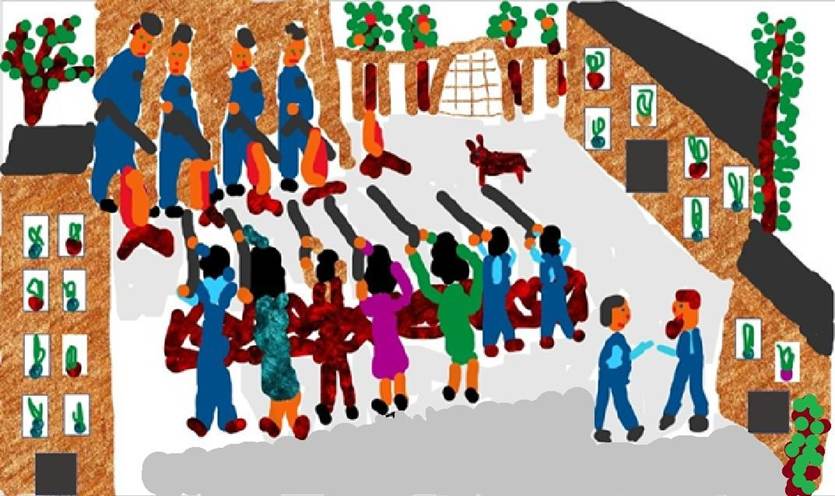
Nicolas and Auguste fighting, by Emmanuel and Laurence
“What if we can’t help them ? Then we will have deceived them ! “
“At least we won’t have been elitist !”
“Not elitist ! We would have arrogated to a small group of revolutionaries the power to determine who is entitled to the spoils of the revolution… opening gate and door to corruption. “
“And in your system, Auguste, the small group of revolutionaries may even decide for whom the revolution is made for in the first place!”
“But in your case, the revolution may end up benefitting the bourgeois and the landowners, because if you reward everyone and don’t want to hurt anyone, you won’t dare attack yourselves at any of the entrenched interests… It is like telling the slaves in ancient Greece or Rome that you want to help them, but then tell them, whether you finally get the decent meal you crave and get released from your chains, will depend on whether the rich slave owners agree… No, you want to abolish slavery, give the slaves decent meals and free them from their chains, and if it means expropriating the slaveholders and chasing them from town or from their lands, so be it.”
“You risk destroying the very fabric of society and cause more harm than good.”
“Oh, little Nicolas, how petit bourgeois you sound ! And while we are talking, the forces of order are mowing down our parents, our brothers, and sisters… You want to fall for your bourgeois propaganda and Machiavellian promises, I’ll fall for the revolution !” And with these words, Auguste threw himself behind the barricades and seized a spare gun from a comrade.
***
“What happened to them?” inquired Emmanuel’s buddy Antoine, one of the first who had stopped looking distracted and fidgeting. “Don’t tell me they got killed by the bourgeois forces? “
“We don’t know, ” said Emmanuel, “but they are immortalised in history by this legend, and their spirits surely participated in our revolution of 2021 for black lives matter, women’s and children’s rights, against the sanitary laws, for peace and the environment and for self-management that ushered in the Great World Revolution.”
***
“So, you think that the trade unions have been acting Machiavellian?” asked comrade Aurélie. Together with comrades Hélène, who had buckled down at Caisse d’ Épargne, and Annie, who had slaved at Amazon, she was one of the most committed trade unionists among the residents of the rural cooperative Illyria Garden Colony Manouche Camp and the urban neighbourhood assemblies Casa Latina Russki Dom Peace Dove at 76 rue de Lorraine, Saint-Denis. “You sound like comrade Dominique.” He was their neighbour at Russki Dom, father of Laurence. Comrade Aurélie had suffered through many discussions with him.
“But he is a peace activist and a green, not a Communist. He deeply believes that trade unions are rotten to the core, that they mislead the workers at the command of the bosses, especially as far as peace and environmental questions are concerned. I told him look at the history of the syndicalist movement.”
“I sent all of you a short chronology via bio-message,” Emmanuel piped up briefly, not wanting to disturb his mamon’s tirade. The chronology is reproduced at the end of this volume.
“Over the last one and half centuries of its existence, the trade unions have organised nothing but demonstrations against the capitalist wars, against the exploitation of mines and miners, for a reduction in the weekly and annual work time and the retirement age, and so on, and so forth, all of which would end wars and lessen the burden on the environment. No end to the evidence that the colleagues are firmly on the side of the peace and environmentalist movements and not fooled by the patrons or bosses at all.” Comrade Aurélie took only one deep breath, then continued. “What’s Machiavellian about that? Or maybe he thinks that way because I worked in underground workshops, the Nouveaux Ateliers, after the revolution. But that was on purpose – three times underlined – of course, to organise the workers, and make sure we whistle-blowed and finished with Huntziger and Co. before they made us produce more toxic fertilisers, dodgy Covet, Coflu and other vaccines or even drones and weaponised smart phones.”
“No, no,” said Dominique. “I did not want to doubt your personal integrity, nor that of comrades Hélène and Annie whom I know very well from the peace movement or that of comrade Alain whom I met at an environmental rally. Not at all. Yet you’ll have to admit that the trade unions for the longest time have had to mediate and compromise, between stalwart Communists like you were and are on the one side, and super-tough, neoliberal capitalists bosses and the governments they put in place, from de Gaulle via Mitterrand and Hollande to Macron on the other. And the workers have had to squeeze by in the middle and be satisfied with short term concessions by haughty capitalist despots, you might say.”
“Yet you would not throw the workers to the wolves, would you?” his mother had said.
“Of course not, but neither should the trade unions have allowed the workers to fall for the capitalist traps and be satisfied with their short-term concessions. Peace in Indochina, but then came Algeria, big fanfare over the Czech revolution in 1968, but then came our own Western repressions of the student movements against the Vietnam war and the cutbacks in the social sector even during the programme commun,” the 1978 agreement between socialists and Communists.
“They tried to present the workers as over-demanding,” said comrade Aurélie. “And your green friends often participated in that witch-hunt. Yet think about it, what did the workers really demand? They cared about the peace issue, we already mentioned that, of course, about the failure to adapt wages to the rising cost of living, the attempts at lowering social protection such as holidays, health insurance, or lowered bosses’ contributions to unemployment insurance, retirement at 60 which if implemented and upheld under capitalism already would have brought an enormous respite to the environment, other environmental issues such as highway construction, water deposits, family farming, persecution of refugees and other migrants, and then in the end, the Draconian sanitary laws. What, please tell me, in that list has been over-demanding or only for short-term gain?”
“Well, so you haven’t fallen for their traps, but you have allowed yourselves to be gotten by the wolves,” Dominique pressed on. Aurélie shook her head.
“What wolves?”
“Grey wolves, green wolves, white wolves, the whole lot,” Dominique sighed.
“D’accord then, what should we have done?” asked Aurélie.
“Focus on self-management.”
“We did after the war, with the enterprise councils.”
“But their importance petered out.”
“Because France moved to the right. Or rather, the establishment ruled, and the establishment was right-wing. And what could the trade unions on their own have done?”
“Take a more resolute class-based position.”
“But we did!”
“Phew!” said Dominique, obviously dissatisfied.
Then comrade Misha spoke out. “If you think the French trade unions have been lame, consider the German ones. They have been much less political than the French ones, raised even fewer demands for better working conditions and for stopping the reductions in social protection. Yeah, they have basically restrained themselves to asking for annual wage increases of one to five percent and a big march on 1st May with hardly any specific demands at all. And then they calmed down as if nothing had happened even if their demands were not fully met or not met at all.”
Chapter 2. In the Revolution

revolution already,” admitted Emmanuel. “However, we are lucky to have here with us many senior comrades who were active participants in the revolution as well as active trade union members, starting with you, comrade Georges! Please tell us how you experienced the revolution.”
Comrade Georges, one of the last chairmen of the PCF before it self-dissolved in the wake of the revolution, was a very old man now, over 80. Yet his eyes were still sparkling, he still had quite some grey hair on his head and a bit of a beard, and he immediately began to talk, cogently and eagerly, as if he had been burning for the opportunity. “We, meaning comrade Jeanette and I were staying with comrade Pierre back then. You young comrades will know that we had the Covet scamdemic back then. Many old people were forced into old people’s or as they called it nursing homes, and they had even threatened to put Jeanette and me into two different homes. That was unacceptable to us.”
“If you want to know more about this and similar Covet and anti-ageism stories, wait for our presentation, comrade Leyla’s and mine,” interjected Félix, comrade Alain’s father.
“I like the term, anti-ageism,” Georges said. “Let’s note after the revolutionary village and quarter assemblies have abolished all old age homes in 2021, Year Zero, old people either live with their families or in room-mating arrangements with other seniors they are friends with or at least get along with well enough. Anyway, comrade Pierre must be an anti-ageist, because he picked up his father as well as us and allowed them to live with him. He was still married to comrade Arlette back then, but they stayed in the living room, so that his son, comrade Léon could keep his room to prepare his bac in, and so his dad could have his own room, and Jeanette and I as well. Later on, he moved in with comrade Marine, and it is almost the almost same story here at Illyria in our flat above the furniture workshop: his father has a room, Marine and he have a room, our Russian comrades Aleksei and Evgenia have one, and Jeanette and I have a room. And we all meet in the live-in kitchen, no separate living room. Yet we are all comrades, and we don’t wear masks with each other, and that’s how you young ones should also keep it, and forever.” There was applause. Comrade Georges wiped the sweat of his brow and continued. “So, it was Day X, we had the revolution, and even we senior comrades wanted to do something. So, we went to blockade the Monoprix in the vicinity, Pierre’s father, Jeanette, Aleksei, Evgenia, and I. Yet, how great was our disappointment when we arrived. A joint cgt-FO team, consisting of three men and two women was already sitting there at a garden table on garden stools with a red parasol over it.
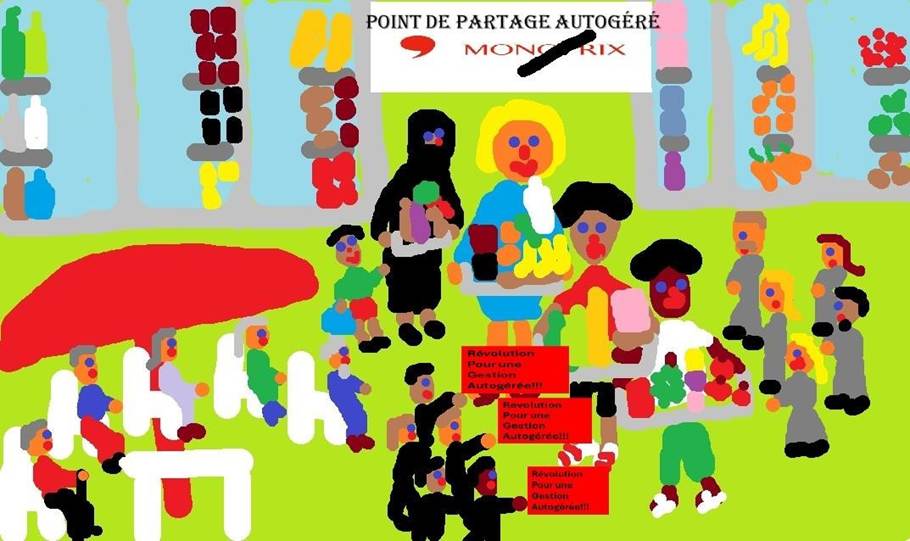
Blockade at the Monoprix, by Rosa and Josip
’That’s for later,’ they explained, ‘when it gets hot.’ Well, they were right, it was July already. They yielded their seats to us and brought new ones. We sat for a while together, discussing the revolution. Then a few unorganised Monoprix workers, three women, and two men arrived and wanted to get past us to open up shop. We all got up. Our cgt-FO colleagues got in their way and barred their way. ‘Colleagues, don’t act dumb,’ I said. ‘Can’t you see that your colleagues are on strike? Just go home and wait what happens. I have a feeling we are in for happy days.’ One of them, maybe a Lepeniste, Rassemblement National thug advanced towards me as if to hit me, but one of the cgt colleagues pulled him aside: ‘Look, he is an old comrade and the fascos have recently abducted and held him for a few days. Let us fight it out if we have to.’ ‘I can see who he is,’ scoffed the RN man. ‘He used to be the chairman of the Stalinist party, and then you have still got the Trotskyites, haven’t you? How are you going to do a revolution that way?’ ‘Not only we cgt, or we Communists, or any other Communist and left-wing party or movement, all of us together,’ I said, ‘because I am also a cgt member, like many of us, starting with Bernard Frachon and Maurice Thorez. But also, you yourselves and your family and everybody will be great revolutionaries. We are all going to be politicians in our neighbourhood assembly, village or quarter and workplace assembly, and decide on all matters together. As a matter of fact, you all work here, don’t you? Why don’t you hold a meeting right here and now, in the sunshine? Jeanette, the other comrades, and I will represent the not so deceived customers.’ ‘That’s a great idea,’ said one of the unorganised women and gave us a wink. ‘I think you cheated customers should have the first word. What do you think should happen with this shop? Don’t you like it at all?’
‘Not much,’ said Jeanette. ‘It looks very dull from outside, and it is the same inside. And the vegetables are never fresh. I think, maybe some of the others will agree with me…’ Of course, we four others started to nod emphatically, we wanted to give comrade Jeanette the support she needed. ‘I think we should pull down the building, we should regreen the place, maybe join it with the little park over there and we should have a farmer’s market here, you know, with vegetable and fruit stalls, a baker’s, a butcher’s, a fishmonger, a fromagerie, maybe a clothes’ and or a toy stall, whatever the people in the neighbourhood care about most.’
‘Does the building really have to go?’ another one of the woman colleagues asked.
‘We can leave that to the village assembly to decide,’ said Aleksei, and when the other trade unionists looked blank, he explained. “Or quarter assembly. You know like in Russia, the assembly of the mir or village community.”
“What will happen to our jobs?” the Lepeniste asked. “I know you are a foreigner. It would never occur to you that you have to work to earn a living. You just come to live on benefits.’
‘That is mega-bullshit,’ said another of the cgt men. ‘ But anyway, you could retrain as a carpenter. I am a carpenter, I could help you, if you cared to learn, that is. We could build up the wooden stalls for the market together.’
The other trade unionists, especially the women, all clapped. The Lepeniste was baffled. It almost seemed he was a bit swayed. Mind you, later on, he turned bad again and called our comrade carpenter a wanderer. Anyway, the discussions continued this way all day, even when the second shift of workers arrived in the afternoon. When customers came, we told them to try a street market that already existed, a few blocks away. Those who insisted, because they had bad legs or feet or thought they did not have enough money, our Monoprix workers let in, and allowed them to pick for free what they needed from the shelves. By the evening, the news of that option seemed to have made the round of the quarter. Maybe also the news from other quarters where boycotts and blockades had turned into looting. That was good, we were all for it, after all, the prices, even for the basics, had been much too high for a long time already. Anyway, some young lads with their girls turned up and said, ‘We’ve heard there is a store to clear out, and we are hungry. Those damn capitalists, you know, they charge our parents too much.’ Well, we did not blame the Monoprix workers for letting them in, and when the five of us went home again to find out what had happened in other parts of town, and especially at the government buildings, the doors of the shop were still open, and more and more people were coming to stuff their bags. When I came home, comrade Frédéric was already there, and we had a conference call with Patrick who was collecting the news at l’Humanité, back then via internet still. Nowadays we would have held the conference via the low frequency, soothing neural wave bio-wifi where the treetops and the birds serve as transmitters instead of ugly, radiating towers.”
“Yes, but before Patrick tells us about the grand picture, why don’t we have a few more vignettes from individual workplaces?” Emmanuel asked. “Senior comrades Jean at Bridgestone, Pierre, Alain at the electricity company ÉdF, Hélène at PTT–Caisse d’Épargne, Annie at Amazon Logistics, and yeah, Frédéric, Mina, and Laurent, you worked at Sorbonne Nouvelle… I suppose that’s also a workplace that can strike and go self-managed. And comrade Marine, you were a prof at a lycée, what nowadays would be part of a complexe scolaire or school complex, with classes all the way up from the six classes of primaire, or all through primary school, to the six classes of the secondaire, or secondary school, all the way to the baccalauréat. And schools are also workplaces as we all know so well.” And he rolled his eyes and dropped his mouth in mock exhaustion.
“Yes, I was at work at our Bridgestone tire factory,” Jean began, “where I was already in the research team working on better tires that could stand field roads as if we organised workers had had a premonition that we would go back to them. Indeed, it turned out a useful job, since the revolutionary villages were about to decide to do away with cross-country highways, périphériques, and all other tarmac and most concrete atrocities altogether. We did like the Monoprix workers had done, constituted ourselves as workplace assembly and SMSed the workers off duty to come in if they could or participate via conference call. We immediately transformed our branch into a self-managed firm to be managed only by its full work collective in assembly. That part of the revolution came easy to us, since Bridgestone headquarters had earmarked us for closure, and we felt not in the least indebted to them. In fact, we cut all links to headquarters and wrote into our plan-programme for the next ten years to reduce our workforce gradually to facilitate self-management. We were about 450 workers back then, now, 20 years later, we have around 40 left. By the way, to come back to the question of Georges’ RN man, we did not fire anyone. Every worker had all the time he or she needed to look around for a new job or a retraining opportunity.
“Didn’t you have any right-wingers in the collective?” asked Emmanuel.
“Yes,” said Jean. “And even later, as others left, new ultra right-wing sympathisers joined when we had major orders. You see,” he interrupted himself. “Even though we have over 95 percent fewer vehicles on the road, just taxis, public transport, and other functional vehicles, such as fire brigades, and correspondingly fewer orders for tires, sometimes we still get big orders, for instance, if a village renews its public mini-busses or ambulances, or a logistics enterprise like Logistique Yvelines replaces a few of its transporters. Then we need help. And on several occasions, we got fasco villains into our brigades who stole materials, for instance graphene, even to weaponise them. They also tried to use us as a base for their private crypto-currency, fake voucher, or other criminal business. No need for cryptocurrencies or even vouchers when all goods are free in the economic circuit.”
“We’ll get back to that,” promised Emmanuel. “How was it at ÉdF, comrades Pierre and Alain?”
“Well, what do you think?” Alain laughed. “We waltzed in and said, let’s be finished with nuclear power, oil, gas, large water works, huge windmill and solar panel parks, and other anti-ecological atrocities in the energy sector. We had votes, then asked whether those who may still have been recalcitrant could live with the consensus. The workers, except for those in the threatened installations themselves, had nothing against it.”
“What about those who would lose their job?”
“We, or rather our local comrades told them, not to worry, there would be other jobs for highly qualified electricians, water, wind, solar, and rubbish incineration experts like they were. In fact, lots of jobs, in research and in the block energy works that were popping up in every neighbourhood all over the French lands. Then we split up in infinitesimally small gridlock repair brigades, just in case a block energy work broke down somewhere and needed help, or if vice-versa, it had an excess and wanted to help other block energy works that might be experiencing a shortfall.”
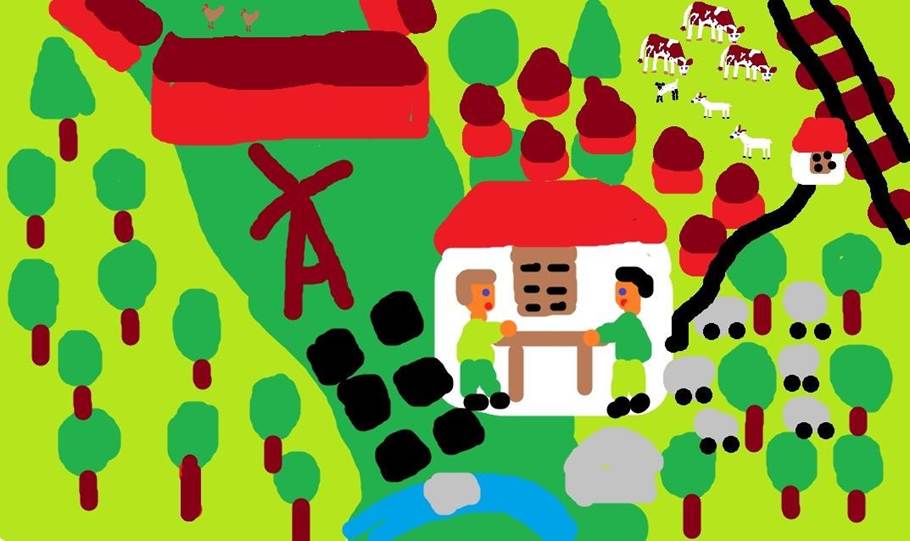
Gridlock Repair Brigade, by Che and Georgette
“Yet recently, it has turned out you are having inter-village, regional, and even hexagon-wide assemblies anyway. Does that not conflict with the principle of self-management and of small size?”
“It definitely does,” nodded comrade Pierre.
“Yet, since this session is supposed to deal only with the revolution in 2021, let’s postpone this problem until later,” said comrade Fabienne who was moderating. “Let me first give comrades Hélène, Annie, Mina, Marine, and Patrick the word, so as round off our understanding of the role the trade unions played in the revolution.”
“Before you do,” said Jean. “At Monoprix and Bridgestone, the trade unions and especially our cgt-FO alliance played a major part. They were gung-ho for the revolution and self-management, ‘We will even self-dissolve,’ one FO comrade told me, ‘As long as you PCF do the same.’ Only when we were trying to explain to our bureaucrats, now known as M&A, management and accounting brigade that they were from now on going to be rank-and-file workers and as a matter of fact would have to rotate their place in the M&A brigade with all other workers, meaning they would only get to sit in their old office behind their desk for a week a year at most, the CGC members panicked. ‘But we are paper workers, you can’t expect us to work on the shop floor!’ Then some of them said, ‘D’accord, we might try.’ Yet others, mainly women, said, they would get another hands-on job, maybe not in a tire factory, but in a tailor couturier workshop or something. However, one cheeky fellow, not a fasco, RN type, but more the neo-liberal Macronyte type asked, could he and a few of his pals maybe form a flying white-collar brigade that would do the M&A tasks at several workshops. ‘You know, a bit like an accounting firm under capitalism?’ ‘That,’ I replied, ‘is unlikely, since you wouldn’t know anything about the plan and the accounts of the workshops you’d work at. Or rather you wouldn’t know about the material balances and input-output tables, since there won’t be any money anymore soon. I wonder, should we here at Bridgestone allow such a flying M&A brigade access to our books?” There were immediate shouts of ‘No, no way!’, and the vote was 99% negative as well. Only the CGC man who had come up with the proposal and his friends had voted yes.”
“Well, did you not suggest them to come work at PTT-CdÉ, meaning Postal Service and Savings Bank?” comrade Hélène asked. “To some of them I would have,” grinned Jean. “But some others just needed some heavy physical work to get the arrogance out of their heads.”
“Then you did well,” said comrade Hélène, still working and the same resolute person at over 60 as she had been at 45 when the revolution broke out. “We had lots of funny situations at PTT-Caisse d’Épargne Saint-Denis during the heydays of the revolution. At first, we almost dissolved our office altogether. Many of us had other plans. We wanted to help our families cope with the revolutionary situation, you know, find a market, get the vouchers, see whether we got along with our neighbourhood assembly or whether we would have to swap our apartment, questions like that. Others wanted to do research on the revolution, that was my plan, for example. The other senior comrades may remember, I was doing a project with comrade Mina to help small family businesses organise themselves in the revolution.
“Yes,” interjected Mina. “In particular, we wanted to make sure the women and older children got to enjoy equal responsibilities to their husband or father.”
“Exactly, and Véro and the other Pléiades and friends, as the young comrades of the second generation became known, were permanently bringing in new stories about other childhood diseases of the revolution as well and we needed lots of time for thought and discussion. So, I had my head elsewhere, I must admit.
“But a cgt comrade, it was not Aurélie – we met later when we were debunking the Nouveaux Ateliers or New Workshops, they were in fact the first underground crypto-capitalist workshops –, but another nice comrade said, ‘Wait comrades, the other women comrades will also have problems on how to find things, how to get vouchers, how to get rid of their money and hopefully still get something for it, how to swap apartments and avoid falling for cryptodealers. We at CdÉ can be revolutionary councillors.” We all clapped and then a young trainee piped up and asked a question that made us all laugh with tears in our eyes. ‘And also, comrades,’ she asked. ‘People will still need their post-office, won’t they? For letters, even if there won’t be any more bureaucracy, but for love letters and cards, and they might want to send a parcel and or receive one.’ So, as soon as we realised we were still needed, we immediately went to work. We all got nice desks we appropriated from some of corporate office buildings in the centre ville. The government ones were too shabby. We would no longer look at people from behind glass, no need, soon there wouldn’t be any money to protect from robbers anymore anyway. Instead, we printed what we called temporary Stamp and Parcel vouchers. Temporary because soon postal services were going to be free like public transport, we agreed, and all of us promised to bring the demand for free postal services up in our neighbourhood and village assemblies.
Yet the stamps would still have pictures on them and come in artistic or educational series, and they do until this day, actually. At the moment, we have one on the 20th anniversary of the revolution.”
“Well, at Amazon regional depot, we had fewer qualms dissolving ourselves,” remembered comrade Annie. “We knew we would be able to send parcels via the self-managed post-offices. Or, alternatively, if we ordered, let us say, inputs from a workshop, the workshop could simply put the requested good into a nice, small, ecological, all-electrical delivery van that would bring it to the next train station or harbour. From there it would be forwarded to the train station closest to its destination. And from there it would be brought to people’s home with another nice transporter from the destination workshop or a nice logistics outfit, just like our Logistique Yvelines. In fact, I already knew I was going to co-found it as a small self-managed enterprise with 50 workers max and work there with comrade Fabien and other nice comrades I knew from Amazon.”
“Any problems with fascos at that point?”
“Yes, not that they objected to our self-dissolution, but they tried to steal equipment, maybe for a clandestine logistics enterprise or logistics station, they call theirs, that they were already contemplating. And to tell the truth, we all did some stealing. The goods that were still in the pipeline we forwarded to their recipients of course, but the money that was still on the accounts we distributed amongst all of us workers, since Amazon had cheated us so royally all through our loyal service. Even the CGC paper tigers agreed to that redistribution or late taxation.”
“We at Sorbonne Nouvelle were also trying to get out very quickly,” laughed Frédéric. “We got together in research and teaching brigades, already mixed ones at that. I was lucky to have comrades Laurent, Mina, and Youssef in my brigade. Laurent was still a student, Mina was a lecturer, Youssef was almost assistant professor already, and I was full professor. That meant that if we kept it to the maximum of seven, we would already have the required mix. Then we coordinated with the other research and teaching brigades and decided to call a full assembly of the Middle Eastern faculty.”
“The lot had fallen on me to moderate,” Mina continued the story. “I said, since we had now formed the research and teaching brigades, we might as well go home, or rather into the streets and participate in the revolution. We would then go on with our studies, now with student participation and non-discrimination of women assured, as soon as things settled. In fact, we were all burning to get to Concorde and meet up with the other Cellule 14 members, as we future adult Illyrians were known back then, as well as the young comrades we called the Pléiades, comrades Léon, Martine, Philippe, Anisah, Robespierre, and so on, and blockade the Assemblée nationale together.
“But then some trade union colleagues from the support workers got up,” comrade Laurent took over here. “And said we were the Middle Eastern Department of Sorbonne Nouvelle after all. We were supposed to be the experts on all these wars in the Middle East that had partly brought on the revolution. And now we, the experts, wouldn’t even come out with a declaration where we wanted things to go. I remember we were a bit ashamed that we had not invited any support staff yet into our brigades.
“So, we formed a brigade by lot to draft an initial memorandum. From us Cell 14 comrades only comrade Frédéric was on it, and we could be lucky that his name got pulled even. The brigade immediately went about drafting our faculty declaration.”
“I put in a line that as true revolutionaries and as humans we abhorred war,” continued Frédéric, “and we should immediately dissolve all armies, police forces, secret services, as well as governmental institutions of all levels, multinational organisations and arms-producing corporations or rather accept their self-dissolution. Somebody else had put ‘…destroy all weapons.’ The creation of mixed faculty-student-support staff research and teaching brigades with a maximum of seven members and on an equal level with all other brigades as well as with the full departmental and full university assemblies was already in the preamble. That was important so that the full assembly could no longer ride rough shot over the concerns of the research and teaching brigades.
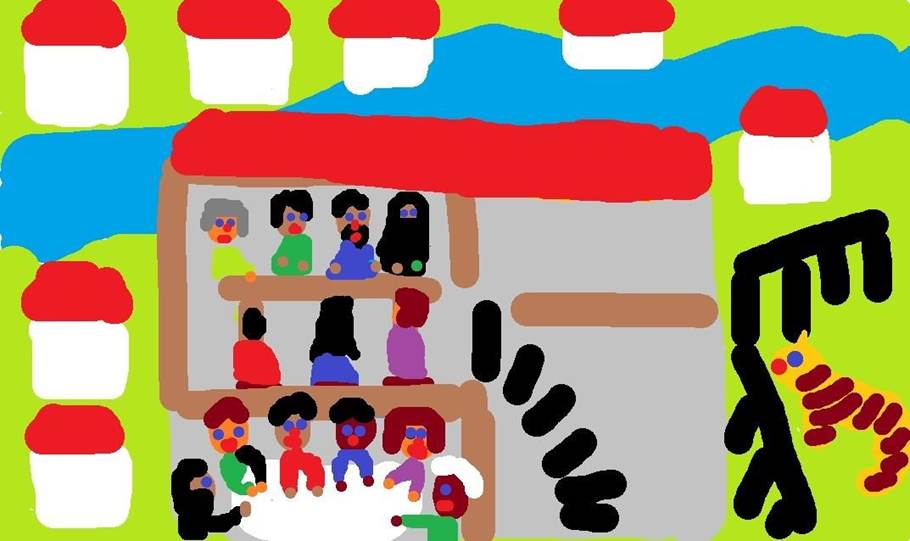
Revolutionary Manifesto from the Middle Eastern Department at Sorbonne Nouvelle, by Jean-Vladimir and Adilah
“We also included a demand to grant immediate asylum with full citizenship rights to all refugees from wars and other capitalist atrocities, and that included climate change, natural disasters, nuclear, biological, and chemical contamination, economic crisis with lots of unemployment, inflation, and so on. Especially the last point was a broad concept that allowed us, or rather the neighbourhood assemblies to accept anyone who was suffering hardship anywhere in the world. And then there were lots of other proposals somewhat less relevant to war and peace, but nonetheless crucial for the emerging economic, ecological, and democratic organisation of the revolution. They included no more private cars and no more fuel-guzzlers, radical expansion of public transport, pulling up of tarmacked roads, parking lots, etc. and build-down of ugly, unneeded, or toxic buildings as suggested by Fridays for the Future and other environmental movements. Also, the immediate housing of all homeless. The apartment or place you were living in at the moment of the revolution would be yours unless you decided to swap it for something more appropriate. But mind you, swap, no more money involved, no more real estate market. If you happened to own several properties you also could only keep the one you decided to stay in for the foreseeable future. The others we would give to homeless people, as we said. And then we all jumped up and ran out into the streets, as if we were homeless ourselves who could not stand being locked up.”
“Well, in the schools, in my case it was the School Complex Paul Élouard in Saint-Denis where I was teaching at the time,” said Marine, nothing in common with Marine Le Pen, but a prize-winning mathematics teacher, and author of a book ‘For a revolutionary mathematics’, with lots of applications of mathematics to revolutionary problems, “We also formed mixed brigades of students, teachers, and teaching assistants. Not support personnel because we were all intent to get rid of the hated surveillants, censeurs and proviseurs altogether. Students agreed that we’d rather do our own cleaning and cooking than be bullied around by paper shufflers. Or as an alternative to mixed brigades, there would be at least a teacher and two teaching assistants in any class of 21 who would rotate between student brigades.
The student brigadiers would change once a day at least like in the rest of society. If students were in so-called sections to prepare the Bac and did not have all their subjects in the same class, the composition of brigades and brigadiers was bound to switch more often even. You were allowed, however, to have as much time together with your designated or beloved buddy as you liked. As for the school assemblies, we decided to keep them big for a time at least, with a maximum as high as 2000 participants, because we wanted to encourage parents to attend and advise on the curriculum and the learning materials they found best.
Then I and some other teachers and students spoke up. One student said, well, teachers had their trade unions, most of them were in the cgt, some in the cfdt, why not have a student-cgt even for the younger kids in the primaire, and that proposal received roaring applause. And I said, one of our main goals should be making education truly free again, removing all capitalist elements from it, and that meant, definitely, we should abolish private schools. Yet also to see it as creative work, not as a socially necessary chore against which you had to strike. In that sense, I said, being cgt would no longer have to mean as much either to the students or the teachers.
“Yet then another student got up and said with a smirk: ‘But comrade, you don’t understand. You are a Communist. Your day is today already. We are all Thunbergytes, Fridays for the Future, we’ll want to strike for a better environment.’ Everybody laughed and clapped, and then everybody also could not get out fast enough to get into the centre of town where you, to our great envy, were all already blockading the government offices.”
“Over to you then, Patrick. We have seen that the trade unions played their part in the small frameworks – shops, utilities, factories, banks, logistics giants, as well as universities and schools. What about the big picture then?”
“Well, as you have already heard from comrades Marie who talked on ‘Revolution in the Streets’ and comrade Antoine who talked on ‘Covet as a Revolutionary Catalyst’, the trade unions, as important as they were, were only one movement in the revolution. There were the students, the peace movement, the environmentalists, the feminists, black lives matter, and other refugee and migrant groups, the yellow vests, farmers, senior citizens… Without all of them and every individual revolutionary citizen turning out and playing their part, it would not have worked.”
“Were the trade unions at the forefront of changes, or were they lagging behind?” asked comrade Denis.
“Well, we policemen were definitely lagging behind,” added his son, comrade Jérôme, like his father, ex-policeman, only that he had worked, not in the Paris police force, but in the infamous DGSI, or domestic secret service. Of course, it had been dissolved in the revolution, and comrade Denis, Jérôme, his partner Michel, as well as DGSI and DGSE affiliates – DGSE being the external secret service –, such as comrades Noah, Youssef, and Seth had put their talents to work to help the spontaneous militia organise itself and defend the revolution.
“You can’t generalise, most cgt and FO members were fervent revolutionaries, but so were some cfdt, meaning socialists and other reformists, and even cftc, meaning the Christian workers. It no longer mattered so much what the trade union executives said since the revolution was organising in a different way. In fact, we revolutionaries had started to prepare months, if not years in advance. We had started by looking at each other and picking members for secret red cells in which we felt confident. These were often based on our neighbourhood, workplace, school, university, party, church or Mosque, but they did not have to be. Cell 14, for instance, was just the former executive committee of the PCF – our senior comrades Annie, Fabienne, Jana, Marie, Mina, Marine, Hélène, Georges, Frédéric, Pierre, Denis, Alain, Jean and myself –, that had resigned collectively in 2020 already to make room for the revolution, and their families, friends, and comrades they were attracting into their circle.
“We, using the resources of l’Huma, but also Pierre at ÉdF,
Jean at Bridgestone, Annie at Amazon, all of us were marking maps with all the places we would need to boycott and pull over to the revolution and self-management: Government offices, corporate headquarters and branch offices, banks, factories, workshops, energy works, train stations, supermarkets, shopping malls, family shops, post offices, restaurants, cafés, fast food outlets. I remember, comrade Clément, who was a decided anti-vaxxer and capitalist conspiracy theorist, doubted that anyone would want to blockade and stalk McDonald’s ‘for fear of catching the virus and the toxic nanobots that carry it,’ he said.
“And anyway, the trade union members were as eager as any of us in finding points to blockade, and there were revolutionary cells that consisted only of trade union members, yet there were others that did not have any unionised members at all.”
“In other words, the trade unions were not the vanguard, but then they never had been, had they?” concluded Emmanuel. “They were just one movement among others.”
Chapter 3. Red Cells versus Brown Cells
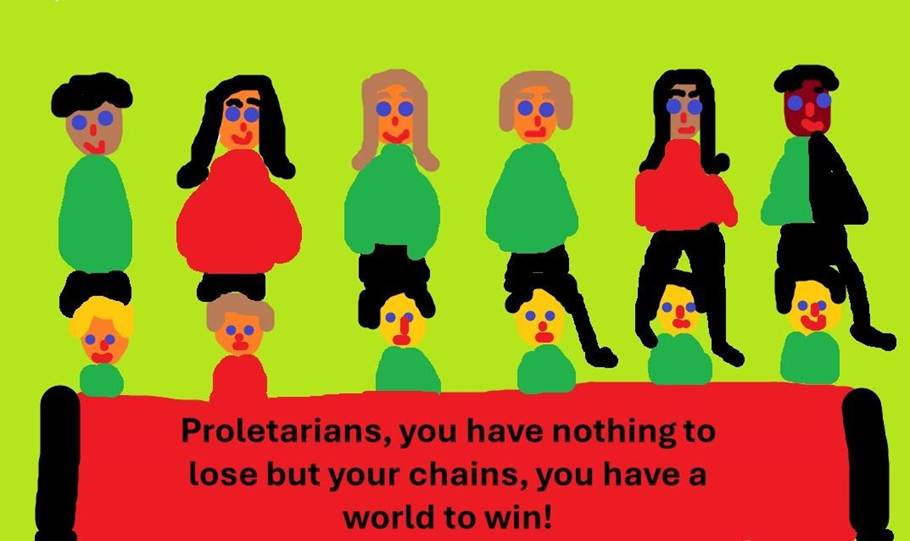
The twelve musketeers, by Jean-Saïd and Natalie
The young Illyrian and Casa Latina Russki Dom Peace Dove comrades were preparing the 1st of May rally. All the various movements were announcing their blocks intraline and via bio-wifi – meaning by the harmless brain waves with a frequency of 100 Hz maximum instead of 5 gigabyte and transported by live harp bio-wifi towers such as humans, animals, robots, and other intranet-conducive materials, and plants. The others decided whether they just wanted to exchange greetings with a particular movement or even plan a common action, a poster, banner, slogan chanting, or even a theatre sketch with a fellow block.
“What is that supposed to mean, the Uberyte block?” asked Laurence, as they were scrolling through them.“Oh, the Ubermenschen, they are great. They are clandestine workers who haven’t dared to whistle-blow on their illegal logistics stations yet. Yet, hopefully, marching in our 1st of May rally will convince them to come out and tell on the violations of self-management at their workshops. Then spontaneous militia can come in, we can call for a workers’ assembly and turn things around.” Emmanuel did not seem to see any threat in these Ubermenschen at all.
“I don’t know but maybe it is, on the contrary, to prevent us from doing that,” warned comrade Hélène. “It seems fishy they are calling themselves the Uberytes or Ubermenschen as if they have fallen for their bosses’ scam. And it does not seem to be intended as a joke. Otherwise, they might call themselves the anti-Uberytes or the Untermenschen, or at least put Uberytes into quotation marks, yet for some reason they seem to be under a lot of pressure to show devotion to their bosses who should not even exist any longer in the revolution. Remember from the school subjects History of productive forces or Ecology or from the Museums of Capitalist atrocities, the stories of the original Uber, Deliverando, Deshalles or DHL, Volt, and others? They let their drivers steer their bicycles through the prerevolutionary bumper to bumper traffic, sometimes for ten hours a day and over long distances, for miserly wages and with hardly any health insurance, to deliver their silly foods and other stuff to people too lazy or too busy to go out. The Uber-Untermenschen were racially or sexually insulted, many of them were migrants or LBGTHQIA, they got horrible muscle and stomach cramps from driving long hours without a proper meal, and terrible rashes from their saddles. Anyway, it was the mobile, late capitalist version of primitive exploitation. Those drivers were very intimidated by their bosses. They often had to do their work with headphones on, receiving commands the whole time. Maybe those bastard neo-capitalists have found a new way of enthralling their victims via the intranet?”
“Never mind, we can always boycott and blockade their sites like we did during the revolution,” Laurence tried to cheer her up, sensitised maybe by her own work on the peace movement, but also fully on her boy-friend’s wavelength.
“And there is another thing that is fishy,” noted Jean-Saïd. “Why do they stress SFCF and ÉdF workers are welcome? They say that here, and there will be banners praising regional assemblies of utilities. They are not working for Uber and Co., are they?”
“No, we are just self-managed brigades guarding railroad switching stations or electricity transformer or toggle stations. As you know, we sometimes still need the grid to help a block energy works in trouble or to siphon of excess current that may have accumulated somewhere,” said Pierre. “No idea why they are getting familiar.”
“I think Natalie and I will march with the Uberytes. Maybe you should as well, comrades Laurence and Emmanuel?”
“Oh, we are. Maybe there is no need for all of us to show up,” said Emmanuel, and began to fear for his sting. He had wanted to pretend to be a Uberyte or Uber-Untermensch himself in order to find out whether they would try to sell things to him against crypto, maybe drugs, or offer him a job in a workshop. Yet if all of the young Illyrians were going to come along, his sting op or incognito raid as he had described it to Laurence was going to be endangered.
“We shall come with you too,” said Faroukh, referring to himself and Sarah.
“And we can be carrying a banner: ‘The proletariat has nothing to lose but its chains… It has a world to win.’ To a convinced revolutionary, nothing more innocuous than that, but let’s see what their banners read, and what their reaction will be,” suggested Sarah.
“You will need security,” said comrade Marwan, Faroukh’s father.
“Oh, papa,” said Faroukh. “Don’t be silly. This won’t be in pre-revolutionary Palestine, but in the middle of Paris. Lots of people will see us.”
“Not if you are hidden in a throng of Uberyte ruffians, depending on how many they are. Take Pascal and me with you!” asked comrade Philippe, senior Pléiade comrade and economist and statistician at the University of Nanterre. “We can pretend to be interviewing them as background for our surveys.”
“And we can be Uber-Untermenschen from Vietnam,” said Dan, one of the four time-travelled Cambodian martial artists living in the garden colony. The others were Ayak, In, and Vit. We can use golden fist if needed. Golden or iron fist was an ancient Chinese martial arts technique even more effective than the red stun beams that the revolution favoured. Both you summoned with will-power. The red stun beams had the disadvantage that you could not use them at close range, with golden fist that was no problem. And you could stun opponents until militia came just as effectively as with red beams. Golden fist was even known to have smashed enemy swords as easily if not more so than the bronze beams the revolutionaries used against weapons. “And if it gets dangerous, we can all disassemble quickly and disappear on a yellow beam,” said Jean-Saïd. “Promise that if one of us gives the distress signal, the twelve of us will all beam out together. No fighting the Uberytes single-handedly.”
On May First, the rally was supposed to go all the way from République to Concorde. Only a 40 minutes march if you were few and concentrating. Yet in this case, we were going to be several hundred thousand if not a million, carrying posters and banners, talking, shouting and singing, and playing theatre. In fact, the other Illyrians were not altogether happy with the “12 musketeers” as they called them taking on the fascos and forgetting about the educational part of the celebrations. “Well, too bad,” said comrade Philippe. “For us, they will have to be for next year. And we’d best go in pairs and try to chat with people but be in constant bio-message contact in case one of us gets into trouble.”
***
“So, you work at a Uberyte logistic station?” Pascal asked his first acquaintance at the rally. “Isn’t that a bit tedious?”
“Tedious yes, but we are trying to get it recognised as socially necessary work. Then we would get all goods for free, plus our bonus on top of it. That would be neat, wouldn’t it?”
“What’s the bonus?” asked Philippe who could not believe his ears. “I thought we had abolished money.”
“You can have gold or silver, stuff like that, drugs, fitness courses, weapons,” and when he saw Philippe’s and Pascal’s dubious expression, he added, “self-defence weapons of course, only for self-defence. Or you can get attention, you know, people will come to you. The two of us found each other this way, didn’t we, Émile?” His buddy smiled and seized his hand. “I don’t know,” said Pascal. “Is it worth it to slave for capitalism just to find buddies that you could meet at school or at work? And these drugs, and training, and weapons you are talking about, are they any good?”
“You can get opiates and hashish for free in revolutionary share points,” added Philippe.
“Yes, look, but later on you may have your own workshop and earn lots of crypto and get a villa and a nice street cruiser and even a boat!” said Émile.
“But you can get a house on the revolution quite without putting down any crypto!” said Philippe. “You can even just swap it against something much larger or smaller but quainter and claim your circumstances have changed! You say you got together with…, what’s your friend’s name?”
“Honoré,” said the other. “You are right, but then you’d have to grovel with your old and new neighbourhood assembly.”
“And you with your bosses. I assume you have bosses, otherwise you wouldn’t be marching as Uberytes.”
“Yes, we have bosses now, but later on we may become the bosses. I mean, I don’t really like to have people below me either, but I would like to have my own firm or private practice. I might study medicine.”
“And then administer toxic Covet, Coflu, and LEP-AL vaccines and other toxic pharmaceutical medicines?”
For the first time, Émile looked Philippe and Pascal into the eyes. “No, you are right, we are trying to attract attention to our situation.”
“Why not simply inform the local village assembly, throw out your bosses and reconstitute yourselves as a self-managed enterprise?”
Honoré laughed. “I can tell you why. Because we would be dead matter. You’d have your private life drawn through their European Empire radio and Smartbox channel, and then you’d have the cryptoleak avengers at your door to finish you off.”
“Well, couldn’t you tell them that you did not leak any crypto deals? After all, officially, there is not any crypto anymore in circulation anywhere. You just told us that they are trying to hold you with other promises: drugs, fitness, weapons, fancy housing and other luxury goods, even sex and love?” asked Pascal.
“By the way, if it was about driving, you could drive a public minibus or a small logistics transporter, or a free taxi, receive all your goods and your house for free and be just as happy as if you had a limousine. And if it was about being a doctor, there are still some in private practice, although most of them prefer being associated with the local policlinic. D’accord, you’ll be the brigadier of your mixed doctor-nurse-support staff brigade only every seventh day or so, big loss! Are you so vain? Most doctors we know say they enjoy letting the others talk and focusing on the patients.” And he was thinking of comrade René, young comrade Sarah’s father.
While Philippe and Pascal had trouble understanding the motives of the two dreamers, as they called them later, Émile and Honoré, Faroukh and Sarah had to do with an even more hard-boiled bunch: Jordan, Kévin, and Raymond, fans of Anne Dalgo and Marion Le Pen. “You want to be Ubermenschen and do not even know about Anne and Marion?” asked Jordan. “Anne will explain it to you, all of it.” And he frowned. “You see, even today, in Year 20 of the revolution, we have too many refugees, migrants, and generally foreigners in France. They come because it is still too hot and the economy too underdeveloped in their region, or there is war, for instance, the Zionists making trouble in Palestine.”
“You mean the fascists?” asked Faroukh, who had understood that in the interests of peace and international solidarity, this distinction was important after all.
“Fascists – Zionists whatever. Those are the refugees, Anne says. You know we had a meeting of our brown cell, where she spoke.
And then there are the migrants. They are not necessarily fleeing from somewhere, they just like France. Still, they are not French, are they? “
March with the Ubermenschen, by Emmanuel and Laurence
“And then there are the foreigners. They are just in France – or nowadays you’d say French lands, that makes us sound bigger, but Anne and Marion still don’t like the term –, because they work here, or they are married here, or they just know somebody here. All three sorts are a burden. They take houses and apartments, they take socially necessary work, and they take goods.”
“Oh, I don’t believe that,” said Sarah. “There is enough socially necessary work and enough food and other goods to go around.”
“And enough houses as well, if you are willing to move to the countryside and live in a deconstructing building while you wait.”
“So far, yes, there is enough!”
“So, why not in the future? The French lands have become more of an agricultural country than before, and the march of the trees and the dispersion of the villages will only contribute to that. There is going to be even more fertile soil, and more farmers to work it. That means more food for each and everyone. And as for other goods, we have plans based on surveys that tell us exactly what everybody needs and wants from the cradle to the grave. The economic circuit makes it all easy. The farmers get the food to the workers, and the workers produce everything from clothes, tools, equipment, furniture, bags, books, and toys to sophisticated intranet bots for each other and for the farmers as well. And the teachers and other cultural workers teach the kids or entertain all of us. And both peasants and workers are grateful to them and produce food and industrial goods for them as well, no problem. No more bureaucracy, that’s clear! And whether somebody is black, white, brown, red, or yellow or from Drancy, Palestine, or Senegal does not matter a f**k, don’t you think?”
“Well, I must admit, it is not as important to me as it is to Anne and Marion…,” said Jordan.
“Yet, don’t you think that France has radiated around the world with the idea of the grande nation?“ asked Raymond.
“Including the notion that it should be in order, well-organised, and calm,” added Kévin. “Even you Commies want it that way, don’t you?”
“Well, yes, but we organise it ourselves, meaning we achieve good organisation through assemblies all on the same level, where everybody has a say, and we look for consensus until we reach it!” explained Sarah. “Even if gets a bit loud at times, that will better than a dictatorship suffered in silence.”
“Tell me!” Faroukh asked Kévin, Jordan, and Raymond, ”What is the difference between Anne Dalgo and Marion Le Pen? Why do we need two right-wing bitches like that?”
“Oh, among us Ubermenschen they are both very popular, ” said Kévin. “Anne Dalgo is linked to Arnaud Arrolle or Arthur Avanti as he calls himself these days. They want to agitate people locally to throw out the refugees, migrants, and foreigners based on a decentralised consensus, if you will.
“Marion Le Pen is like her whole family, deeply rooted in authoritarianism. She wants to rewind the clock to let us say May 2021, meaning masks, Covet-19 vaccines, sanitary passes, and then hope that the unloved arrivals get back into their rubber dinghies of their own accord and leave.
She has a German equivalent, Alice Wedel – apparently Wedel means broom in German –, who does the local recruiting and advertising for Ronald Gunpump, now Bär, Stephen Kocho, now Eis, and Fritz Schneid, now Willy Schal, you know, to make them sound like socialists or greens.”
”We know, Julian Redswan and Dorian Kopf were almost out of themselves when they heard that.“
“What do you Untermenschen know about these traitors?“ Kévin asked suspiciously, and Sarah stepped meaningfully on Faroukh’s toes.
The conversation took a similar turn between Jean-Saïd, Natalie and two further Uberytes, Janis and Bruno.
“We don’t really know why we joined Henri Uber’s lot. Maybe it won’t be so bad to have a few of these capitalist outfits, for shy and voracious people like us, Bruno, what do you think?”
“Ben oueh, shy and voracious, that sums us up,” Bruno laughed bitterly, and Jean-Saïd shook his head: “You shouldn’t be condemned to slave as an Untermensch just for being shy.”
“And for having a good appetite,” added Natalie. “We are going to have the march of the trees world-wide and the dispersion of cities. Lots of food to go around. Voracious people like you will be in high demand.“
”Buffalo shit,“ said Bruno, ”and if you ask me, the revolution has gone a bit wrong in focusing on all that green stuff. We are counting the years until the trees grow, instead of eliminating the remaining inequalities between people.”
”You think that way and then you work for the capitalists!?” said Emmanuel who had just joined their group with Laurence. “You need not join the trade unions, but definitely, you should be with a red cell.”
“You know what the young comrade over there just told us?” asked Laurence. “The boss slept with her, but the only reason seems to have been to make her join a brown cell. She works at the SFCF as an information agent. Her friend, she says, is a conductor.”
“That’s me,” said Janis. ”I am a conductor. I am often out of town, that’s when it happened, but Dénise immediately told me and we are going to take steps.”
”Like what?”
”Like ask him for an alimony!” Janis said bitterly. “We think Dénise might be pregnant.”
“But if you ask him for an alimony, you might be stuck in the underground sector forever.”
”But don’t you understand, we work for a self-managed organisation, don’t we? The switching station we are attached to is a self-managed workshop. They just want us to join a brown cell, where brown means not adverse to doing a load for a bonus, let’s say a gold coin, or drugs, or crypto, something like that,” said Janis.
”And it also means being a law-and-order type, asking people for village ID and discriminating against foreigners,” added his pal Bruno. “And finally, it may mean being for the recentralisation of SCFC and also the other utilities, like electricity and water. We are supposed to speak out for inter-village and regional assemblies rather than just small, decentralised switching stations or transformer stations slash grid monitors or local village sewage and wastewater treatment. You see that way the demand for recentralisation will come from below. Comrade Claire here, she is with ÉdF, she can tell you.”
“Yes, we spoke to her. She told us all of that already,” said Emmanuel. “But tell us, what does it have to do with Uber, Deliverando, Deshalles, and Volt, those are the real Uberytes, aren’t they?”
“Oh, there is a very simple reason they are interested,“ said Bruno. “It will make it easier for their shipments to piggy-back onto the revolutionary ones, those that are part of the economic circuit that is real, meaning for free.“
“And also, to do electricity and water sabotage like they did from Year One,” explained Claire who seemed to be a red cell agitator already.
“But that’s terrible. Why do you march with these people?“
”Don’t you understand? That way we let you know what’s happening and at the same time make us look more respectable, as if we were already working in self-managed workshops again. Only that we don’t rotate every day, the fascos are serving permanently.”
”So, who are they, not Uber, Deliverando, Deshalles, and Volt, are they? The real sponsors are far away in the ex-U.S., Canada, Rome, and Riga, correct?”
”Oh, they are just nasties who succeed in getting around the rotation rule and manage to be in power permanently,” said Dénise.
“We are twenty-one workers in our workshop,” another Untermensch told them. “There are three permanent brigadiers, Thomas, Willy, and Florian, but they don’t lift a finger, and they have thugs to help them. You’ll have to help us.”
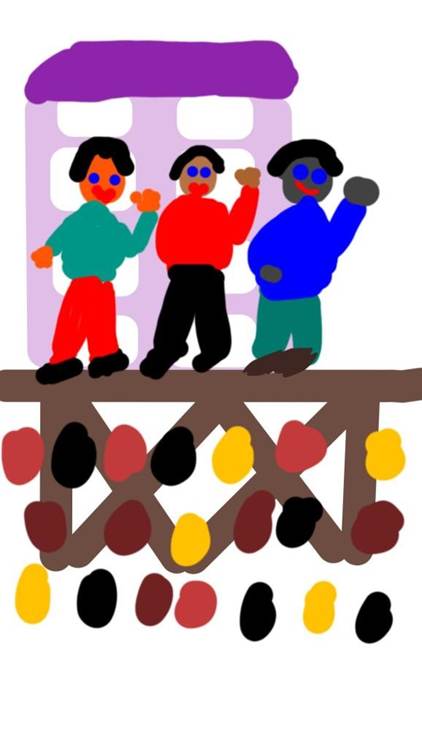
Revenge by the Untermenschen, by Faroukh and Sarah
”Well, why don’t you participate at our meeting at Illyria tonight, you can help us debunk them and the other Uberytes,” said Jean-Saïd, maybe giving away their game that way, but it was time because they had reached a stage where the Illyrians were setting up a play, Revenge by the Untermenschen, about the rebellion of the people they had just talked to.
They saw many of the superior Uberytes bush and try to get away from the rally, while a few others stuck around and asked our Cambodian martial artists, Dan, In, Ayak, and Vit whether they could teach them Martial Arts for free. ”Can you train us?” Our Shaolin comrades said “Of course.” Only when the Uberytes asked them to teach them to fight with weapons did our comrades say no. All they wanted to spread was skillful wrestling and Kung Fu and harmless red and bronze stun beams and Golden Fist based solely on willpower. Emmanuel later held that the first of May rally in the Uberyte block had been a perfect demonstration of how to do revolutionary agitation.
Chapter 4. The Wild Strikes of Spring, Year 20
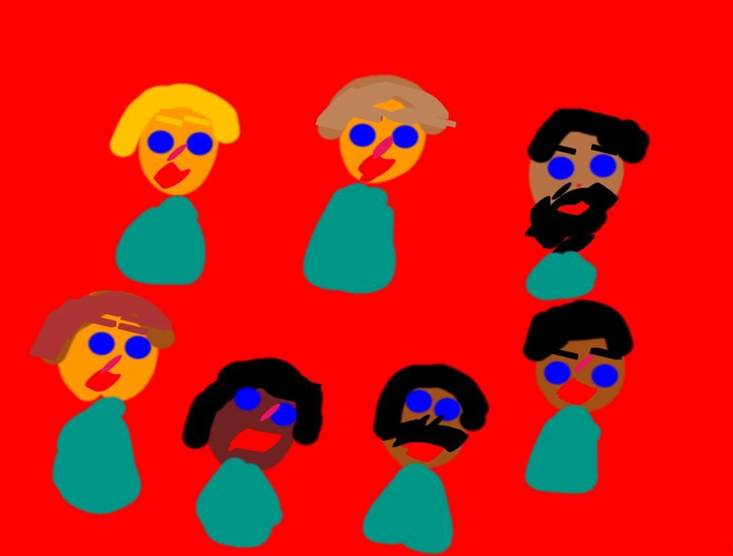
Meeting with red cell members, by Jean-Saïd and Natalie. From the top left to right, Honoré, Émile, Vincent, Emmanuel, guest from Illyria, Flavel, Hakim, and Ismail
“The idea for our strikes came up during the First of May rallies actually, not only in Paris, but also in other agglo(-meration)s and villages. It was to form red cells once more like we did during the Commune and the revolution. And we founded them not only in the clearly illegal workshops, but also in the utilities and industrial workshops that were recentralising under fasco influence. The clearly illegal workshops were producing drugs, weapons, offering training with weapons, cheap entertainment, sex, or dangerous medical operations ranging from inadequately material-checked vaccines to untested gender ops, such as the one comrade Cato had to suffer.
All dodgy workshops had brown cells consisting of the new bosses, or you might call them permanent brigadiers or constant moderators, as well as unchecked M&A, management and accountant teams. So, why should we revolutionaries not have red trade union cells defending the interests of the cheated and exploited workers, just as we have material checkers, hierarchy- and cryptoleakers, meaning whistle-blowers on incipient hierarchies and crypto use?“
“It became clear to us marching with the revolutionary comrades at the First of May rallies that they did not hate us as our bosses had told us,” added Vincent. “No, they simply no longer knew us because we were no longer on the rolls at a normal self-managed workshop. Some of us even had fake village IDs. We got our fasco bosses that way when we struck wild. We stayed at home and when they, or rather the cryptoleak avengers showed up to drag us back to work, we played naive and said, ‘Oh, we just had to put in a few hours of socially necessary labour time in the neighbourhood or at our old workshop.’ Or, ‘We had to get a new village ID, otherwise they might not longer have known us at the market stall when we asked for our food and other basics.’
Then the cryptoleak avengers or the bosses, in case we got dragged to them, feigned ignorance; ‘Oh, we did not know you were suffering hardship. We could have gotten you something to eat…’ Which is buffalo shit, of course, the Reaction has hardly any farms, clothes and other workshops for basic goods under its control to help out in situations like that. And the genuine revolutionary workshops, market stalls and share points do not recognise old money, crypto, token, or vouchers, all these fasco tools. Anyway, let me tell the story from the beginning, as it happened at our workshop, my name is Vincent by the way.
“So, we met in these red cells with the solid bio-thicket – both real as well as wave-thicket or ‘white’ noise – protection around us, so they would not be able to catch us on bio-wifi. We told each other all the stories of how they were abusing us, the foremen never changed, the workload was getting ever heavier, and the money reward, for which we had joined after all, was ridiculously small. None of us were really gung-ho counter-revolutionaries, so knowing that, the fasco barons should have made more of an effort to impress us. However, the crypto never came, or if it came, it wouldn’t buy us anything. Several of you have commented on how hungry and delapidated we looked at the rallies. Well, that was the reason. Some of us asked to be paid in kind. Yet instead of basics or maybe a transporter that the driving maniacs among us would have liked, we got drugs to get high on and weapons to shoot revs with! What if we did not want to shoot at our comrades?
“So, in these red cells, we came up with a strategy of how to get back at these nasty usurper bosses. First of all, we decided that next time they would bully us, we would talk back and the other red cell members would assist the one in trouble.
Second, we would convince other workers to form red cells as well, and all of us would start to work more slowly and methodically again, not neglecting the material checks at least, even if hierarchy checks were not permitted.
And then, third, if we had all or at least a large majority of the workers on side, we could try a real strike, you know, with people staying home except for any pickets that might rotate.
In our workshop, the golden occasion to test the slow work came the other day when our bosses confronted us with a rush order for Coflu, Covet, LEP-AL, and the Moral Atrophy virus. These are all supposed vaccines that the remaining pharmaceutical producers among the clandestine entrepreneurs have developed, but they do the opposite. They will give you cold, flu, Covet 19, as well as lymphatic encephalitic pulmonary syndrome including hallucinations and paranoia, known as asymptomatic leprechaunitis, because of the visions of leprechauns it involves. And even moral atrophy. That is the worst medicine, quote-unquote, that they have come up with since the stomach cancer virus of Year 8. It can actually make you cynical and lethargic, hence the name, MA, or Moral Atrophy virus.
The idea of Messieurs Uber, Deliverando, Deshalles, and Volt was to produce them here at our logistics station, maybe even as an omnibus vaccine, with several agents in the same multi-stage rocket-type syringe and then use our transporters to get them to private policlinics and private physicians who worked with the counter-revolution.
Those of us who were drivers were moderately enthusiastic. We had joined the outfit because we loved to drive, and since there were no more private cars in the revolution, if you wanted to drive, you needed to drive some kind of functional vehicle. It also sounded like there was going to be some reward at the end, since policlinics and private physicians tended to have crypto and similar money semblances and pay with them. Of course, then there would still be the question of where to spend it. You could no longer ask these crooks to build you a villa somewhere, because self-respecting construction workers would not slave for them.
On the other hand, those of us who were going to man the lab were much less enthusiastic. “There is an old lab on our premises, left-over probably from some other clandestine outfit,” Thomas, who was not very bright, betrayed their true affiliation. “What are you talking about, we are not clandestine!?” Florian tried to save the situation. “We are as self-managed as Logistique Yvelines.”
“I got my drivers’ training at Logistique Yvelines,“ a young comrade said. “I was allowed to be brigadier on my first day already.” I later invited him, his name is Ismael, and two of his driver colleagues, Flavel and Hakim, to our red cell meeting. “But here the foremen have never changed, and this is the first workplace assembly we are having since we started at this joint.”
Thomas’ mouth went open and shut for lack of words, so did that of his pals, called Florian and Willy. Willy was probably the watchdog from the Papppbergerytes in the German lands. He talked with a German accent and looked a bit like the militia photos of Fritz Schneid, be it without a beard. Fritz, a.k.a. Willy approached Ismael as if he was going to hit him. I held him back, gently, mind you, but I am tall, as you can see, so he gave in.
“Anyway,” I said. “I am a trained lab assistant, I did a few semesters of biochemistry at university already, and I know this lab has to be cleaned thoroughly first, especially if we want to try something sophisticated like an omnibus vaccine.”

Cleaning the Lab, by Emmanuel and Laurence
”D’accord then,“ Thomas said. “The rest of today for cleaning the lab! All of you except if one of the drivers is needed for an urgent haul.”
We slaved like madmen. First we cleaned the floor, the walls – luckily, parts of them were tiled –, and even the ceiling, be it maybe not with the recommended revolutionary detergents, then the cupboards, surfaces, sinks, radiators, ceiling lamps, and other fixtures, including the fridges.
Our three slave masters at times made us go down on our knees and often stood right behind us when we were sweeping the floor, wiping the cupboards, and the fridges and cleaning the radiators, ready to hit us if they were not satisfied.
My second fear, next to getting hit by them was that the cleaning agents they had provided us with might not pass a material check. That alone might be reason enough not to pass their omnibus vaccine either, and then what would they do with us workers? Blame us!
It was almost getting dark already, when we put up the equipment again: the small conveyer belt, the robot arms, the microscopes, and so on. We had also rigged up several desktop computers and laptops, mind you, not the small, light intranet plushbots, but the old-fashioned heavy, big-screened ones. “Well, I suppose we’ll still need those for material testing, will we?“ wondered Honoré, but Émile and I both shook our heads. “Where I got trained in Paris, they used humanoid harpoids,” Honoré said. “They will even tell you with a human voice what’s the matter, they have hands to place the samples under the microscope, and they use a third at most of the electricity a laptop uses, a fifth of what one of these desktops needs.“
“Doesn’t matter at this stage,“ I said. ”These syringes and their content will have to get double and triple checked by several competent Paris institutes anyway. They will have the up-to-date robots.“ And I earned a nasty look from Thomas and Willy. It was obvious that they did not want to involve too many experts, who might be potential critics and whistleblowers at that.
“At nine o’clock, it was dark already, a couple of unknown drivers arrived with a transporter full of cooling boxes filled with petri dishes marked in various colours, as well as a dozen large boxes containing empty syringes.
“Look!” I heard Willy explain to Thomas. Thomas seemed to be only the nominal boss, Willy, probably a.k.a. Fritz Schneid knew more. “Blue is for Coflu, red for Covet, green for LEP-AL, and brown for MA. Don’t worry, they don’t get mixed, the syringe has compartments and as the nurse presses the syringe, the medicines enter the human body one after the other. And we no longer have to fill the syringes by hand, the robot arms do that. As long as they are functioning well and those ones we got here are brand-new, we’ll have to just depress a button, have our workers watch them, and they’ll produce syringes to the tune of hundreds, if not thousands a day. They work more accurately than a 3D printer even with complicated measurements.”
”I believe you,” said Thomas. “And then what?”
“Then our drivers will deliver them in these cooling boxes which are just like fridges, they keep them nice and sterile, to policlinics and physicians’ cabinets all around the French lands and maybe all around Europe.“
At that point, I could not bear it anymore and stepped in.
“But won’t we have to get them material checked?“
“Oh, they will pass the material checks,” Willy Schal moved his hand impatiently. ”If each of the individual vaccines has passed them, the omnibus vaccine will as well. After all, the only new addition will be the syringe. And it looks decent enough, doesn’t it?“
“Oh, more than decent,“ said Florian, playing the enthusiast, “it looks very stylish, indeed like a multi-stage rocket.“
”A workshop founded on the basis of the German weapon producer, Rheinmetall, in collaboration with Dassault, I think, has developed it. Ask Étienne and Arthur who will arrive tomorrow with Adèle and Marianne, they’ve recently decided on a deal during a meeting in Siberia.“
***
It was after ten when they finally let us workers go home, because we had to make sure all the Petri dishes had been securely placed in the fridges and the lab was as clean as before their arrival.
Then we revolutionary workers, fourteen of us, seven drivers and several biochemistry or medical students figuring as lab workers still met for the rest of the night in our red cells communicating via intranet protected by bio-thicket.
“Listen, comrades, do not be irritated by their name changes,” said Emmanuel who was visiting our red cell from Illyria. “These fasco barons, Étienne, Arthur, Adèle, and Marianne who will arrive tomorrow are probably identical with the known felons, counter-revolutionary media producers and politicians Édouard Stérilé, Arnaud Arrolle, Anne Dalgo, and Marion Le Pen. And then, I am pretty sure, Willy Schal must be identical to Fritz Schneid.”
“And the two bearded fellows on the transporter who brought the vaccine would be Ronald Gunpump and Stephen Kocho, old hands of Pappberger and Co.,” interjected comrade Olivier intraline from Illyria.
“So, they are all in the French lands now,” continued Emmanuel. “And they are trying to realise their plan of undermining self-management and direct democracy based on assemblies with rotating moderators and the search for consensus with their brown cells. And you notice that these brown cells do not arise from the workers at all. They are creations of the crypto-capitalist usurper bosses, at ÉdF and SCFC as well. We already have cases of permanent moderators at their regional assemblies which will already be undemocratic anyway, because they are too large and they risk being one level above the local.”
“D’accord, but how do we get these crypto-capitalist bosses out again once they have entrenched themselves?” Vincent asked and answered his own question. “I think we should get them via the material check. They will try to pretend they are experts and wave it all through without involvement by the workers, let alone outside institutes.”
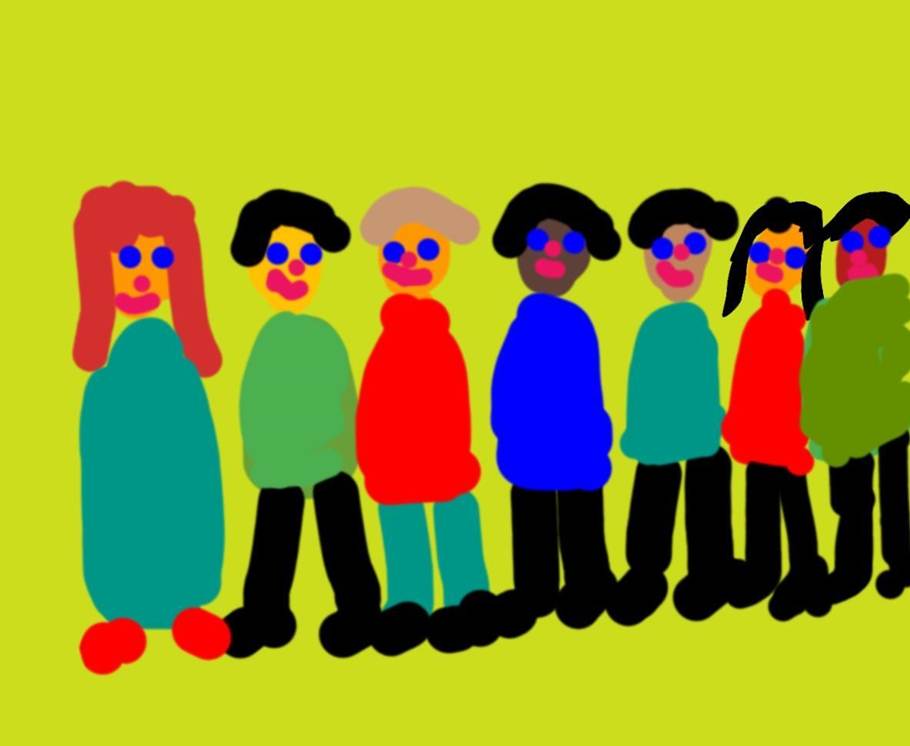
The material-checkers from Institut Pasteur, by Maher and Karla
“No problem, you can have us, comrades Fabienne, Michel, Maher, Karla, René, Maurice, and Assad come in to fail them, which is a foregone conclusion since 99 percent of all village assemblies have already rejected the individual agents against Coflu, Covet, LEP-AL, and MA for having serious side effects, for oftentimes infecting people with the disease they purport to prevent, as well as their nanobot carriers being too hard, and moreover, reusable so they could even be reprogrammed to inflict death. Comrade Fabienne can show that they are not natural, comrades Michel and Assad that they or at least their nanobot carriers are responsible for stomach disorders and cancer, comrades René and Maurice that the omnibus methods risk overloading especially young and old patients up to the point of killing them, and comrades Karla and I that they contain chemical drugs like tranquilisers, amphetamines, steroids, and neurolepts that are supposed to affect patient’s psyche and other bodily functions along with the vaccine agents. Mostly, they are used to making the injected docile followers of the counter-revolution. Hence people have sometimes nicknamed their Coflux brand docility vax.
“And the chemical side-agents may be used to euthanise people,” interjected comrade Égale.
“Exactly,” sighed her friend, Peter Gar or Pierre le Gars as he was known in the French lands.
“Very good, you confront them with all of that, and then, if our bosses don’t yield, which they won’t, you quickly beam out of our workshop with yellow beam so they can’t harm you, while we, the two red cells, transport and lab, call for a workshop assembly to stop production. If they won’t allow the assembly to meet, we go on strike. Then what can they do?” And the red cells continued to enthusiastically and carefully plan their strategy of reconquering their enterprise until the wee hours of the morning.
Chapter 5. Material Check
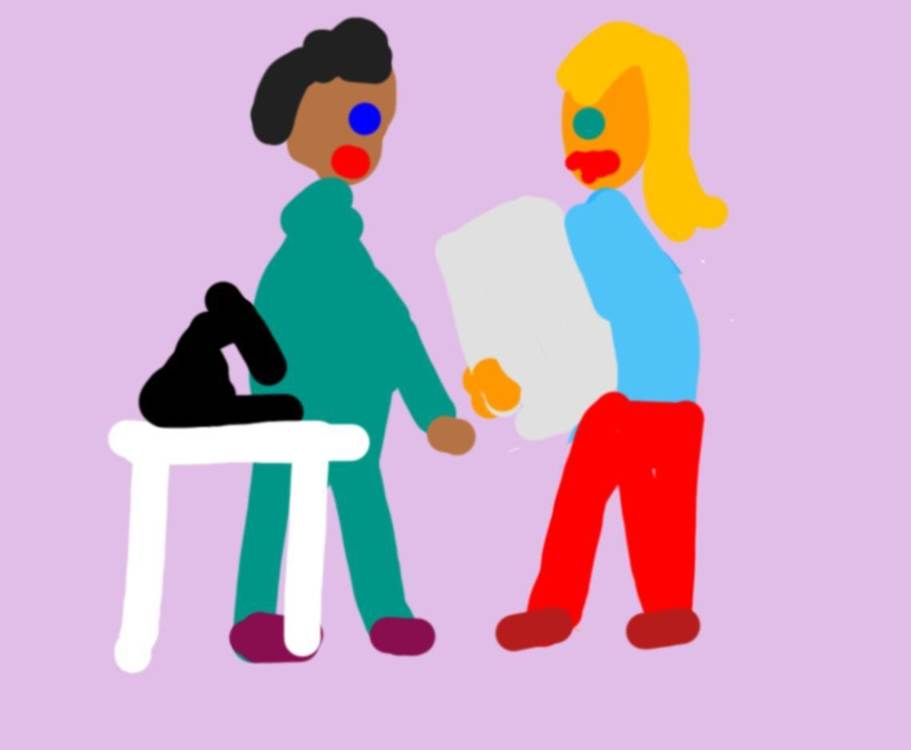
Two types of material checkers, by Emmanuel and Laurence
“Bonjour, here we are, Étienne and Arthur, you know our assistants, Ronald and Stéphane, and our ladies are also biochemists. Adèle and Marianne, please introduce yourselves. And they brought a list of the village assemblies in the région parisienne or Paris region that have already approved the new omnibus vaccine.
“But then about a kilometre from here, we picked up another team that you apparently also invited, what were your names?” “Michel, Fabienne, Maurice, René, Maher, Karla, and Assad, all from either Institut Pasteur or the material checkers at Art et Métiers. The work collective of this workshop asked for our opinion. You are the Red flame biochemical workshop, aren’t you?” asked Michel.
“You see,” said Maher who, just upon one his father’s nice smiles, had received one of the lists of village assemblies from Adèle and Marianne. “There might be a problem these village assemblies have not considered. I see upon recommendation by their policlinics, they have approved the four individual agents against Coflu-20, Covet-20, LEP-AL-20, and MA-20, as well as what the vote by the three policlinics calls the novel idea of an omnibus vaccine…”
“It’s a forgery,” comrade Assad instantly bio-messaged the six comrades. “The names signed do not correspond to any of the staff in these three policlinics. Here I just received the lists of their actual work collectives from the three acting receptionist brigades.” “Great, merci, comrade Assad,” Maher biomessaged back. “In that case, no need to pussy-foot around.”
Aloud he said: “…However, they may have neglected the problem of permeability and reverse contamination.”
“I am impressed,” said Thomas. “A young man able to throw around with big words like this… permeability and reverse infection. Please elucidate us non-experts on what you mean by that.”
“I am a colleague of Maher’s, expert on omnibus vaccines,” said Maurice. “The idea of the omnibus vaccine is that you receive one stage of the vaccine after the other, each being good against one of the diseases you need to get vaccinated against. Yet what if these agents mix before the desired virus or antibody has been created? You can get sick with one or several agents before you are even fully vaccinated against the first one. They need not already mix in the syringe, I know you claim they are pretty good, but building up a defence against a live virus the messenger RNA has told your body to create or against a spike protein that is supposed to bring about production of virus and antibody takes time and strength. Especially young or senior patients might not have either, especially not for four vaccine agents in a row.”
“Have you run all necessary tests?” was Fabienne’s laconic question. “Even under late capitalism already and a fortiori in the revolution, medicines have to be tested in a small sample of a few hundred, then a few thousands, and finally on 5000 patients at least. May we have a look at the report, please?”
“What about the nanobots you use to transport the agent? I assume you use nanobots?” asked comrade Karla. “Some of them proposed by illegal outfits have been found to be too hard on patients’ stomachs, especially those of children.”
“By the way, I have here a study on the problems of permeability and reverse infection our institute has done,” said René. “At least a third of the two-thousand young test persons showed adverse symptoms. Then we stopped designing further omnibus vaccines.”

Echinacea, by Maurice and Lulu
“You may know the revolution is developing a catalogue of natural medicines,” added Fabienne. “Bed rest always helps, drinking a lot of non-alcoholic, non-caffeinated and warm fluids, eating bland foods, breathing in lightly salted water steam, using lightly salted water nasal spray, as well as compresses… And there are special infusions, honey-lemon-ginger tea helps against the cold, multi-herbal infusions and maintaining bed rest – because they may make you wobbly –, help against Covet, oak leaf potion against LEP-AL, and Echinacea against inflammations and MA.”
“You can keep researching, but so far you have not produced a sure cure for anything!”
“Well, neither have you, look at your latest cures against Lymphatic Encephalitic Pulmonary syndrome, asymptomatic leprechaunitis, LEP-AL for short, and Moral Atrophy, MA. The people, and even the animals and plants get sick from them as if you were spreading the disease instead of fighting it. What was the use spraying your so-called medicine, as you did in the French lands, Ireland, and Siberia, tell us? And the Siberian comrades even accuse you to have mixed it with White Phosphor, unless you did that separately, will you tell us?”
At that point, Arnaud, alias Arthur gave a few gorillas who had kept in the background a sign. They threw themselves at the spot where the seven members of the material check brigade had stood just a second ago.
Yet, we, meaning I and the other workers could only see a faint yellow ray with a few little dots on it. Then you were gone, as if by magic. That must have been these yellow transport beams everybody is enthusiastic about. You summon them, tell them where to take you, and at the same time order yourself to disassemble to the molecular state. You will have a crumbly feeling as you disassemble, then nothing for a moment when you are fully disassembled. Yet then your live spirit will already begin picking up as you reassemble before your final destination.”
“We practiced those at school in Phys Ed already,” said Flavel, who was one of the youngest workers. “I can do it.”
“They said on the revolutionary radio, Radio Huma or Lanterne rouge, they would soon have everyone practice them, except pregnant girls, starting in Sixième, sixth class.”
“Yes, but in the meantime, let me tell you what happened next,” said Vincent. “Adèle, a.k.a. Anne, or this time it was Marianne, a.k.a. Marion. Not your comrade Marianne obviously, I met her the other day at the May Day Parade. She is a charming person, very knowledgeable on Latin America, a real working-class Spanish teacher, not her, but Marion Le Pen calling herself Marianne came up with another paper supposedly reporting on tests in the ex-U.S. with several thousand participants, none of whom had shown any serious adverse side effects. I bio-scanned it and immediately bio-messaged it to you. Did you get it?”
“Yes, we immediately forwarded it to our comrades in North America, Malcolm, Jason, Josh, Luis, Martin, Jesse, etc. Let’s call them America’s Deconstruction Hounds, because that is their expertise, but they have friends and comrades who work in policlinics and institute labs, of course. They checked. No record of any such study anywhere in North America, not even in the Canadian lands, where Henri Uber’s outfits have their hub, so that was another forgery. Yet we did not want them to catch you and of course also did not want them to hurt us, so when Thomas and Willy told us, we went to work, set up the first trial production runs for their cursed omnibus vaccine, ten units per hour ‘That’s too few,’ shouted Schal, alias Schneid. ‘We want to sell them all over Europe after all. Make it at least twenty, no one hundred per hour.’ You see, all these fasco, clandestine industrial barons, especially if they have knowledge of Big Pharma and the Covet boom, dream of a repeat of that scamdemic, where they sold millions of dodgy, hence expensive vaccine kits and cheated the people out of trillions…”
“Do we know whether they produce this omnibus vaccine in North America already?” wondered Jérôme.
“Yes,” said comrade Kamala intraline. “And they play down its risks, claiming Coflux which many people have taken even after the revolution was an omnibus vaccine already since it supposedly helps prevent and cure both the ordinary flu as well as Covet. So, quite a few policlinics are buying it. They get a crypto, token, voucher credit for it from the Reaction which they then have to pay back from selling the vaccine to poor patients, who then have to take up a credit as well. It is a real Ponzi scheme that will carry itself as long as some people believe in it.”
“The money from the credulous policlinics and patients will then be used to pay us,” said Hakim. “How shameful being duped like that.”
“Yes,” said Vincent. “But we Red Cells are resisting them. So, once we had set up the machines, for twenty units no more, Hakim and I humbly asked our bosses for a meeting of the workplace assembly.
“What would you need a workplace assembly for, cheeky boys? You should actually be fired for embarrassing us before Édouard Stérilé, Arnaud Arrolle, Anne Dalgo and Co. by inviting these idiots savants from Institut Pasteur. You had no business to do that, did you?”
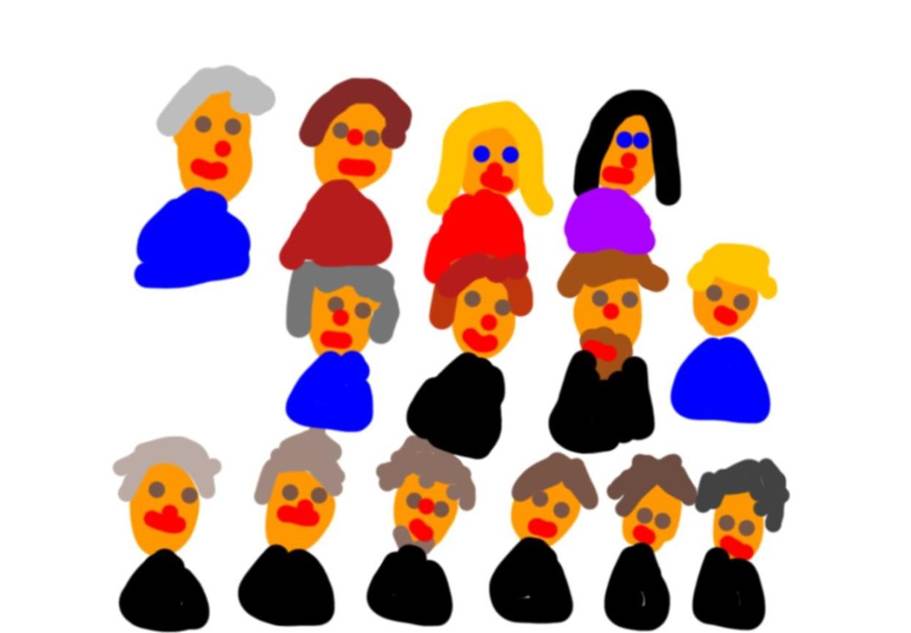
Fasco hierarchy at Red flame omnibus vaccine workshop, Year 20, by Olivier and Danièle
“But none of your associates are scientists, let alone pharmacologists.”
“Ho, ho, young lad,” said Fritz Schneid, a.k.a. Willy. ”But I am a chemical engineer and have produced synthetic fertilisers and pesticides for over twenty years. Ever heard of Garden Crown and Greentex ? And we have done ecological methods when you lads weren’t even born yet. There isn’t just Monsatan.”
“But Monsatan did a lot of damage,” I mumbled.
“And Ronald and Stéphane are physical engineers, they have designed weapons before that silly revolution forced them to become drivers.”
“We know about the importance of material checks,” said Stéphane in a conciliatory tone of voice.
“However, Anne, Marion, Édouard, and Arnaud are just politicians, media channel operators and local agitators to be precise,” I said. “Yet you claimed they were all biochemists. That was a lie.” “Yes, but Reinhard Fischer was one. He even did medical nanobots. He might have designed the whole omnibus vaccine for all we know. He really won’t come back, you don’t think?” Stéphane seemed genuinely sorry.
“No, he wrote a letter, published on Édouard’s channel, Smartbox, where he said Adieu to us, and said he would dedicate his knowledge to the revolution from now on in.”
“Well, anyway, if I hadn’t invited comrade Maher, I know him from school still, we wouldn’t have gotten material-checked at all!”
“Phew, what did they do? Look at the individual vaccines and the syringe, then say, what did they call it? There might be a problem with permeability and reverse infection. Any evil wisher would have said that.”
“Plus, the individual vaccines had also not passed the material check,” said Flavel, not meaning to be cheeky, only for completeness sake, but now Thomas and Willy and their hitmen were all over us. Four of them jumped at Hakim and me, kicking, hitting, and strangling us until we were black and blue from the neck down to the knees.
Then they turned around to Flavel. “Ah, black boy – amateur driver wants to be a biochemist now, heh?” asked Fritz and rubbed himself against Flavel as if wanting to fuck him. Flavel, tall, strong, and dexterous, gave him a slap in the face. Thomas tried to pull his partner back, but he had already tried to seize Flavel’s privates. As he could no longer hit him in the face, because Thomas was pulling him back, Flavel now lifted his leg and tried to kick Fritz’s leg. Yet now, Ronald and Stéphane pulled him from behind and threw him on the floor. He was lying there, writhing in pain holding his genitals. Ismail rushed to help him, but one of the gangster guards who had finished with Hakim and me pushed him back rudely, so he fell as well.
“Had enough of a meet for today?” Thomas asked me. I said yes and between us, we dragged and carried poor Flavel, who was the worst off, to one of the transporters. Ismail drove us to the policlinic. The two red cells formed by the Red flames logistics station drivers and lab workers, were allowed to hold a joint meeting in the cafeteria of the policlinic, with Emmanuel, Laurence, and a few other Illyrians again in attendance.
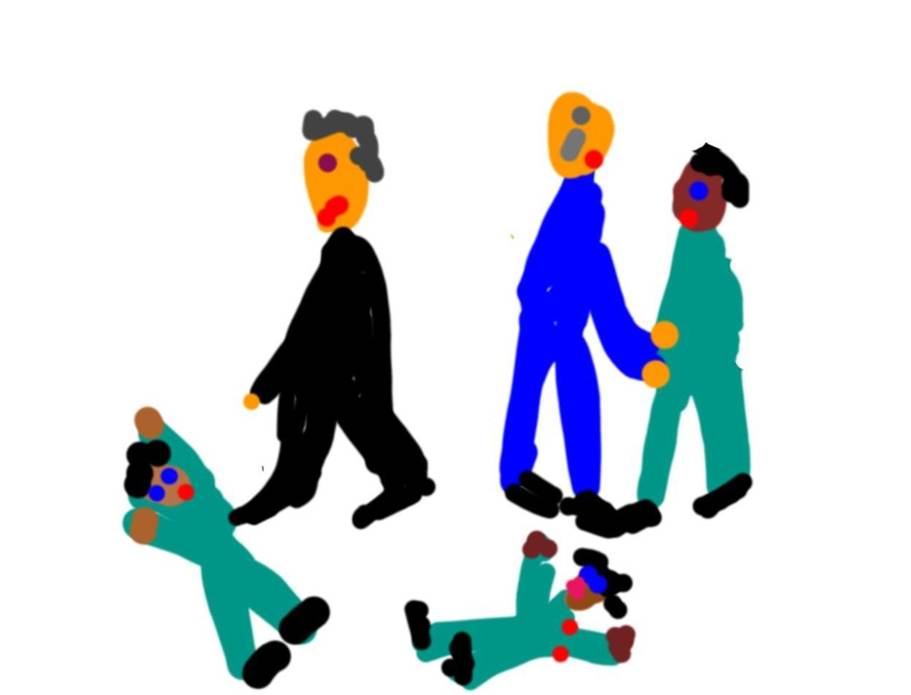
Assault against Hakim, Flavel and Ismail, by Emmanuel and Laurence
“That was assault,” whimpered Ismail who seemed almost as sick as Flavel.
“That was because I am black!” added Flavel.
“He is right,” said comrade Denis. He and comrade Jean had come over from Illyria to make sure we were alright. In their presence, we decided that our would-be, usurper bosses had crossed a threshold with this aggressive and sexually demeaning behaviour, not only vis-à-vis Hakim, me, and Flavel, but against Ismail as well, and sickening verbal abuse as well.
We decided to go on strike. We would not need pickets, only a blockade, since all of us except the would-be bosses, Thomas, Florian, Willy, Ronald, and Stéphane and their most faithful thug subordinates were present at the meeting. We would be at home and wait what would happen. If experience was any guide, they would first try to disparage us on their European Empire, Figaro, Smartbox and other channels, even via the intranet if they got other people, animals, and plants to participate in the mobbing. Then, what was worse, they would send us their cryptoleak avengers. You Illyrians promised to help and each of us fourteen got at least one Illyrian security expert stationed at their house to defend us. You know best yourselves what excellent brigades of fighters you have and what a cosmopolitan team you put together this time as well! Comrades Miguel from Mexico, Venezuela, or Argentina, depending which period of his life you quiz him about, Noah from Mali, Seth from Niger, Ronggang and Michel from China, Aslan, Zelim, and Muhammed from Chechnia, Boris, Rodion, and Saïd from the Russian lands or respectively, Palestine-Lebanon, and Dan, In, Ayak, and Vit, time-travelled Shaolin monks from Cambodia.”
“Don’t forget our harpoids,” said comrade Robespierre .
“Oh, yes, each of the soldiers brought a harpoid with him, sometimes also called haproid robot, maybe depending on whether the robot or the plant element in their nature chorus or bio-wifi set-up was dominant. By the way, they call themselves soldiers, always in a slightly deprecatory tone of voice, but that is to make clear that while we are against violent conflict of all sorts, the fascos at times force us to fight.”
“Not only that,” said Laurence’s papa, comrade Dominique, who as a peace researcher knew more about this issue.
“Almost all of your protectors have been fasco mercenaries at one point, some of them have even served in the pre-revolutionary security forces. And you are right. They refer to themselves as soldiers to remind themselves and all of us of the trauma of war.”
“Were soldiers allowed to have trade unions by the way?” asked Emmanuel, happy about an occasion to harp on about his core subject once more. “No way!” laughed his mother, Aurélie. “Remember the sailors going on strike in Russia in 1917? That was the beginning of the first world revolution, or near-world revolution, I should say.”
Emmanuel blushed but bravely asked another question to clear up his earlier confusion. “And why do you sometimes say harpoids, and sometimes haproids?”
“Both are acronyms derived from android, which is another word for robot, to indicate that they need not necessarily have the classic robot shape,” explained comrade Sylvain, with comrade Robespierre, senior member of the robot brigade. “H stands for humanoid robots, a for animal shape, r for robot, p for plant, and d for dinosaur shape. When they are haproids, they do not yet have all the faculties of speech, including nature language and song that would enable them to fully participate in the nature chorus, nor the vision, hearing, smell, taste, touch, especially manual and limb agility and strength that would enable them to fully substitute for us humans in all our chores. I must say I for one am pretty satisfied with our latest prototype series. That is why I call them harpoids, almost on a par with harpists, for humans, animals, robots, and plants, where the animal category includes our time-travelled friends, the dinosaurs, and the r for robots may also stand for remaining or rest, meaning the remaining or the rest of bio-wifi capable materials besides living beings and robots. These include water, many metals, minerals, rare earths, and also many things humans use which have taken over some of the human spirit and have therefore acquired bio-wifi capability.”
“So, then, how do you think you be able to protect us against the cryptoleak avengers tomorrow?” asked Vincent.
“It is important that we do not do it for all fourteen of you in the same way,” Jérôme explained, “because they will definitely go from house to house, and even if they have several groups, there won’t be fourteen of them, meaning they will be able to communicate among each other after the first missions. Yet they should in no way see a pattern. We can have tricks of course, but we should vary them sufficiently so that they cannot see through our game. The animals or harpoids can always be there for a surprise effect. A second trick can be that someone will always be with you, not only your family, but we can be other friends, neighbours, or just passers-by who come running in alerted by the noise. Never alone, always together!, as the old scout saying goes. A third surprise can be that you won’t always act the same. Of course, they know that Vincent, Ismail, Flavel, and Hakim are not their flaming counter-revolutionaries, and will be so even less in light of yesterday’s events. Yet you others may be more equivocal, to protect yourselves physically obviously, not to fall for their traps.”
“Don’t we have any idea as to who these cryptoleak avengers may be?”
“Not necessarily,” explained young comrade security expert Olivier, taking over from his senior. “Remember, in the most recent surveys, only one individual in 2000 shows any sympathies for the counter-revolution. That means if they want to recruit their henchmen from not too far away, which makes sense, so they can find all the places and know escape routes as well, that will still mean that they are likely to use individuals from all over the région parisienne, from its Southern part only if they are lucky.”
“A few more facts about cryptoleak avengers,” continued comrade Jérôme, “that are worth knowing. They tend to be motorised. Sometimes their vehicles are outright illegal, sometimes disguised as delivery vehicles or taxis. They are always electrical, since the cryptoleak avengers are well-paid, or have access to lots of perks, given that old money, vouchers, crypto, and tokens are definitely no longer the sort of door-openers that they used to be. They tend to wear long wide and floating coats with gold embroidery, to make them look like something in between Ku-Klux-Klan and wise magician, the latter in case you swing around and become docile counter-revolutionary again. You just play it by ear. You may try to debate them a bit, but don’t get reckless. We’ll be there to bail you out as soon as a bad thing seems bad enough.”
“What if they try to drag us back to work?” another worker asked. “You let us know via bio-message whether you want us to stop the rigmarole immediately or go back there to organise the return of your workshop to self-management. What do you want to become, by the way, a self-managed logistics enterprise, a medicine producer, or something completely different?”
“I think those of us who want to drive would do well just going back to Logistique Yvelines, don’t you think, comrades? It is a very nice site, strategically located between Versailles and Chartres and in the woods, with only field roads all around, not even the parking lot is tarmacked anymore and yet they clean their vehicles squeaky clean with water from the river or from their well. Rotation works perfectly, no one is brigadier more than a day in a row, and the position of accountant brigadier also rotates between all the drivers in a brigade, or rather everybody does their own accounting, he or she only checks what they are jotting down, time spent driving, passengers and loads taken on, battery charges and other vehicle services taken, etc. All strategic decisions get taken in the full enterprise assembly and by consensus only, and the moderator role also changes once an hour.”
“We are fifty people,” explained comrade Annie. “We have moderator teams of five… Our workplace meetings typically last two days, five hours a day. That means every driver or organiser, I am only an organiser, gets to moderate for one hour at least.”
“What, comrade Annie, you don’t drive? I thought somebody with such flaming red hair would be behind the wheel 24/7!” said Flavel.
“Merci, young comrade,” Annie smiled. “But you forget that I am a grandma pensioner already, 65, sometimes I even have young comrade, baby Fabien next to me in his pram, when the crêche is not working and his mamon, comrade Rosa, is busy. Anyway, we need somebody to (wo)man the phone, or nowadays to record all the bio-calls. I invite you all to train with us for a while even if you can’t stay with us. Comrade Ismail has done it. He can tell you what a nice collective we are!”
There were loud shouts of ‘Oui, on s’en doutait’ from the seven comrades in the red driver cell as well as a few ‘If you’ll have us’, clearly addressed to their colleagues at Logistique Yvelines. “Yes, of course,” said senior comrade Fabien intraline from the garden colony, full-time driver at Logistique Yvelines. “We are actually missing three drivers in our contingent at the moment. If all seven of you wanted to join, however, we’d need permission from the surrounding village assemblies, for ecological reasons. Even our fully electrical vehicles cause a little bit of damage. Not for lack of work! We are having our hands full, because many farms in the area, just like Illyria, choose not even to have their own transporter and rely on us to get their food to the market and their tools and inputs from the train. But look, no reason to look sad, there are other self-managed logistics enterprises in the area who’d love to have you. We’ll help you hook up. By the way, anyone of you who does not want to be a driver anymore?” Flavel raised his bruised hands, “I don’t have the guts to drive any of these fascists around anymore. It can even happen by mistake. I’d want to hierarchy check them immediately.”
Emmanuel laughed. “You are right. Otherwise, some of you might want to become taxi drivers as well. Nothing demeaning in that. They are also free in the revolution. The drivers get their goods through the economic circuit, and these days they are mainly for old or sick people, or women with children and too much to carry. In other words, you would normally not expect a fasco to get in.
“Anyway, what about the eight others, including Flavel. If you really decide to quit driving, any ideas of what your two-brigade workshop might become?”
“Yes,” said one of them. “My name is Quentin, but I am not a fasco.” There had been a legendary fasco activist and martyr by that name before the revolution. “It could become a recycling workshop for vehicles maybe, electro-vehicles and bikes, but if I may propose something, mainly computers, robots, even nanobots. That way our microscopes and other lab equipment may still be of use. People tend to keep so much electronic junk at home that they don’t know what to do with – pre-revolutionary internet devices, revolutionary ones featuring the One World operating system, Aurora browser, Chinese Wall security suite, and the revolutionary apps, then the very first intranet devices that we have already phased out. I worked as a recycling worker for a while, and people kept telling me ‘We could open an internet and intranet museum at our place, but so could our neighbours’, and I always had to tell them, ‘Just wait, you are straining at the leash. The proper recycling workshops for this kind of stuff are far away, and there is a waiting list.’ Don’t you think it would be worth having one close by?” The other seven, including Flavel, clapped.
“We could call ourselves March of the Computers, you know like march of the trees, and have a poster and even a little comic strip where all these devices disassemble-reassemble at our place.” Now everybody was ecstatic. “That is a very good idea. And do you have a sufficient number of experts among you?” asked Sylvain. “This is not to make you antsy, on the contrary, there is the robot workshop at Illyria close by. We shall help you, and there is Oranges révolutionnaires which is an intranet phone shop which is converting to plushbots now, you know the small versions of the full-sized and grow-up-with-you haproids, just to do homework and other sedentary tasks? The good thing about them is that because the intranet develops so much less heat than old-fashioned electrical charge and the internet, we’ll be able to make them of lighter material, even soft plush and other fluffy material, be it natural fibre of course. Yet due to their environment-friendliness, they may last longer than their metal-plastic antecedents. And the grow-up-with-you harpoids that can expand even longer of course.”
Three of the red cell members aside from Quentin turned out to be trained computer experts – a boom training course in the revolution, for obvious reasons –, who had just joined the fasco workshop to learn some more. One was even a studied robotics engineer. Two were electricians, which was close enough, and Flavel would be the expert on vehicles. They contacted the revolutionary oranges of Oranges révolutionnaires and convened a first workplace assembly for the earliest possible time once the fascos had been thrown out. Everybody was now only hoping that the visits by the cryptoleak avengers would put everything to a head and things would progress from there on back into the rosy revolutionary future.
Chapter 6. Visit by the cryptoleak avengers
Visit by the Cryptoleak Avengers 1, by Bashir and Sevim
“I am afraid they are forewarned. Look through the window!” Stéphane Kocho was bored. Of course, the revolutionaries would have known that they were coming. Four groups à four persons with Thomas, Fritz, a.k.a. Willy, and Ronald each in charge of one group, while Florian with two security goons was guarding the Red flames logistics station and workshop, and Arnaud, Édouard, Anne, and Marion were staying somewhere safe in Versailles or thereabouts, was it Marne la Coquette ?, monitoring their progress via bio-video. It had been difficult already recruiting the twelve subordinate mercs. Of the six thugs who had served them at the logistics station, three had gone home and even demanded and received a pay-off for not squealing on them. Thomas and Willy had begged the other three to bring them some friends and relatives willing to be trained in as cryptoleak avengers, and Édouard, Arnaud, and Florian had contacted a few more in other regions.
Since all of them were relatively new to the task or at least serving on new territory far from home, they had to give them a pep-talk and even some initial training on what to say, wearing and moving in the cryptoleak avengers costumes, and how to react when encountering unexpected resistance.
In fact, the initial pep-talk, from Édouard speaking via Smartbox had gone something like that. Hopefully, it had not been intercepted by the revolutionaries, since it gave away quite a lot about counter-revolutionary strategy, past and future! “I don’t know whether all of you are even familiar with the history of our glorious ‘Cause’. It started with a group of ex-politicians, bureaucrats, security experts – military and police –and businessmen around the Limarna think-tank, where Limarna stands for Liberté – Marché – Nation, three values and in fact mainstays of our civilisation that the revolution has frivolously forsaken. After the revolution, the founders of Limarna and their successors have not stopped working for their restitution. The names and the methods of our struggle may not be the same, but we keep carrying the flame. We now call ourselves the Pericles group after the wise Athenian leader, and under this name have been able to establish good relations with the North American, Italian, and Baltic Uber groups, with Henri Uber, Fernando Deliverando, Louis Deshalles, and Viesturs Volt and the bankers Tino Cryptolla, Robert Capito and Mort Buckley on the one hand…”
“I hope you don’t want us to deliver things by bike like the old Uberytes,” said one of the newcomer mercs. “Because the little money in it wasn’t worth all the stress even before the revolution.”
“Oh, no,” Stéphane interjected. “You will be independent security agents, something like enforcers or debt collectors in the ancien régime. Your job will be much more hands-on.”
“Yes,” continued Édouard. “And on the other hand, we are in contact with the much more ambitious people you have just heard from, people around big industrial barons such as Pappberger in the German lands, Ricky Handsome in England, Mick Mc Leary in Ireland and what is left of the management of Dassault, Thales, for example, here in the French lands.
“Anyway, we have considered the return to a bike delivery scheme, especially to circumvent the village assemblies’ prohibition on all vehicles except functional ones and transporting for free as part of their revolutionary circuit. We believe that our associates, and you are our associates, should have more of an incentive.”
“You want to give us crypto, token, old money, stuff like that,” sighed another prospective cryptoleak avenger. “Yet where to spend them? Nobody wants to take them anymore. Getting things, even houses and flats, directly from a producing workshop or builder, on the market, or in a share point, which can be virtual, like a housing exchange, is much faster, safer, and ensures better quality.”
“That is because rats have betrayed our deals,” shouted Fritz. “And that’s why we call this battalion of the Cause the cryptoleak avengers, to punish those who have ratted out people who would have otherwise stood to gain from the vibrancy of private initiative.”
“D’accord, how much are you willing to pay?”
Willy, who had the best relations to the bankers, transmitted each of them a sum in crypto-francs via intranet bio-wifi and encrypted with bio-thicket.
“D’accord, that sounds reasonable,” said another of the newcomers. “I only wonder, was it wise to send this via biomessage. Any squirrel on a tree or bird in a bush can pass this information on to the revolutionaries.”
“In that case, we have here for each of you a new village ID with a new name you can use to run and establish a new life elsewhere. The deniability of information passed via the nature chorus is extremely high, trust me! You are familiar with travel via golden, nowadays brown beam?”
“It is like their revolutionary yellow beam, isn’t it? You summon the beam to go somewhere and when it comes you’ll disintegrate into molecular state so as to get fast and unseen to wherever you want to go. And as you land in your final destination, you’ll be reintegrating already.”
“I have used brown beam,” said another recruit. “It is better than golden beam that we cryptoleak avengers used to go on, because they can’t see you and once it’s going they can’t see the beam either. And it does not require any booster grenades. In fact, it is almost as good as their yellow beam, very energy-efficient, except that you get a bit angry as you disintegrate. Well, I am understating, you get super-hot as if you were about to explode. But that is a passing phenomenon. By the time you reintegrate, you won’t feel it anymore.“
“Quite accurate,” nodded Édouard. “Now, those of you Arnaud, Anne, Marion, and I brought in already know about the dresses of the cryptoleak avengers. Can one of you explain it to the others?”
“Yes, it is a long white cloak with gold embroidery to symbolise the value we carry and that the traitor may have criminally betrayed. Like the transport beams, they are a bit magical, in that they seem benign and benevolent to the innocent and dangerous and violent to those who may have switched, voluntarily or under duress, to the side of the revolution. Depending on their reaction, we know what to do, drag them back to task, punish them for their treacheries and if they are really bad traitors, kill them…”
Visit by the cryptoleak avengers 2, by Zamir and Odile
Back to Stephen Kocho, alias Stéphane. “They even have a dinosaur sitting at the table, a Rhabdodon from what I remember from the revolutionary channels. They gave a presentation of all the time-travelled dinosaurs. Did you watch it by any chance? It was very interesting.”
“Focus on your god damn work, will you?” Édouard shouted, who clearly had to consider this praise of the revolutionary channels a disparagement of his European Empire and Smartbox ventures. What was he supposed to have done? Praise the revolutionaries for reinventing time travel and talking to the dinosaurs and animals?
They walked in, where their former worker-slave Akhmed was sitting at the kitchen table with a friend, an Asian, Chinese or Indochinese, Vietnamese maybe or Laotian, together with the dinosaur, by the looks of it a Rhabdodon. “We did not expect you so early,” Akhmed prattled on, who thought it was best if the other comrades had some more time to prepare, at least for this group of cryptoleak avengers. “We have not got all day!” snarled Fritz, a.k.a. Willy. “What were you thinking, simply not showing up for work this morning?”
“We think that your omnibus virus transmitter plus tranquiliser won’t get approved by any village assembly worldwide,” said Dan. “I am from Cambodia, and in my region, they have already rejected any kind of omnibus vaccine ten or more years ago,” he could not give the precise date, because like the Rhabdodon, he had come only recently via time travel from the Middle Ages, the era when the Shaolin monastery flowered and taught everybody in the Chinese lands and surrounding regions, including Indochina, the art of kungfu and non-violent martial arts, “and in this case, the prohibition would hold up all the more firmly since we have found all the so-called vaccines you put into the syringe, Coflux-20, Covet-20, LEP-AL-20, and MA-20 toxic in prior individual material checks.”
“You might as well scrap the production line we set up yesterday,” Akhmed said soothingly to Fritz as if talking to a madman. “I myself have worked for a few months in a policlinic already. I am a medical student, that’s why Thomas and his guys recruited me originally, and I know that no self-managing policlinic would admit your vaccine. Imagine, all the doctors, the nurses or carers, and the support staff would have to approve of your vaccine, although they all have good medical knowledge and the ambition to contribute to the natural medicine we revolutionaries are developing. Moreover, they would have to agree to buying it against crypto, tokens, or vouchers, where they could get it for free at the local pharmacy or order it from the producing workshop. And if they bought it from you they would probably have to incur a debt to finance it. They would have to try to administer it to the patients against payment, where they are already used to receiving all treatments for free. In fact, medicine, like public transport, education, and other public services was one of the first goods to become free or at least acquirable by voucher only, no insurance payment or any other money involved. So, why should people suffer setbacks to this revolutionary entitlement of theirs?”
“I think,” said Rhabdon and Fritz, alias Willy and his companions were amazed that they could understand the rhabdodon although it was talking ice-age nature language or nature speak at least, as if they were revolutionaries already, “it had to do with this MA, for Moral Atrophy virus that you have developed, and that gives humans the flu and makes them cynical, and they don’t want it. They also know about the consequences it has on animals and plants. Small animals may just keel over and writhe in agony, while bigger ones like dogs, cows, and even small dinos may still develop twitching and depression. Plant leaves may wilt more quickly, and in some cases the whole plant may die. And the effects are even worse if you apply MA together with White Phosphor because that can give humans and animals necrosis, kidney, and liver problems, and can stifle even strong trees so they can no longer participate in the march of the trees for restoring the forest.”
“Don’t tell us that is your intention?” asked Dan, but Willy had got back his bravado by now. He motioned his three helpers to seize Akhmed, then the five of them disassembled – the fascists call it disintegrate – within split seconds before comrades Dan and Rhabdon could even get over the pleasure of having made a good point. It did not matter. The enemy had fled and taken one hostage. So, they immediately disassembled as well, then swung themselves on a yellow beam and bolted after the felons. In fact, they were already reassembled at the entrance of the logistics station setting up their blockade when Fritz and the rank-and-file cryptoleak avengers were just disassembling inside to go out again, having just deposited Akhmed at the station.
The outcome of the cryptoleak avengers action was even more favourable to the revolution in most other cases. The fascos had already bruised poor Ismail and manhandled poor Hakim quite roughly as well. Because of the delay Fritz Schneid and his minions had accumulated because of our comrades’ speeches, comrade Ismail did not only have comrade Vit and Struthio, the Struthiosaurus there to scare them, but as soon as Willy had cornered him with the words, “You are already sitting up and seem to feel better. Why did you not show up for work?”, and Ismail had reproachfully shown him his bruises, the doctor, Ismail’s family doctor whom Ismail’s girlfriend had summoned from the local policlinic, had rung the bell, then knocked. The four fascos, obviously afraid that Ismail would tell the good doctor what had happened to him and that they had done it, dropped all pretence and jumped through a window and over the fence. By the time Ismail and his comrade helpers had requested a spontaneous militia brigade, and it had received the minimal quorum of twenty percent of all villagers, Fritz, alias Willy and his fellow gangsters had already arrived at their next stop, comrade Hakim’s house, where Hakim welcomed them in bed, with comrade Muhammed sitting by his bedside playing the concerned friend. “Pack yourself, imam!” one of the cryptoleak avengers scoffed, but just as Muhammed got up, outraged at the religious and racial slur, Hakim’s little daughter came in to say good-bye before school and started to cry. “Oh, papa, papa, why is your face all red and blue and your arms as well?” Fritz and his three helpers, no longer up to chit-chat, tried to pull Hakim out of bed and get him to come with them. Yet, when they summoned the beam it wouldn’t come, instead, Muhammed almost stunned them with a revolutionary red beam, before they managed to floor him with their reactionary brown beams. Comrade Hakim’s little daughter ran out screaming and it was a matter of minutes until the spontaneous militia brigade she and her mother would surely summon, got its quorum, and would turn up to arrest them. In their haste to get out, they did not bother to drag along Hakim. In fact, they were almost brought to a fall by the cheeky chicken band in the yard who did not mind the pain of placing themselves exactly in their way in order to make them stumble. Cursing, the fascos kicked them aside and had to take another beam to avoid militia and to arrive quickly at their next and last assignment, where comrade Saleh was receiving help from comrade Boris, as well as Obeli, the Obelignathus.
“Comrade Saleh is not feeling so well,” Boris informed them, imitating the capitalist lackey style he had learnt during his work at capitalist forums, “too many sugary processed foods he took at your logistics organisation to keep up the crazy pace of work. He told me you don’t even practice rotation and refuse to hold assembly meetings. Is that true?”
“Look, comrade Saleh is coming with us, he is a good chemical worker,” said Willy, a.k.a. Fritz. Two of his three companions had already seized Saleh, who was resisting, by the arms and were dragging him along, when Obeli stopped them at the door, blocking their exit. Obelignathuses are not predators, they are harmless vegans, but even as young as comrade Obeli was, he was quite big and hard to push aside. So, again, our four fasco would-be abductors had to let go of comrade Saleh and leave the premises through a window and on a brown beam. Their mission had ended in a disaster. Apart from comrade Akhmed, they had recovered none of the striking workers.
Comrade Thomas and his team had promised to take on the next four, but when Willy and his band arrived for the second time at the logistics station, they were already expecting them. They still had Akhmed, yet Vit and Struthio, Boris and Obeli, comrade Muhammed and Saleh and even the chicken had joined the blockade outside. And they had recovered none of the strikers, the reason being that Thomas and his crew had arrived late, and the revolutionary guards had been much better prepared.
Comrades Nasar and In had already brought themselves into position when the four of them entered. And next to them stood a big and scary baby Loricatosaurus, again not a predator, but looking more dangerous than Rhabdodon with fangs and jaggy skin. They had to beat a quick retreat.
With comrades Hasan, Zelim, and Compso, the Compsognathus, they had more of a discussion. Hasan was one of the drivers. He was not interested in producing pharmaceutical medicine. “You would be crazy if you were!” said Compso. Then Zelim asked Thomas and the cryptoleak avengers whether they would not rather defect and rehabilitate. Thomas tried to stun him, but Zelim avoided the beam, and the other three cryptoleak avengers looked more agnostic already. Yet, for the time being, they fled again.
Comrade Karwa had comrade Rodion and a horse as helpers. Before the fascists could really grab them, they had got away on their horse.
The fascos had already hurt Vincent, but Saïd and he were agile and also had a small, but dangerous Poekilo Pleuron dinosaur to help them. While comrades Vincent and Saïd got on a beam to join the blockade, the Poekilo Pleuron bit all four fascos in the legs so bad that they shouted from pain. Then the Poekilo Pleuron disassembled as well and got on the yellow beam to join the blockade.
Bruno and Ayak were able to flee to the forest and hide from the fascos using the help of a deer. The three of them later arrived on foot at the logistics station.
So did Marcus and Miguel, who were able to leave the fascos behind, because comrade Fox bit them in their legs.
On the other hand, comrades Pierre, Flavel and Joseph had to go with the fascos. Pierre because he and Aslan were afraid that they would harm his cow. Yet Aslan immediately joined the blockade and all those present vowed to get the kidnapped out of the station fast.
Flavel had his sheep to worry about and went along pretending to be quite weak and meek still from yesterday’s ordeal. As a matter of fact, he was bio-messaging constantly with comrade Noah which gave the revolutionaries a good idea of the situation inside the logistics station.
Comrade Joseph grumbled more than Flavel and his goats tried to push the reactionaries so they would leave him alone, but they were not as strong as dinos, obviously. In fact, the reactionaries threatened to use shotguns on them, so they ran. Yet they joined the blockade like the other animals and plants as well. The plants established themselves as bio-thicket around the fasco logistics station protecting revolutionary communications and delaying the fasco ones.
Finally, comrades Minh and Ronggang were able to floor four fascos with martial arts tricks and take them prisoners. They took them to the blockade in a Logistique Yvelines transporter where they admitted to having felt grave misgivings about the Cause for some time already.
Chapter 7. Hierarchy Check
Getting out of hierarchy with red cells, by Emmanuel and Laurence
“We might start with a workers’ assembly,” one of the hesitating cryptoleak avengers meanwhile proposed to the fasco barons, Thomas, Willy, Édouard and the others inside the station. “At least we have to introduce ourselves to each other. Four of us are already on the other side. Fortunately, we’ve got four of the old workers back, Akhmed, Pierre, Flavel, and Joseph. And then we have you, messieurs Florian, Thomas, Willy, Édouard, or Étienne, whatever your name is, Arnaud or Arthur, Anne or Adèle, and Marion or Marianne. That’s seventeen and should be enough for one driver and one lab worker brigade with two substitutes each if you barons are willing to chip in a little bit.”
“Objection,” said Étienne good-naturedly. “But the four of us barons, if you wish, may have to leave soon because there are regional meetings of ÉdF and SFCF coming up where our presence is required.”
“I thought they were organised by the transformer or toggle stations in case of ÉdF, or the train or switching stations, whatever you call them, in the case of SFCF?” asked Fritz, visibly scared to be left alone with the rebellious workers.
“We might not have time for introductions, let alone democratic niceties like rotation,” Arnaud ignored him. “The revs must have followed us here, even the dinosaurs and the farm as well as some wild animals, and they have surrounded the whole place with their pickets. They have even stopped one driver already. He must have come from another logistics station. I wonder what he was supposed to deliver to us.”
“We are not going to have a separate driver brigade for the time being,” Thomas stopped him. “We must fulfill our obligations towards the Uberyte policlinics that have ordered the vaccine. For the time being, you shall all be lab workers.”
“Not with me!” “Leave me out!” “I came here to drive and not to fill syringes or watch robots do it!” “We are cryptoleak avengers, not drivers or lab attendants.” “Wasn’t there the good idea to reconstitute as a self-managed computer and robot recycling workshop?” That was Flavel asking.
“Well, if you want to that, it’s rebellion!” shouted Thomas.
“Let me tell you something for free,” comrade Pierre yelled back. “From Day 1 you have acted as little dictators here. The two of you have been brigadiers the whole time, you have also done all the M&A which has provided you with additional powers. This is only the second workers’ assembly we have held in the several months of our existence.”
“You have supposedly striven to hire qualified chemical workers or lab workers, including comrade Vincent and me,” said Akhmed. “But you have chosen to consistently ignore our advice. We have begged you to clean the lab first, only yesterday did you condescend to allowing that. We have urged a material check, but then you brought in bogus experts,” and he gesticulated in the direction of Édouard, Arnaud, Anne, and Marion, “and ignored the good ones Vincent and Ismail had invited. In fact, you beat up comrades Vincent and Hakim, as well as comrades Flavel and Ismail, that is violent behaviour on the shop floor that we cannot tolerate.”
“And then you requested cryptoleak avengers,” said one of them. “Yet it has turned out the workers did not leak any crypto deals. In fact, there weren’t any. You, Thomas and Willy had not paid you, you, the workers said. In fact, we cryptoleak avengers have not seen any money either. For that reason alone, Thomas and Willy should be sacked. Don’t you agree?” All ten workers lifted or waved their hands in consensus.
“Now we might as well open the door to the comrades blockading us,” said Joseph, and while they all agreed and just wanted to decide on someone to do it, Thomas and Willy as well as two of the cryptoleak avengers, who maybe felt they had too much on their conscience to let the revolutionaries question them, had summoned brown beams, disintegrated and were gone.
“Just a minute,” said Arnaud. “ I am myself a community organiser. I know how terrible it feels if principles of democracy and social justice are violated. And this can happen even in the revolution.” And he pulled a sad face to make the workers believe that he was feeling with them. “Why don’t you allow Étienne and me six minutes with each of you in private, and we should also invite in the four the revolutionaries have arrested, just six minutes for each of you to find out whether we cannot come to an agreement that will make it conceivable for you to stay with the Cause.”
“In other words, you want to offer us crypto, token, vouchers, one of your crazy money substitutes,” said Flavel. “I for one am not asking for any, I am leaving.” And when he, Akhmed, Joseph, and Pierre left as a kind of united red cell, none of the four cryptoleak avengers who remained made any attempt at holding them back.
When they asked at the strike headquarters that had been established in a large tent under an oak tree, because it had started to rain, none of the cryptoleak avengers already apprehended had any desire to go back to the barons. In fact, they were willing to continue testifying against them.
The red cells constituted as spontaneous militia left the barons half an hour to talk to the four recalcitrants. Then they entered the building. When they came in, Emmanuel, Laurence and a few other Illyrians and Casa Latina Russki Dom Peace Dove young revolutionaries were with them as observers, all four ex-cryptoleak avengers were still there, ready to switch sides, as they said. “These barons were disgusting!” one of them said. “When I became a cryptoleak avenger a few years ago, I thought I was doing it for the benefit of liberty, and that included money, we thought back then, free markets, and democracy. Yet now we know we were wrong. In fact, we were misled by the ex-capitalists and other counter-revolutionaries.
“Freedom to choose, well-stacked markets, and direct democracy in the assemblies are all points on the side of the revolution.”
“I am glad you realise that,” said Emmanuel. “What is your name?” “Mathieu!” “That’s formidable, comrade Mathieu, we have a neighbour at number 76 rue de Lorraine who is also a good revolutionary like you, although he worked with a branch Rothschild banker family as a gardener of their estate, no less, and was probably offered tons of underground money to stay loyal to them. If you want to you can accompany us to our next debate with the fascos at ÉdF and SCFC and tell the workers about your experience. That may prevent them from falling for their traps. Would you and any of your comrades like that?” All of them without exception declared themselves ready to testify against their former masters.
March of the Computers, by Olivier and Danièle
Meanwhile, at ÉdF and SFCF, the fascists were trying to recruit people for their brown cells. “First, they feel you out over a glass of beer or wine, or a cup of coffee or tea if you tell them you don’t like alcohol,” explained comrade Claire. “They are looking for conservative women, you know, who are afraid of strangers, refugees, migrants, and other foreigners especially, and who are too shy to speak up at brigade meetings if something is bothering them. ‘Join our brown cells, we will protect you!’ So, I did, comrade Dénise, Janis’ girlfriend did so as well. We are both information agents, we sit behind what used to be the ticket counter, from the time when you still had to pay to use the train, and inform people about tracks, delays, connections, and so on. The first thing we noticed was that we had to support a fasco as permanent brigadier.”
“But how can that be? Doesn’t the position of brigadier always rotate?”
“It does, but you can get around it. Before I joined an Uberyte logistics station, I worked for ÉdF. At my station we were three people,” said Bruno. “Two, including me, were always ill when their turn came, so that the third, a committed fasco could always be brigadier. He told me the three demands of right-wingers, or brown cell members. You have to love crypto, and other stuff like that, you have to hate foreigners, and you have to be for the centralisation of ÉdF and SFCF, in other words, regional meetings, permanent authorities, meaning bosses also at that level. And this would, our fasco agitators hoped, lead us back to a situation where there would be a state and the government would decide what happens to the utilities. Should they be expanded, or cut back, or maybe privatised?
“Then when I joined the logistics station, it became even clearer to me why they needed both brown cells and centralisation. Let’s say, we wanted to take electricity from the grid because we couldn’t be bothered setting up a block energy works. Some guy either close or far away would help us, but to get help we needed both types. Same when we wanted to transport stuff by train against crypto and without attracting attention to ourselves. Our friendly helper could be local or central, but we needed both types, otherwise our shipment would get stopped somewhere in case of getting through.”
“There is no need for them to play ill,” comrade Dénise commented. “The boss simply pretends to have an affair with you and maybe your friends as well. He does not have to be the official brigadier, as long as he calls the shots.”
“I have heard of cases where they were banging guys,” said Claire. “All they want is to make sure they will vote with them in the brigade and at the workplace assembly. ‘The rule is,’ one of them told me, at least half the brigade plus one have to be brownies, so in a brigade six or seven members strong, four members of have to be fascos or vote with them.”
“It is even better if they take crypto. Then the fascos can simply call them up even if they are in another brigade, and say, we have a project going at this or that site, can you reattach us to the grid? Or, I have an urgent shipment coming up, can you make sure it gets transferred to the right train?”
“Yet, but we noted when at the Red flames logistics station and biochemical workshop, there was a real issue, for instance, cleaning the lab, or producing these vaccines without proper material checks,” said Emmanuel, “the workers voted with the revolution, and in fact, they joined our red cells rather than sticking with their brown cells if they even had been members of one.”
“No doubt of that, at the logistics stations, and also at the Uberyte fitness studios, night-clubs, and policlinics, they flock back to the revolution at the first sign of somebody blowing the whistle. It need not be they themselves or their closest friend to get abused by the bosses for them to say, ‘That is what I have been saying all along. These bossy types are no good. Comrades, let’s blockade the place, so we or our girlfriends no longer have to go there,’” said Janis. “For instance, I thought of myself as a law-and-order type until the boss raped my fiancé.”
“But at SFCF, the situation is a bit different than at the Uberyte places,” said Claire. “The train stations and even the switching stations enjoy a lot of independence, and it is hard for somebody or a group to just come and take them over. Yet they can use tricks, like those we mentioned before, illness or pretend-affairs, and they may send a rep to a regional or hexagon-wide meeting even if only four members of the local brigade are in full agreement with that. And if it is about a clandestine outfit loading some stuff on a train, that need not even be a matter of discussion in the train station brigade, in the train brigade on the train itself, or at the switching station. That type of corrosive activity, also throwing out or at least harassing or ignoring foreign workers can go on without all brigade members agreeing or even knowing about it.”
“Same at the ÉdF toggle stations,” nodded Bruno. “They can be a sort of no-man’s land, where self-management no longer applies, but the workers have not blown the whistle on the brownies yet.”
“And if we don’t stop them, the brown cells may proliferate like a cancer,” said Emmanuel. “Four brownies in every brigade at ÉdF transformer stations and SFCF station, train, and switching brigades. That would be a nightmare. So, what should we do? I propose we remind ourselves of the methods of the revolution. We have had the first of May rallies. Now we can try slow work and other strike forms, as well as boycotts and blockades.”
“As long as we don’t stop the trains and the emergency grid entirely!” warned senior comrade Pierre. “We won’t,” said Emmanuel. “The red cells can take over before that happens! Sleep well!”
Chapter 8. Boycotts and Blockades, Revolution in Year 20
Boycotting and Blockading ÉdF, by Che and Georgette
“Significantly enough, they have scheduled their ÉdF and their SFCF meeting on the same day, maybe so Édouard and Arnaud could attend both of them.”
“Which would mean their sponsors, probably in the ex-U.S., are hard strapped not only for workers and mercs but even for leaders or barons as their followers call them.”
“How then were they able to set up these meetings?”
“On the basis of the brown cells, and some people let themselves be dragged along although they did not quite see what the centralisation would be good for.”
“’Well, that is obvious, it would be good for efficiency,’ they would tell us,” comrade Bruno responded via intranet. “Listen and watch, I am recording a bio-video now. That will give you an idea of how they tick.” You could see Édouard Stérilé and Arnaud Arrolle sit in the first row, ready to get on the podium, together with three other people whom they did not know. Meanwhile the fellow on the podium introduced himself, ‘I am Valéry Lacron, and I shall be the moderator for this hour.’
“Notice they don’t bother pulling lots or allowing hierarchy checks for these moderators. Even electing them like they did in pseudo-democratic gatherings before the revolution would make more sense. That gives you an idea of what you would be getting under the capitalist restauration, just getting talked down to from above.”
Meanwhile Lacron had already started preaching from on high. “Comrade Étienne Fécondet is now going to explain why he and comrade Arthur have proposed these assemblies, not to undermine self-management and democracy but to make them even better.”
“Étienne Fécondet and Arthur Avanti, weren’t those the two class enemies that did not object to three workers being humiliated and beaten up by German fascos just for having urged rotation of brigadiers, material checks, and cleaning work facilities?” a voice shouted from the very last row.
The unelected moderators pretended not to have heard him. “Comrade Étienne, you have the word!”
“There are many reasons we propose to hold these regional assemblies. First and foremost is the fact that electricity, water, the railroads and a few other networks like this are what you’d call in economics, natural monopolies, linked with considerable economies of scale. It does not make sense to break them down to single toggle stations. What if there is a natural disaster?” “But we are not doing that. The transformer stations can all communicate via intranet!” another voice shouted from in back.
“That works especially well in case of a natural disaster,” a woodpecker sounded from outside. “Because we animal and plant harpists will be just as concerned if not more so than you humans. We’ll drum the alarm, don’t worry.” “And we’ll sing it,” a red robin seconded him. “No, need for all of you to travel and sit in a boring meeting.”
“Yet somebody needs to be responsible for the countermeasures we take to maintain the grid!”
“Yes, the workers’ brigades at the basis and their local assemblies.”
“D’accord!” said Arnaud, alias Arthur. “As some of you may know, dear ÉdF colleagues, I have been a community organiser before I became a trade unionist. Let me ask you, where do you think local ends and regional begins?”
“A local assembly of toggle stations consists of the work collectives of seven basic transformer stations maximum, fifty workers. That maximum size for a workers’ assembly has been ascertained as the best, so as to guarantee all the workers a say and make sure everybody gets to be a moderator for at least an hour during a one-day meeting. My name is Patrice. We have meetings like that in the Congo as well to organise the security of the block energy works and electricity supply during the march of the trees. We find any meeting larger than that will be unproductive and stifling. I mean, how many are we here, 300? We can’t even hear you in the last row.” Applause branded up and a few of those attending got up in sign of protest. “If you want to leave with us, please do! We are organising a blockade outside to protest against this meeting which has no legitimacy whatsoever, certainly not in an assembly-based organisation like ours, and not even in a representative system, because tell us, comrades, have you ever been elected delegates by your brigade or your local assembly of transformer station collectives?”
“We certainly weren’t,” a few other followers agreed and got up as well. “This is the wrong crowd here, they are brownies,” another one said. “We thought they were red cells.”
“You don’t even want to listen to our arguments,” Édouard said angrily, and he and Arnaud got up as well. “Too bad, we have to run to our next meeting anyway. We were going to tell you, regional meetings such as this one would be good as well to unmask foreign infiltrators such as those you mentioned and whose criminally violent actions we had to witness.”
“Buffalo shit, you were pacting with them,” noted Vincent.
“You were acting like their bosses, so you were ultimately the ones who got us roughed up,” added Ismail. Yet the two pretend-organisers, would-be dictators had already exited through a back door, jumped into a big black limousine, and bolted off to their next meeting at SFCF.
Boycotting and Blockading SFCF, by Jean–Wadi and Zafira
Yet as they approached, their drivers and security agents, three unrepentant cryptoleak avengers, became increasingly concerned. “I am afraid, messieurs, we are not going to get through here. They are partying around your meeting point, hundreds of them, probably not only the inhabitants of this village, but villagers from the surrounding areas. “Look, there ahead of us, they have built up a grill in the middle of the road. This would hardly have happened when we still had the tarmacked roads, but now that we have the sand and dirt roads, it is comfier to sit down, and easier to light a fire.”
“I suggest we turn around,” said one of the cryptoleak avengers. “I doubt there will be anyone at the conference hall by the time we get there.”
“And, listen, I am just listening to a local radio intraline. Your conference was supposed to take place in the auditorium of a local school complex, but what they are now conducting there are what they call debunking workshops of what they call your anti-democratic conference.”
“That was a good idea, wasn’t it?” said Emmanuel. “I came up with that.”
“You are as strong as a lion, as smart as a fox, and the wolves won’t have you,” his girlfriend, Laurence, praised him. She was in an exuberant mood today herself as well, because she had been able to get her presentation on the peace movement postponed, giving her more time to think, and also upon hearing the happy news that she was pregnant with a little girl or boy she and Emmanuel were going to call Charles or Caroline, for all things square and valuable. And now Emmanuel’s debunking workshops were scaring the most elitist of the contemporary fascos.
“Listen to what they are saying!”
“I did some research on the cutbacks on public transports as one reason for the revolution,” one young comrade, Hasan, was reporting. “At the same time, they were doing the cutbacks, the capitalist pseudo-environmentalist movements were organising a petition for forbidding all unnecessary car traffic in the inner city. The idea was good of course. You would need an exemption such as a pregnant or sick relative to drive your car within the périphérique, and if you did not get it, you would have to get an ambulance or a taxi which still cost money back then of course. That would have encouraged many people to get rid of their private car already before the revolution.
Yet there were pitfalls. First, delivery vans were going to come in for an exemption which the capitalist powers would grant much more easily than revolutionary quarter or neighbourhood assemblies. Second, the authors of the petition claimed that the restriction on vehicle traffic would require several hundred million if not a whole billion of additional expenditures for public transport. And third, obviously, we did not have a deconstruction plan then. The capitalist opponents of the idea would have moaned about what to do now with their beloved tarmacked road and concrete monster parking garages. Would-be signers of the petition were put off by all these internal contradictions and the petition failed, at least in Paris. Luckily, then the revolutionary neighbourhood assemblies came up with the much better conceived plan of everybody driving their car to the next filling station and receiving a life-long free public transport and free taxi voucher in exchange. Of course, there was also a plan for radically expanding public transport. All health services, including ambulances, were now free. And the neighbourhood assemblies could turn to self-managed deconstruction workshops and borrow the quiet, hand-held, solar-powered drills comrade Léon from nearby Illyria and his friends had invented to help themselves get rid of the tarmac and the concrete around their buildings and in the streets. I decided to call this story “All is well that ends well.”
“And there could be a similar story on the fasco plan to re-centralise the SFCF,” Emmanuel continued the debunking. “Instead of just station, train, and switching station brigades and maybe local meetings and if needed long-distance intranet conferences to coordinate actions for instance in emergencies, the fascos wanted to have undemocratic regional and even France-wide assemblies of railroad workers. Not trade union, syndicalist meetings, but something like stock-or as they called it in Davos-forum-type late capitalism, stakeholder conferences. They claimed these would be very difficult to organise without some sort of money, crypto, or some other money substitute. The SFCF becoming national again would also require some sort of national, central government to hold the strings, as they put it. And once the national network was set up again, you could use it to transport big tanks and other weapons to prepare for capitalist wars again. What a nightmarish argument for re-centralisation! How good we are stopping them in their tracks, isn’t it?” And just as this jovial question sounded in their brains and on their limousine’s bio-radio, also running on low-frequency neural waves just like the revolutionary computers and robots, Emmanuel stuck his head through their car window and repeated his question. “Isn’t it, messieurs?” It took them half an hour to prove, on the basis of another set of village IDs that they were neither Édouard Stérilé, Arnaud Arrolle, Anne Dalgo, and Marion Le Pen, nor Étienne Fécondet, Arthur Avanti, with their partners Adèle and Marianne, but just visitors out to take the spring air and celebrate the victory over capitalist recidivists with the others, and that their limousine was a delivery van a local farmer had lent them. He later on had to be bribed with bags of crypto coins and cash to be willing to confirm the story. What was supposed to have been the great revival of public-private utilities had ended in a revolutionary victory celebration. What a disaster for the Reaction, what a triumph for the revolution of the harp!
Chapter 9. Anarcho-Syndicalism 2.1
Spontaneous Red Cells, By Emmanuel and Laurence
We want to build the new anarcho-syndicalism of the 21st century. We shall have red cells wherever appropriate, and even more spontaneity wherever needed. Yet at first, let us explain what the step from Communism to anarcho-syndicalism entails.
The communist revolution has brought us peace, equality, democracy and freedom.
Peace, because of the abolition of the state, of armies, weapons, and all other things and behaviour conducive to war.
Equality, because of the abolition of private business and money, as well as all inordinate material wealth. Equality means that everybody is entitled to the full satisfaction of his or her needs, but without exploiting others to this end. The farmers, industrial workers, and workers in social organisations such as schools, policlinics, logistics organisations such as railways or any organisation producing other public goods produce their goods for free, provide their services free to all other members of society and in return get all the inputs, equipment, and basic and more sophisticated consumer goods they need for free as well.
Food will be free and local farmers will produce it except for exotic food that the village will acquire by long-term revolutionary barter agreements with villages in the producing region.
Clothes will be free, we’ll make them of natural fibre, except for some synthetics we can still recycle. We shall produce no new synthetics until at least one village assembly, and all of its neighbour assemblies explicitly allow it and then material-check the producer workshop permanently.”
“There is already a role for red cells,” noted Laurence. “Exactly,” nodded Emmanuel. “Red cells shall exist in all farms, workshops, and social organisations to check for hierarchies, quality deficiencies, re-emergence of crypto and other money substitutes or, and – you just said it – observance of environmental standards. Let’s come back to that though. Let me first explain about Communism.
Other basic goods such as household goods, bags, books, toys, small and large furniture, small electrical appliances such as razors and large ones such as washing machines shall also be free and shared within households and between neighbours. There will be no longer the need to steal things. Typical venues of exchange are village markets and share points, or you can order goods from producing farms or workshops. Farmers and industrial workers will be happy to supply teachers, health workers, transport workers, and other service workers with their produce and goods, since they obviously also provide use-values everybody needs and wants.
Housing will also be free. As you know, each household received the house or apartment they were staying at free with the revolution. The neighbourhood assemblies deliberated so that they could house homeless, migrants, and refugees as quickly as possible. We transformed government and corporate office buildings as well as many shops into apartment buildings to make this possible. The revolution did away with orphanages, homeless and similar abodes, mental clinics – all diseases have physical origins and entitle you to medical treatment in a normal hospital without violence and abuse –, nursing homes – old people should be allowed to stay with their families, or if these don’t exist, with other old people in room-mating arrangement and receive proper care at home unless their condition requires them to go to hospital.
Public transport and taxis shall also be free – taxi drivers, like all transport workers, shall participate in the economic circuit –, hence there will be no more need for private vehicles. Taking driving lessons in school as part of my preparation for spontaneous militia duty has convinced me that people don’t crave vehicles as a status symbol but for the pleasure of driving, and to satisfy that need, being a driver in a logistics organisation, such as Logistique Yvelines or the local taxi hub, driving public transport busses or any type of functional vehicle like a tractor, an excavator or crane for deconstruction, a fire engine or ambulance will be sufficient to fulfil the needs of most vehicle lovers.”
“Travelling on a yellow beam is fun as well,” interjected Jean-Saïd.
“Exactly. The pleasure from driving a car under capitalism may have come from the sense of freedom it provided…”
“… Which did not warrant exploiting the poor mining and car assembly workers world-wide and paying exorbitant money for drivers’ licences, insurance, parking fees, fuel, oil, repairs, speeding and other fines, and certainly not the wars capitalist nations fought over the fuel,” Faroukh continued the argument. Everybody clapped.
“That is why the neighbourhood assemblies in their immense majority approved of the immediate abolition of private cars,” comrade Emmanuel took over again, “especially fuel-guzzlers, and most people drove them to the next filling station or garage joyfully and accepted the free transport voucher and the small functional vehicle toys for the kids that we got in exchange.” Everybody clapped again.
“Which brings me to the third thing the Communist revolution has brought us already: democracy and freedom. Not the false bourgeois democracy, but the true democracy we have because of self-management we have at the workplace, and that includes social organisations, such as schools, as well as in neighbourhood and village assemblies. The brigade or red cell is the basic unit of society, but it is not inferior to the workplace, neighbourhood, or village assembly. They are all on the same level, their fore(wo)men change at least every day in a school, university research and teaching, or medical brigade, at least every week in the case of the chair(wo)man of a neighbourhood assembly, and at least every hour in the case of moderators at workplace and village assemblies.
How can we make sure that hierarchies, money, and bad quality, which includes neglect of environmental and harp – human, animal, robot, and plant communication – principles, do not creep back into this perfect quadrangle of self-managed and self-managing assemblies?
Comrade Véro in her work on kindergardens, Sevim in hers on schools, Michelle on universities, Nicole and others in their work on the militia, Pauline and Karima in their forthcoming presentation on mixed doctor- nurses-support staff brigades in policlinics, comrade Louise in her presentation on the undermining of share points, comrade Alain on sabotage at the block energy works, comrade Jana on travesties of self-management in workshops, all those trying to eliminate Uberyte logistics stations and all other kinds of clandestine enterprises have pointed to the delay between the appearance of a problem with hierarchy, the time the first whistle-blowers appear, and the time the workers’ assembly manages to eliminate the problem, meaning chase the usurpers or even kidnappers and reconstitute as a self-managed revolutionary enterprise. This also usually entails changing the product line, because travesties of self-management more often than not entail the use of crypto and other money substitutes instead of free distribution via the trefoil – free, shared, bartered –, as well as the production of dangerous products that the village assemblies and local, regional, continental, and even global referendums have forbidden for a long time, such as weapons, medicines and drugs, synthetic fertilisers and pesticides and other harmful synthetics, sugary or other harmful processed foods, and jealousy-inducing luxuries, such as private vehicles, luxurious villas yachts and even planes, garish jewelry, you name it. This process of material check, crypto- and hierarchy leak checking, and so on often takes much too long. On the other hand, even the spontaneous militia brigades are being criticised for being anti-democratic – the quorums of villagers that have to agree to their forming can be too low or too high. Especially in small villages, the same people may still be serving every time. People may abuse their spontaneous militia access codes to forge village IDs for fasco fugitives, and so on.
So, democracy and freedom, based on self-management and assemblies is never complete, we need to restart it at every assembly, and even a single individual or small group that disagrees with a consensus or leaks a hierarchy, a crypto flow or a material defect will relaunch the whole process once more until everybody in the harp assemblies is happy and satisfied that no more incipient hierarchy, no more clandestine exploitation and crypto, and no more ecological hazard is disturbing the idyll. The revolution needs to be permanent.
And I think, and many people who have worked in red cells agree that red cells can be a way to keep the revolution going. They can exist at any workplace, any social organisation, and in every neighbourhood. They can be like the spontaneous militia, meaning appear at any sign of trouble, and raise a hierarchy storm, whistle-blow on a crypto leak, demand a material check, or point to signs of incipient exploitation…”
“But they may be prone to incipient hierarchies themselves,” objected Sevim.
“Remember, we promised to keep the number of revolutionary venues as slick as possible,” warned Renée. “Back then, I included the trade unions as a movement to be held on to in my presentation on venues, but more for tradition’s sake.”
Emmanuel blushed or got red with anger, it was not sure. “We should have trade unions not only for the sake of tradition. That’s why we came up with the idea of red cells. They are small, with a maximum of seven members. We can make them spontaneous like the militia. In fact, as our Communism plus – where Communism is peace, equality, democracy and freedom –, Communism plus as I just tried to explain…..”
“Hint, hint, before you rudely interrupted me,” Faroukh defended his friend.
“Communism plus means all that plus permanent revolution so as to prevent incipient hierarchies, and crypto and material frauds from re-emerging. Anarchy, or the new anarcho–syndicalism of the 21st century means spontaneous red cells in every workplace, social organisation, neighbourhood, and village to make sure the process of permanent revolution never stops, and that we strictly observe the principles of peace, equality, democracy and freedom, based on self-management, rotation, permanent discussion, consensus, constant material checks, hierarchy checks, cryptoleaks whenever there are signs of abuse and exploitation.”
There were shouts of, “Next, you will want to re-introduce bureaucracy!”
“We’d better be minimalist.”
Yet then senior comrade Jean spoke some words of wisdom. “I think young comrade Emmanuel is right. Don’t forget, he is from an agglo, Saint-Denis, which moreover is close to an even bigger agglo, Paris. They have a lot more people, more families, more neighbourhood assemblies, more workplaces and social organisations, more village assemblies than we have here in the countryside. It is much easier to miss nefarious developments in a megalopolis although the comrades have done their darndest to break up the workplaces, then the quarters, then to further reduce the size of workshops as well as that of village assemblies. The fact remains that the two venues most conducive to democracy are the brigade, with a maximum of seven members, and the brigadier switching at least daily, in schools and universities he switches much more often, comrade Zamir and Mina tell me,” he was referring to his youngest son, age 12, and his younger partner, Mina, researcher at Sorbonne Nouvelle, “and the neighbourhood assembly with a maximum of seven households, two being the minimum. Any assembly larger than that is already a bit of a travesty of revolutionary, anarchical Communist principles, I agree with you, comrade Emmanuel. Yet until the trees have completed their march, and we truly live back in the woods in minute villages as did our ancestors in the stone ages, and where we know every bushel of grass and every bird and squirrel in the tree so we can easily achieve a true harp consensus…” everybody clapped. “That’s were we must head!” shouted Danièle. “… Until then,” Jean continued grinningly, “it will be better to have spontaneous red cells emerging as we had at the Uberyte workshop comrade Vincent uncovered, at ÉdF, and SFCF where our comrades detected the brown cells, rather than wait too long until individual whistle-blowers emerge or the fascists betray themselves another way, don’t you agree?” “Of course!” shouted comrade Alain. “ Long live the united workers’ front.” “Long live the red cells!” concluded comrade Emmanuel.
Postscript in Illyria and Saint-Denis. To the one-hundredth Illyrian!

On a rubber dinghy, by Lulu and Maurice
“And long live international solidarity!” continued comrade Hélène, who was moderating. “Next it will be for your long-postponed Part 1 of the “African Trilogy. Part 1. On a Rubber Dinghy.”Comrade Omsinbaba, you have the word!” “And Fofana as well, she suffered just as much as I did. Even Lulu in her stomach and later as a baby and a little toddler suffered more hardship than most of you, who are lucky to be born after the revolution, will ever suffer in their whole lifetimes. And it is true what many historians and sociologists writing about that period have stressed, we refugees were really the playball of big and unsympathetic interests: the elites of our countries who got rid of mouths to feed basically, but also other regional powers, religious interests – Muslim versus Christian –, capitalists at the periphery, capitalists at the centre, political parties and movements in these countries, including even refugee and migrant organisations. Fofana and I have already reported on our journey from Senegal to Tripoli’s on the land route, we were not rich enough to sail along the coast like our more well-to-do compatriots were, but now we shall tell you about all the interests involved and especially how the war between capitalist powers affected us, the ordinary people. Not even the other migrants were willing to help us unconditionally. When a boat of theirs fished us out of the water, we were immediately recruited. ‘ You can either be spies for the French internal secret police, the external secret service or French customs. We said customs, because DGSI and DGSE sounded difficult.
We were once lucky to find a way to move from Marseille to Paris. Our daughter comrade Lulu already told you more in her university entry presentation, Black lives triumph, on how the racists ran the police service. You can also read up there and in comrade Hélène’s and others’ Debunking Misogyny on the bare bones of our story before I will fill you in on the gruesome details.
Anyway, we were twice lucky to run into comrade Marie, who back then was a street worker in Paris, who referred us to comrade René, pediatrician, but who, back then already, took care of the whole families of his little patients. That way not only was comrade Fofana able to give birth to Little Lulu under half-way decent conditions, but our voluntary custom’s duty, mind you voluntary, no money or other perquisites Iike that passed hands, got swept under the table and then forgotten. And I can tell you a lot about the forefathers of the present-day fasco barons and mercs, so as for you to realise why they are such a formidable challenge. They had money, lots of people fell for their xenophobic propaganda, they tried to infiltrate the working-class just as they do now with brown cells, bref, it was the same people that we are up against today. And comrade Fofana will tell us more in her presentation on how they tried to undermine the health service. That is why we Africans are with the revolution and the peace movement so fervently, because we know what the capitalists and their fasco mercs can do to you. Over to you, young comrade Laurence!”
“I’ll ask you some questions first. What does the title In the name of the peace dove. Gasping for air, suggest to you?”
“Tariff wars between nations so as to get even the workers and their trade unions involved in their capitalist rivalries,” said Emmanuel in an immediate attempt to support his girlfriend. Everybody applauded.
“The blockade of Cuba before the revolution, and how the Global North-West almost suffocated this brave socialist country had not our revolution come to relieve it?” guessed Jean-Fidel.
Laurence praised Jean-Fidel. “Excellent input, comrade Jean-Fidel.”
“Well, definitely the mask-wearing and other requirements during Covet-19,” said comrade Maurice. “And the Global North-West almost went to war with Russia because it did not want to close its borders right away, with India because they asked to be allowed to reproduce Fishy Moony Cicero and Old-fashioned vaccines for free or at least more cheaply, and even with China for entering into competition with Big Pharma with their Sinovac.”
“Parks and gardens, or least large balconies or roof gardens for the rich versus smog for the poor,” suggested Danièle. “That is the class war over air.”
“Exactly!” said Olivier, her boyfriend and father of her baby to come, Flore, and expert on fasco sabotage and other violent crimes. “As well as plane and drone warfare.”
“Expensive transgender ops in their private clinics,” said Cato. “That is their war to asphyxiate LBGTQHlA!”, and comrades Hélène, Annie, Arlette, Misha, Yvonne, Carla, Alain, Bulan, Saïd, Rodion, Marius, Jean-Luc and others applauded passionately.
“Trying to melt the ice caps on the poles, the so-called Zamboni cataclysm,” suggested Jean-Saïd, thinking of their baby to come Lina, whom Natalie and he wanted to become an ecologist working on the Far North, as they had seen during their work in the Taiga how much there was to do up there. “Shortly before the revolution, president Trumple even wanted to invade Greenland, robbing the Greenlanders of their ecological lifestyle.”
“War for racist reasons, from the Nazi’s Second World War to the colonial wars, to the war over Palestine, with some trouble even persisting after the revolution,” said Jean-Vladimir. “They were strangulating diversity.”
“Wars over drugs in Latin America,” suggested Brazilian comrade Josetta shyly.
“And between ghettos and burbs over more just distribution that comrades Martin and Malcolm were telling us about,” added comrade Tim, budding deconstruction engineer, who had listened particularly intently during comrade Danièle’s presentation on deconstructing the agglos and the fasco attempts at suffocating the march of the trees. “Nothing left to say, comrades!” said Laurence. “You have filled my oxygen tank with your stimulating ideas.”
“Private property is one of the most problematic inventions of capitalism,” comrade Salma. “And it has been one of the hardest institutions to abolish, along with money. Even these days, we still find big mansions hidden in the forest, in the mountains, or in remote bays. We find luxury limousines parked in front of them that we no longer need since free public transport is abundant, reaches into the remotest necks of the woods and even deserts, and can always be supplemented by free taxis for people too ill to walk. We spot small fuel-guzzling yachts in the harbours, and other signs of wealth. We have tried so hard to make people’s life easy in the revolution. Everything is free, no more money. We are providing all basic goods at the markets and share points, producing others custom-made and delivering them, making work, even the socially necessary part, let alone the creative part pleasurable and stimulating, eliminating all reasons for jealousy and fear… and yet the elites still manage to exploit some of us to continue their lavish life-styles, to sabotage our well-being and wind us up against each other.
And as we have heard in this presentation by comrade Emmanuel, there seems to be a never-ending flow of clandestine workshops which usually belong to one individual or a small group and moreover are managed by petty potentates in defiance of self-management. They no longer produce food, clothes and other basics, since those are free in the revolution, but drugs, weapons, and other dangerous goods. This means the workers will starve if they do not manage either to sell this toxic stuff for money, crypto, and other money substitutes or get rid of it in exchange for the actually free revolutionary goods, or to work two or more jobs: their fifteen hours a week of socially necessary working time to get their free goods, and the fifteen hours plus many on the illegal sites. We now learnt from comrade Emmanuel how to deal with that, by forming red cells and launching blockades and friendly take-overs as during the revolution.
The World Belongs to all will focus on another side of the subterranean capitalist war-mongering, the attempt at forcing supposed innovations, then demanding copyright and patent fees, or starting ruinous competitive wars over mostly minor improvements. Comrade Maurice already mentioned how this brought India to the brink of war during Covet or at least impoverished it greatly.
Other related but separate cases are robots and nanobots, first produced by the capitalists, but which we revolutionaries had to take over and make harmless and ecological so as to be able to withstand their capitalist sabotage.
There is also software, such as the infamous revolutionary purpose app which claims to help young people choose their revolutionary purpose, but in fact it is just a revamped capitalist career test designed to pull young comrades into their clandestine sweatshops.
And most dangerous, we have already talked about this at length at comrade Emmanuel’s presentation, is illegally produced medicine that has undergone no or inadequate material checks. How to prevent these devilish inventors from continuing their work and claiming copyrights and patents to prevent us from debunking them?
“Coups in Africa as in South America and Asia have usually pitted different colonialist and post-colonialist, capexogarch – for capitalists and ex-oligarchs –, interests against each other. I, Seth, shall talk about the on-going Year 19-20 coup in Niger in The Coup, with comrades Égale and Pierre le Gars contributing the story of concurrent events in Sudan, and comrades Jean-Vladimir, Jean-Saïd, and Faroukh informing us on the effects of these coups on the situation in Palestine and all of the Middle East.”
“Although my topic will actually be Intifada – Revolution,” clarified Faroukh, “on how the Palestinian revolution led to the world revolution. It is late, and I won’t get into a discussion with you on whether Zionism is the main culprit of war or fascism, they may be two sides of the same coin. Just wait until my presentation, I shall also talk on that question.”
“The idea of Green Timbuktu is this: while we wait for the trees to arrive with their march from the Congo jungle, we should make sure all agglos and more and more villages have constant water and are surrounded with fertile soil ensuring their subsistence,” explained Noah. “So, we know what to do, dig wells, search for subterranean grottos, make sure global cooling continues, meaning no more big limousines, no more large-scale production, attention to needs, and so on. And we were exchanging ideas, such as camel, cow, sheep, and even dinosaur manure as organic fertilisers, when some kind of fasco hothead proposed to bring back NPK, meaning nitrogen-potash-kalium fertilisers, and at least some villagers were swayed. We tried to tell them that these types of synthetics are no good in the heat, that only the capexogarchs were still willing to produce them, since they had flunked all the material tests, and they would demand crypto and enslave us. Now we are having to do with some kind of anti-ecological coup by these capexogarchs.”
“We can wait for Mali villages to come green again by natural methods, since we produce excesses in Europe,” said Sarah. “That is what Food for Everybody – Food for All is all about, about consumer and user surveys, plans, and exchanges until everybody has enough food, and there is enough for all.”
“My presentation will also be about that,” comrade Jean-Luc tried himself in here. “How to use Revolutionary Accounting in the economic circuit to make sure the Gotha principle ‘To each according to his or her needs, from each according to their abilities’ applies in the whole economy, to all useful goods, and all harmful goods get definitely eliminated.”
“Wonder–Cattle is an animal that will be non-voracious, milk-giving, meat-yielding, wool-bearing, egg-laying, plough-pulling, load carrying, guard standing and cuddling, in other words a jack of all trades as well as a good companion and that can then have his robot , haproid or harpoid equivalent as well of course,” Marius introduced his subject. “Yet of course, we first have to produce the live version. There are several possibilities, actual cross-breeding, in-vitro cross-breeding, or creation of live DNA. We’ll pick the best, and make sure we ask the animals at each step what they want their new fellows to be like, and the wonder-cattle itself how he or she feels the happiest. It will be exciting, especially as the fasco producers are after us as well, hoping to beat us with patents and copyrights and restore capitalism that way.”
“The Metalmongers are similar to the Big Pharmacists, another epitome of capitalism. You wonder why in the age of the intranet we are still producing robots and plushbots. Maybe only because the capitalists have created the need for these devices and we have to be afraid if we don’t produce ever-new nifty versions, such as grow-up-with-you robots and plushbots they will,” said young comrade Zamir. “So, we have to make sure we recycle as much as we can, especially metal, minerals, and rare earth, which capitalism has exploited so ruthlessly.”
“Kindergarden Manifesto, 2nd edition will be a revolutionary stock-taking of how successful we have been with turning all of us into good people, and how our experience may help the fourth generation of revolutionaries, the children whom the Rosy-coloured glasses, Red Star, We shall overcome, Revolution is Love, 5th International Brigade, Peace Doves, and Young Pioneers have already brought into this world or who will still come later, how we can make them even better yet. Even if the fasco saboteurs don’t want us to!” young comrade Odile concluded brilliantly.
The debates and adventures of our comrades in the cooperative Illyria, the neighbourhood assemblies Casa Latina Russki Dom Peace Dove at rue de Lorraine, Saint-Denis, and their friends world-wide shall continue in African Trilogy vol. 1 On a Rubber Dinghy, In the sign of the Peace Dove. Gasping for Air, The World Belongs to All, African Trilogy vol. 2 The Coup, Intifada – Revolution, African Trilogy vol. 3 Green Timbuktu, Food for Everybody – Food for all, Revolutionary Accounting, Les Jours heureux – Wonder Cattle, The Metalmongers, and Kindergarden Manifesto, 2nd edition. Enjoy!
History of the “Red” Trade Union Cells before the Revolution
1864 right to form trade unions and strike, foundation of the First International
1869 Bookbinders union created in Paris
1892 First job exchanges created
1895 Creation of the cgt, relying mainly on the railroad workers and on the job exchanges
1904 cgt raises demand for eight-hour working day
- Teacher’s union joins cgt
- cgt adopts resolute anti-war position
- government agrees to the 8-hour working day and in principle to the interdiction of night shifts
- strike of railroad workers for nationalisation fails, cgt almost forbidden
1922 cgt joins red trade union international
1920s fight for two-week annual holiday
1930 social insurance law passed, does not stop effects of world economic crisis, unemployment rises along with trade union membership
1930s cgt against Munich agreements, and baffled by Molotov-Ribbentrop pact, excludes new members who would not castigate the agreement
1940s during German occupation and Vichy strikes forbidden, cgt joins the resistance movement
1945 CNR government institutes Enterprise councils, Social Security laws, and Communist Maurice Thorez signs for Public Employee Law, CGT has over 5 million members and is strongest force at Council elections
1947“Red strikes” against economic difficulties and poverty in France, while Germany gets Marshall Plan
1948 cgt fuses with FO
1949-50 strikes against Indochina wars which seals France’s lapse into authoritarianism
1953 General strike across all trade unions against rise in the retirement age
1954-62 cgt supports the Algerian war for independence, and after the war rejects the French repatriated colonialists, the so-called ‘pieds-noirs’
1963 miners’ strike successful, Pompidou government makes concessions on wages and holidays
1966 cgt and CFDT also join forces, which helps the common struggle against Social Security decrees during the
1968 attempt at revolution which fails but leads to resignation of de Gaulle
1969-2021 working class struggles have to go on even during the programme commun of the Left parties, for higher minimum wages, longer holidays, better medical insurance and family benefits, better working conditions, against the European constitution project and the Lisbon treaty, against further rises in the retirement age, neoliberal work laws, until the world revolution of 2021 finally unifies syndicalist red cells with those of all other revolutionary groups against the “sanitary laws”
2021-today trade unions apparently just one movement among others resisting fasco underground workshops, crypto-currencies and other money substitutes, and frequent large-scale sabotage attempts by the very few remaining counter-revolutionaries and eternal reactionaries, adepts of their sinister ‘Cause’ of return to capitalism
Map of Aimeran at the time of comrade Emmanuel’s presentation “Red Cells. The Trade Unions in our Revolution”, during Year 20 of the Revolution, by Marius and Jean-Luc
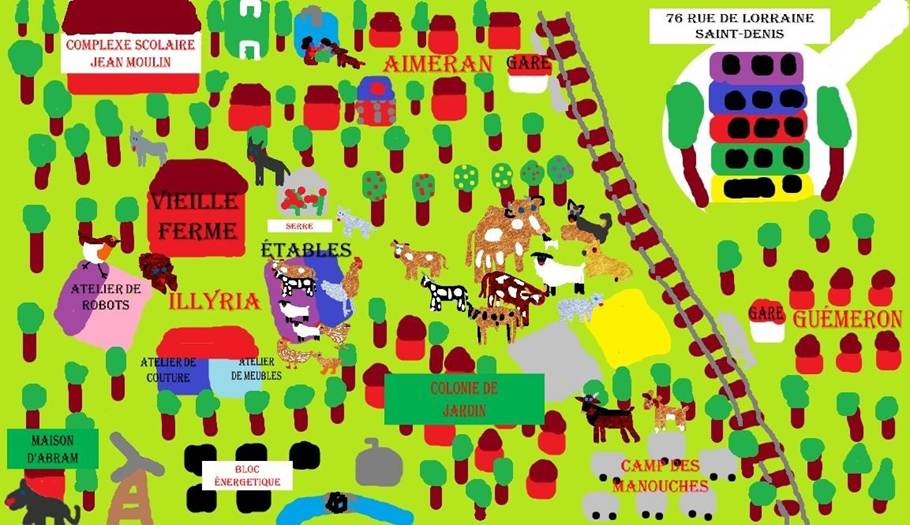
Map and Plan of our rural cooperative Illyria, Yvelines, and our neighbourhood assemblies Casa Latina Russki Dom Peace Dove on 76 rue de Lorraine, Saint-Denis, State Year 20 of the Revolution during comrade Emmanuel’s presentation “Red Cells. The Trade Unions in our Revolution”, there are 17 three-room apartments with the bedrooms occupied as follows, Young Revolutionaries marked in italics:
Apartments in the old Farmhouse
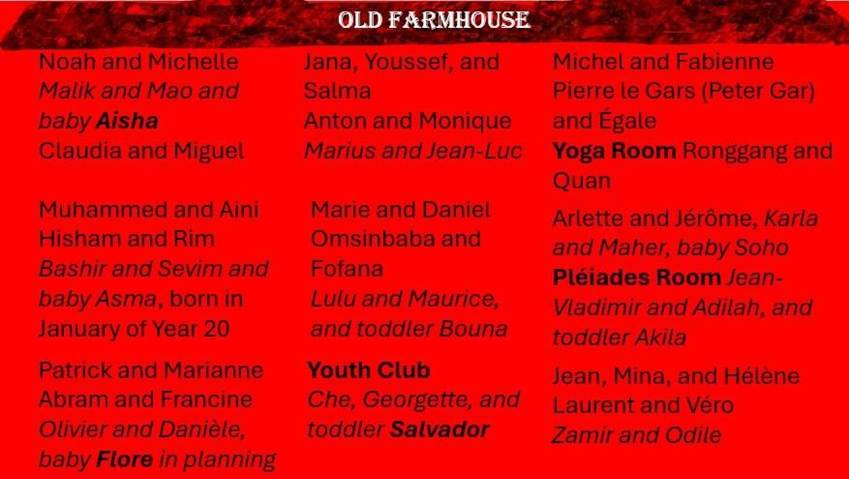
Apartments above the Robot Workshop
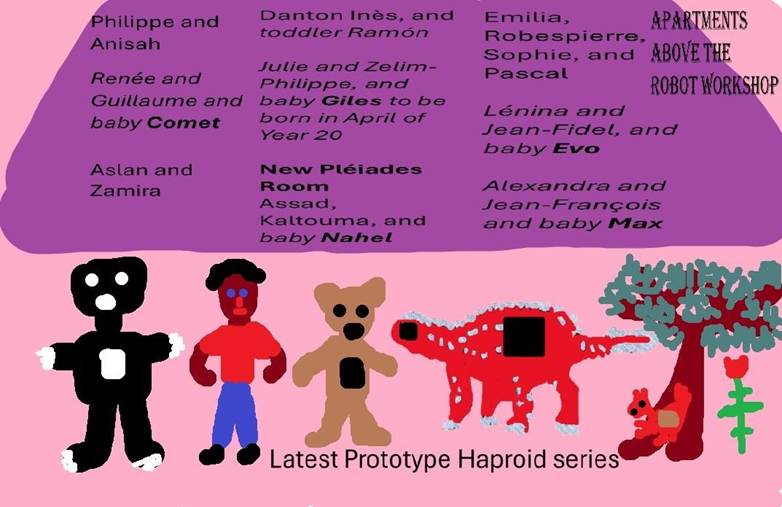
Apartments above the Stables
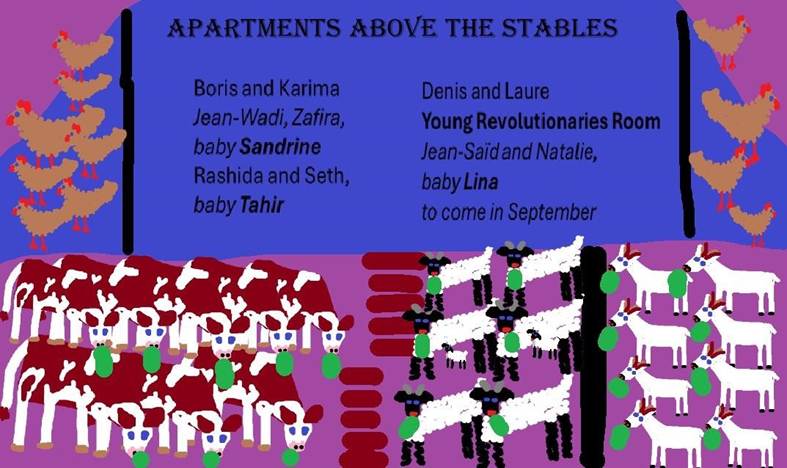
Apartments above the Furniture and Clothes Workshops
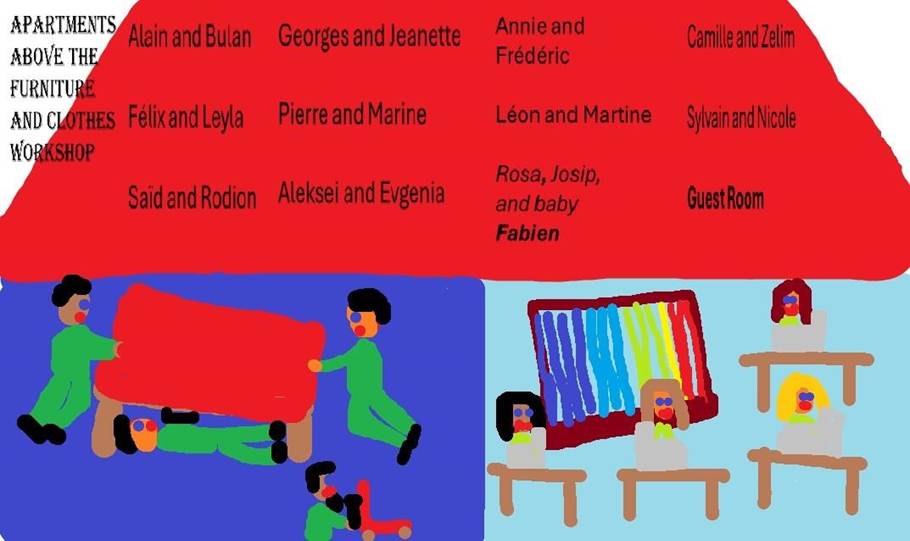
Dark blue: furniture workshop, light blue: clothes workshop
Inhabitants of the Garden Colony and the Manouche Camp
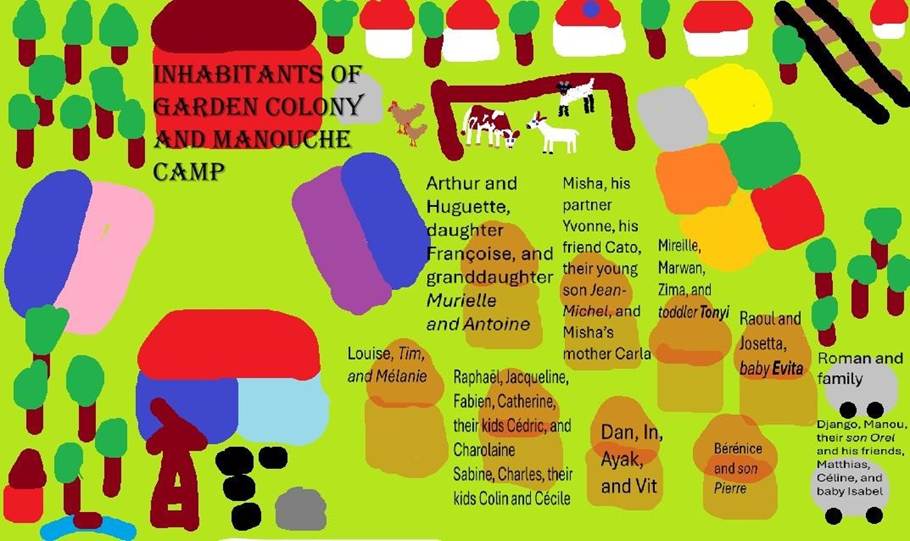
Neighbourhood Assemblies Casa Latina Russki Dom Peace Dove at 76 rue de Lorraine, Saint-Denis
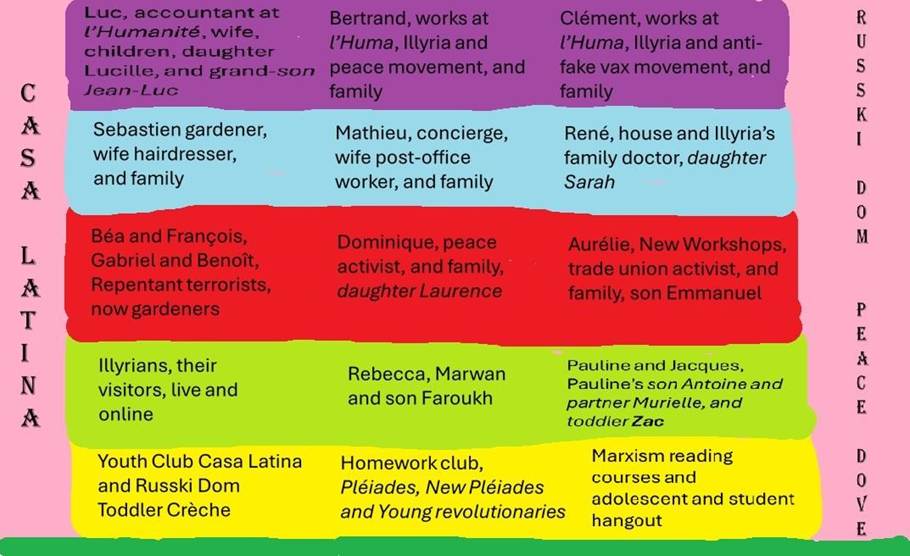
Yellow: first floor, youth club; Green: second floor; Red: third floor; Blue: fourth floor, and violet: fifth floor. 2nd and 3rd floors: Casa Latina Russki Dom, 4th and 5th floor: Peace Dove.
Other books by Carla O’Gallchobhair you will also enjoy:

the Woods, by Carla O’Gallchobhair. Young comrade Danièle and her comrades outline ways humans, animals, including time-travelled dinosaurs, plants and their robots might overcome the difference between city and countryside and restore one of the world’s most pristine natural habitats, the forest. Meanwhile, the fascos have wrought new damage in the Taiga using the Moral Atrophy virus and White Phosphorous and are about to launch a new campaign to undermine self-management and a major movement of the revolution, the trade unions.

as the Epitome of Fascism, by Carla O’Gallchobhair. You expect boring security theory, and instead what a cliffhanger! For his university entry project – he wants to be a sociologist –, comrade Olivier, member of the 5th International Brigade, son of comrades Marianne and Patrick, or Aslan rather, will do a sociological analysis of fascist terrorism as of spring of Year 20 of the World Revolution, 2021 being Year Zero. Olivier is working on a comparison of the fasco brown cells with the Red Brigades of the 70s and 80s, reruns of 9/11, Covet, and state terrorism. As if to dissuade and scare Olivier personally as well as all other revolutionaries, the fascos have reinvented one of their original crimes: kidnapping and torture, as well as a new virus, the MA or moral atrophy virus.”
“What a smasher,” comments Peter Gar. “The MA or Moral Atrophy virus will get you, unless you get the MS or Moral Strength one.”

révolutions colorées à la révolution rouge, by Carla O’Gallchobhair. (in English) It turns out that capitalist trouble-makers inspired the majority of Middle Eastern part tragic, part choreographed demonstrations and uprisings under late capitalism themselves, just so as to prevent any viable revolutionary organisation to emerge. Yet the grievances and yearning for freedom of the different populations in the various regions were real. Youssef analyses the way true class solidarity finally paved the way for the real Communist revolution. He takes us on a historical journey through Moroccan, Algerian, Tunisian, Libyan, Egyptian, Sudanese, Yemeni, Arabian and Emirate, Iraqi, Iranian, Syrian, and Palestinian stories to show how the diverse currents of anti-capitalist and anti-imperialist resistance in the Middle East finally fused in the World Revolution of 2021.


after the EU, by Carla O’Gallchobhair. The revolution is gaining hold in Europe. Everywhere, the state is being replaced by small neighbourhood assemblies. Justice will be spoken at town meetings. Firms will be self-managed by workers’ assemblies and work-place brigades with rotating chairmen and women. Radical ecological restructuring is spreading through Europe and the world. The remaining problems of the new society are being inventoried to be addressed. However, all over Europe, fascist terrorists and their sponsors in the élite are mounting ferocious rear-guard actions. This book is Part 2 in a series, Part 1 was entitled Jean in Moscow, Part 3 will be called Happening.

Jana’s Self-Management Course, by Carla O’Gallchobhair. In this second volume of Anti-Communism 2.1., the rightwing terrorists, well connected within the capitalist class and with supporters up into the highest ranks of government, continue their nefarious actions against the friendly and engaging figureheads of the PCF, its youth movement, and French society as a whole. Against all odds, the Communists manage to spread their agenda of self-management in the economy, democratisation of the state, decent housing, good public health, fair wages, scientific and moral education, full employment, collective action, citizens’ rights for migrants and refugees, consistent environmental change, and international peace. Part 2 of a series. Part 1 was entitled International Consortium hunts PCF, next to follow will be Of Missiles and Men.
 worldrevolution21.com